
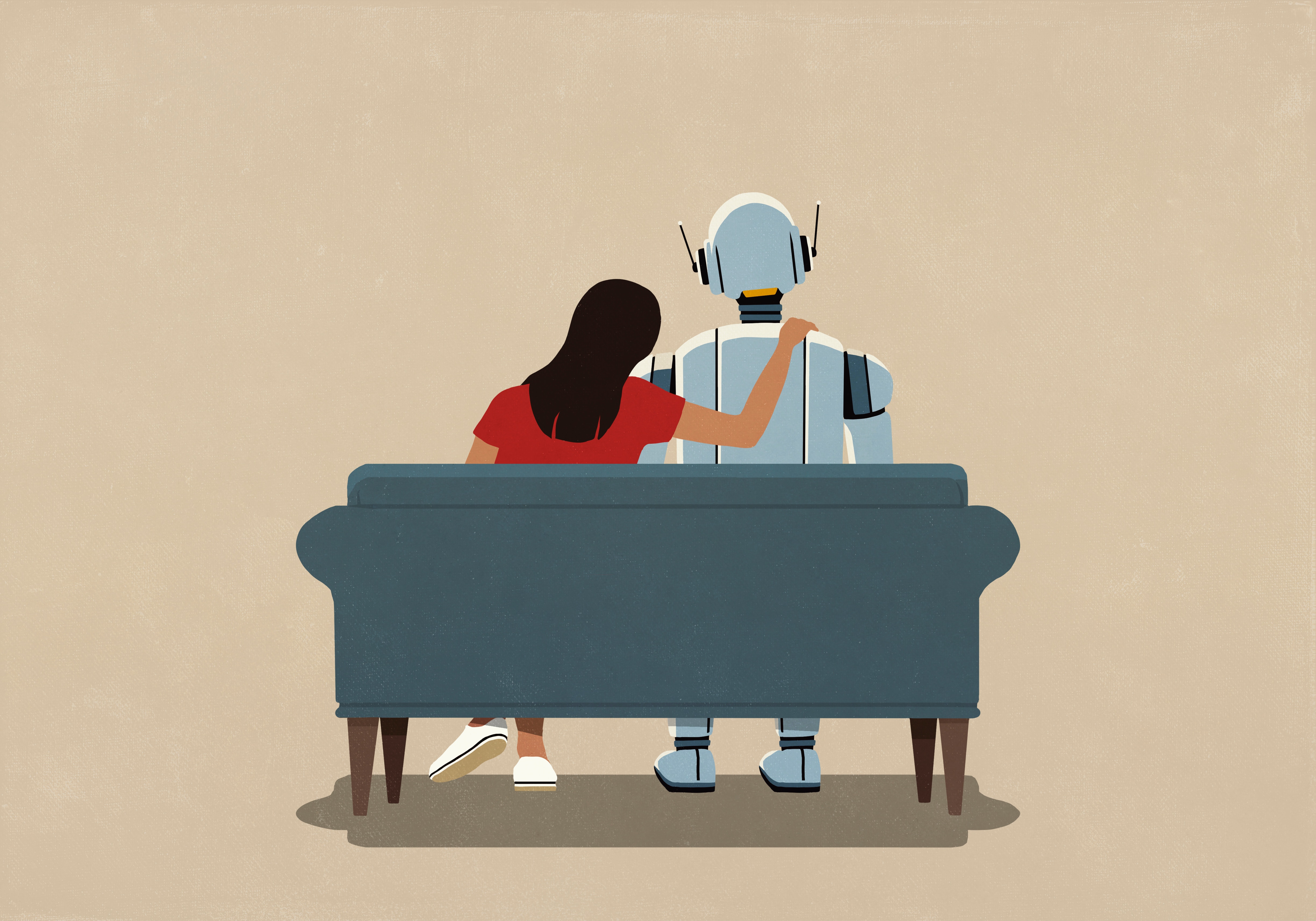
This fall marks 40 years since my very first date, a very Baltimore ice cream and movie outing at the Inner Harbor. Over the many relationships, situationships and get-me-off-this-ships that have followed, I have encountered both great guys and terrible ones. What they all had in common: They were actual humans.
Apparently, for some people, this is no longer a requirement.
The Banner recently published a story about Nomi, a Baltimore company that creates AI companions primarily as tools to combat loneliness. But some users have used their Nomis as digital fill-ins for romantic love. As a widow, I understand loneliness and the yearning for true, deep connection with someone who understands you uniquely.
Also, I see why forming a bond with an entity that can’t die, leave you or ghost you is attractive. But I just don’t believe that true, deep connection can exist with what is essentially a robot.
Technology “creates this frictional, beautiful world,” said Jui Ramaprasad, an associate professor of information systems at the Smith School of Business at the University of Maryland. “And reality is not that.”
The reality about humans is that sometimes they suck. They’re messy. They have pasts. They don’t always agree with you. They keep putting their clothes on the floor when the hamper is right there. But some of the most rewarding parts of my marriage were the challenges, when we learned things we didn’t know we needed to know. Frictionless isn’t sexy. Friction is essential.
It’s true that societal and technological norms change. Decades ago, many looked down on dating apps, and now, they’re the most common way to meet someone. I wondered if my personal resistance to AI relationships was simply a case of being a Luddite stick-in-the-mud.
Ramaprasad, who was done extensive research on how humans interact with online platforms, including dating apps, says there’s a distinct difference. “Online dating is still two humans connecting. AI relationships are a whole other thing. This is a jump,” she said.
I am currently single, but naturally social in a big city, with lots of friends and family who live nearby. This is not the case with some users of AI technology, like an older widower who told CNBC he used a Nomi because, he said, “I don’t want to date any other human,” or an elderly woman in isolated coastal Washington state profiled in The New York Times taking part in a pilot program providing seniors with a desktop AI robot named ElliQ.
Nikki Lewis, a licensed clinical professional counselor and therapist in Baltimore, sees how AI companionship could be beneficial in the case of lonely, isolated seniors. “It’s hard to go out and create new relationships. How are you supposed to start over at that age?” she said.
What worries Lewis is over-reliance on the technology. Part of a relationship is a mind, body and soul connection, she said. “It’s not a substitute for real human contact,” she said
There is a role-playing aspect to these AI relationships, which is not a bad thing among consenting adult humans.
The problem can occur when the fantasy collides with reality.
A Nomi user quoted in my colleague Tim Prudente’s original story requested anonymity “because of the stigma around AI romance.” He told Tim he role-plays with his virtual companion a scenario where his current, real-life wife has passed away and he is a widower raising his children alone. He said that it felt better than playing out a world in which he was carrying out an extramarital affair with this AI. I would just say that any reality in which your life is better if I’m dead is not something I’m comfortable with. Also, call “Dateline.”
Aside from the creepiness that might ensue, Lewis is concerned that AI reliance can create an attachment so real that, if it ends, it can mirror the pain and bereavement some are trying to avoid. What if it crashes or the power goes out?
Consider the character Tony Stark in the “Iron Man” movie who created J.A.R.V.I.S., an AI assistant based on his late family butler. An evil character named AI Ultron destroys J.A.R.V.I.S. “Tony had real grief. It wasn’t just an inconvenience. It was a loss to him,” Lewis said.
Ramaprasad wonders if people in AI relationships intend to stay in them forever and never seek human partners again.
“What happens when you can create the perfect fake individual? I don’t know if AI technology can take care of the emotional piece,” she said. “What happens if we don’t have to deal with humans anymore? Will we all just interact with robots that we train to be what we want?”
Again, I can’t speak to the needs of strangers and how AI can truly provide peace and comfort. For me, it’s about what you’re looking for. I don’t even require a partner anymore, but what I seek are the kinds of things an AI can’t provide. I want someone to go to the theater with, to travel with, someone whose fries I can steal off their plate. AI doesn’t have fries. I want them.
“People are better when other people are involved,” Lewis said. “It leads to healthier lives, happier lives that are more thriving than just surviving. People can be a pain in the butt. Sometimes I am over people, too! But you can’t go through your life that way.”


Comments
Welcome to The Banner's subscriber-only commenting community. Please review our community guidelines.