
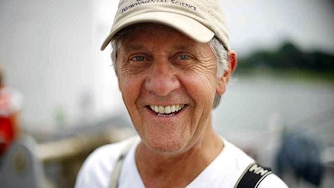
After five decades in Maryland, Chesapeake Bay scientist Walter Boynton still dropped the Boston “R.” A folksy son of a commercial fisherman, he was famous in scientific and political circles for speaking plainly — and oftentimes with humor — about complex concepts.
Ever the raconteur, he would say that nitrogen was the perfect pollutant for a politician – you could get it out of the system in a four-year political term if you just tried hard enough.
The systems ecologist at the Chesapeake Biological Lab in Southern Maryland spoke of eutrophication (too much nitrogen and phosphorus) and epiphytic growth (a plant that grows on top of another plant) with the ease of a mechanic explaining gaskets and engines.
That’s why Ann Swanson, the retired longtime director of the Chesapeake Bay Commission, used to introduce her friend as “Car Talk” for Chesapeake Bay ecology. He would have fit right in with Click and Clack, the hosts of the long-running NPR show that featured the two Boston brothers doling out auto mechanic advice.
In the doom-and gloom-atmosphere of a Chesapeake Bay that still wasn’t saved, Boynton was also something rare: an optimist. A single change, he believed, could catalyze others. He had seen it happen in his career, how even a small reduction in the amount of ntirogen, phosphorus and sediment – “too much dirt and too much poop,” he’d say — could bring back the grasses in one river system.
Read More
Boynton, 79, died Sept. 14 at the George Washington University Hospital in Washington, D.C., after a long-term illness.
In an article after his death, the University of Maryland Center for Environmental Science posted that Boynton, long part of that institution, “fundamentally transformed the scientific understanding and environmental management of the Chesapeake Bay and coastal ecosystems worldwide.”
Swanson and other colleagues say that’s no exaggeration. He had his hand in nearly every Chesapeake Bay policy triumph over the past four decades, from signing the Chesapeake Bay Agreement in 1983 to banning phosphate in detergent in 1985, implementing a fee to pay for statewide sewage upgrades in 2004, and to the great grass comebacks of the last two decades.
“He had seen that when leaders and communities applied themselves, there were results,” Swanson said. “He helped us unravel the problems in the Chesapeake Bay so we could understand them and solve them.”
Boynton grew up in a small Massachusetts town, studied at Springfield College, and took a summer internship at the Chesapeake Biological Laboratory on Solomon’s Island, excited to do real science. In reality, he said in a 2025 interview, his main job was running the Xerox machine.

Yet, he found the experienced scientists engaging and tagged along on their fieldwork. They encouraged him to continue his studies. After finishing his doctorate in environmental engineering at the University of Florida, he and his wife, Mary Ellen, whom he’d met on his internship, decided to return for a few years so Boynton could work as a professor.
He arrived to find a previously bountiful Patuxent River in increasingly more distress as the suburbs around Baltimore and Washington rapidly developed. A feisty band of Southern Maryland politicians, led by Democratic former state Sen. Bernie Fowler, sued the state and the federal government for allowing too much sewage from upstream counties to pollute the Patuxent.
A few scientists, including Boynton, spoke up for the river — in court and in newspapers. The counties ultimately won, and a federal judge ordered the Environmental Protection Agency and the state to come up with a new cleanup plan.
That was the beginning of the Chesapeake Bay Agreement, which committed the six states and the District of Columbia to milestones that would reduce pollution and support aquatic life. Fowler drew attention to water clarity progress each year with a wade-in to determine how far he could see his white sneakers. The senator died in 2021, but the “Sneaker Index” tradition continues on the second Sunday in June.
This year, Patuxent Riverkeeper Fred Tutman was tickled to see Boynton wading in while holding his grandchild.
“It felt like a Patuxent rite of passage. And he was very focused on that, trying to reboot the spirit of activism for a new generation,” Tutman said.
Boynton was part of the Fridays Group, a ragtag collection of aging Patuxent scientists, policymakers and activists who were becoming increasingly concerned that the younger generation hadn’t embraced the urgency of environmental stewardship. Tutman called Boynton “the soul of the science of our movement.” He had been helping the group launch a Substack newsletter.

Never without his gung-ho spirit, Boynton named his lab The Gonzo Group. He took inspiration from the famed journalist Hunter S. Thompson, whose “involvement in the action” was an apt model for their science, Boynton said.
In 2016, Boynton became one of just seven recipients of the prestigious Mathias Medal, which honors contributions to Chesapeake Bay environmental policy.
In his last months, Boynton came to the lab once a week for tea and conversation with the graduate students, who asked to engage more with him, said William Dennison, provost for the University of Maryland Center for Environmental Science.
His ease with such talks contrasted with Boynton’s first professional speaking experience — when he fell backward off the stage into a nest of dust bunnies. It was one of the stories he loved to tell.

Don Boesch, former president of the University of Maryland Center for Environmental Science, met Boynton in the 1970s. Boynton’s work on everything from deep water dead zones to disappearing underwater grasses to tipping points helped formulate the modern bay movement’s attention to nutrient pollution, he said.
A 2005 report Boesch and Boynton helped author the most cited scientific paper on the Chesapeake Bay. Just this summer, the longtime colleagues published together one more time. Their new paper, “Escape from Neverland,” aims to shake leaders of a pessimism that restoring the estuary must be a never-ending project.
Though serious about his scientific work, Boynton had an approachable demeanor not necessarily common in researchers of his stature, said Mike Naylor, a longtime ecologist with the Maryland Department of Natural Resources.
Boynton’s death, Naylor said, is “a blow to the scientific community. He was such a reference point that was always there. When you lose something like that, there’s no recovering. You never get it back.”
The Banner publishes news stories about people who have recently died in Maryland. Our weekly obituaries newsletter shares these stories and death notices with you every Friday.
If your loved one has passed and you would like to inquire about an obituary, please fill out this form or contact obituary@thebanner.com. If you are interested in placing a paid death notice, please contact groupsales@thebanner.com or visit this website.



Comments
Welcome to The Banner's subscriber-only commenting community. Please review our community guidelines.