
Big changes are coming to Montgomery County Public Schools.
With their vote Thursday night, the school board reshaped campus boundaries and academic programs. Their decisions came after months of protests and often contentious debate on both sides of the issues.
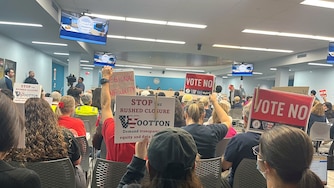
A group of parents has already pledged to pursue legal action over one of the most high-profile elements of the plan: relocating Wootton High School from its Rockville campus to a new building in Gaithersburg.
MCPS acrimony will stretch on. Also on Thursday, the board approved Superintendent Thomas Taylor’s request to study changing boundaries for elementary and middle schools — which could involve closures.
The meeting was tense, with security staff standing by and residents jeering as board members justified their votes.
“It will be hard, because systematic reform is hard,” board Vice President Brenda Wolff said. “There will be bumps and trials ahead. But if not here, where? And if not now, when?”
Read More
The school board voted 7-1 to adopt the high school boundary and program changes. Board member Julie Yang cast the sole vote against it.
Parents left the board room chanting “shame.”
Here’s what will change over the next several years in Montgomery County schools.
High school boundaries
District leaders redrew high school boundary lines to account for the construction of the Crown High School building, the expansion of Damascus High School and the reopening of Charles W. Woodward High School for the 2027-28 year.
They had to decide which kids should attend those campuses, a reshuffling that ripples countywide.
The plan blindsided some parents, including those of elementary schoolers affected by the decision. District officials didn’t do enough to explain the changes, they said.
For example, families whose kids attend Wheaton Woods Elementary learned recently they would go on to Woodward High rather than Wheaton High — a shift intended to balance enrollment.
“There was absolutely no movement from the county on any level to talk to our community,” said MCPS dad Mark Weisbrot.
Board members said Thursday night that they did try to engage with parents who felt overlooked.
The loudest opposition came from a group of Wootton families. Students who expected to attend the Rockville high school will instead go to the newly constructed Crown campus, about three miles away.
Moving teenagers out of Wootton’s building would allow the district to use it as a “holding school” to house other students while their own campuses undergo renovations. The Wootton school is in dire need of repairs, as are many MCPS buildings.
Wootton parents threatening legal action spoke out Thursday to challenge the district’s process, timeline and data. They slammed the board for breaking their trust.
New boundary lines incite angst because people buy their homes and plan their lives around where they expect to send their children to school. Campuses like Wootton serve as community hubs and symbols of neighborhood pride.
Rockville City Council member Adam Van Grack told the school board Thursday that he and the rest of the council are concerned about the numbers used to justify the Wootton plan.
“When many communities and entire clusters join together with serious opposition and serious concerns, the answer should not be to move forward. The answer should be to pause and work together,” he said.
Board President Grace Rivera-Oven said if the district waited for a total consensus, they would never move.
“There is no map — no map — that is going to make everyone happy,” she said. “It is time to act.”
The rollout will be staggered.
Freshmen and sophomores will move in the 2027-2028 school year, while upperclassmen will remain in their current schools. Full implementation will come by the 2029-30 school year.
In Wootton’s case, however, all students in the attendance zone are generally expected to relocate to the Crown site in the 2027–28 school year regardless of grade.
Academic programs
The school board also approved Taylor’s plan to divide the county’s roughly two dozen high schools into six regions, each with a slate of parallel academic programs focused on themes such as STEM, health care and the performing arts.
Taylor said this will expand students’ access to rigorous programs in an equitable way. Right now, some students have far greater opportunities to participate in specialized academic programming to prepare them for life after high school.
Thursday’s vote dissolves the Downcounty Consortium and the Northeast Consortium, two long-standing programs that provide high school choice within specific parts of the district. Consortium schools will be split amid the regions.
The new model will begin in the 2027–28 school year.
Community complaints about the regional model mirror those of the boundary study. Families feel it was rushed and opaque.
They’re concerned the district will dilute strong programs because of a dearth of necessary staff and resources.
Many others are excited about the move, saying it takes meaningful steps to expand access for students who have been historically left behind by MCPS.
The Black and Brown Coalition for Educational Equity and Excellence backed the new model, saying it would “advance the laudable goal of providing all students, including eligible Black and Brown students who have long been underserved, expanded seats and proximal access to exciting academic opportunities, no matter where they live.”
Before voting on the program model, board members added a new requirement: The superintendent must provide regular updates on its implementation, laying out both challenges and successes.
Elementary boundaries?
Next up: a deep-dive into elementary school boundaries and the possibility of closing campuses.
The district is confronting an enrollment decline: the number of children in kindergarten through fifth grade dropped from 72,085 students in 2019 to 65,627 students in 2025.
“These trends reflect broader demographic changes, including reduced birth rates, economic factors, and changes in housing turnover patterns,” district documents say.
With a smaller student population, elementary enrollment is unbalanced. Some areas of the county are growing, while campuses in other parts are below capacity.
Taylor asked district staffers to issue recommendations on whether schools should be closed or consolidated. Next would be the comprehensive boundary study.
The superintendent told board members that school closures are a possibility, not a guarantee.




Comments
Welcome to The Banner's subscriber-only commenting community. Please review our community guidelines.