
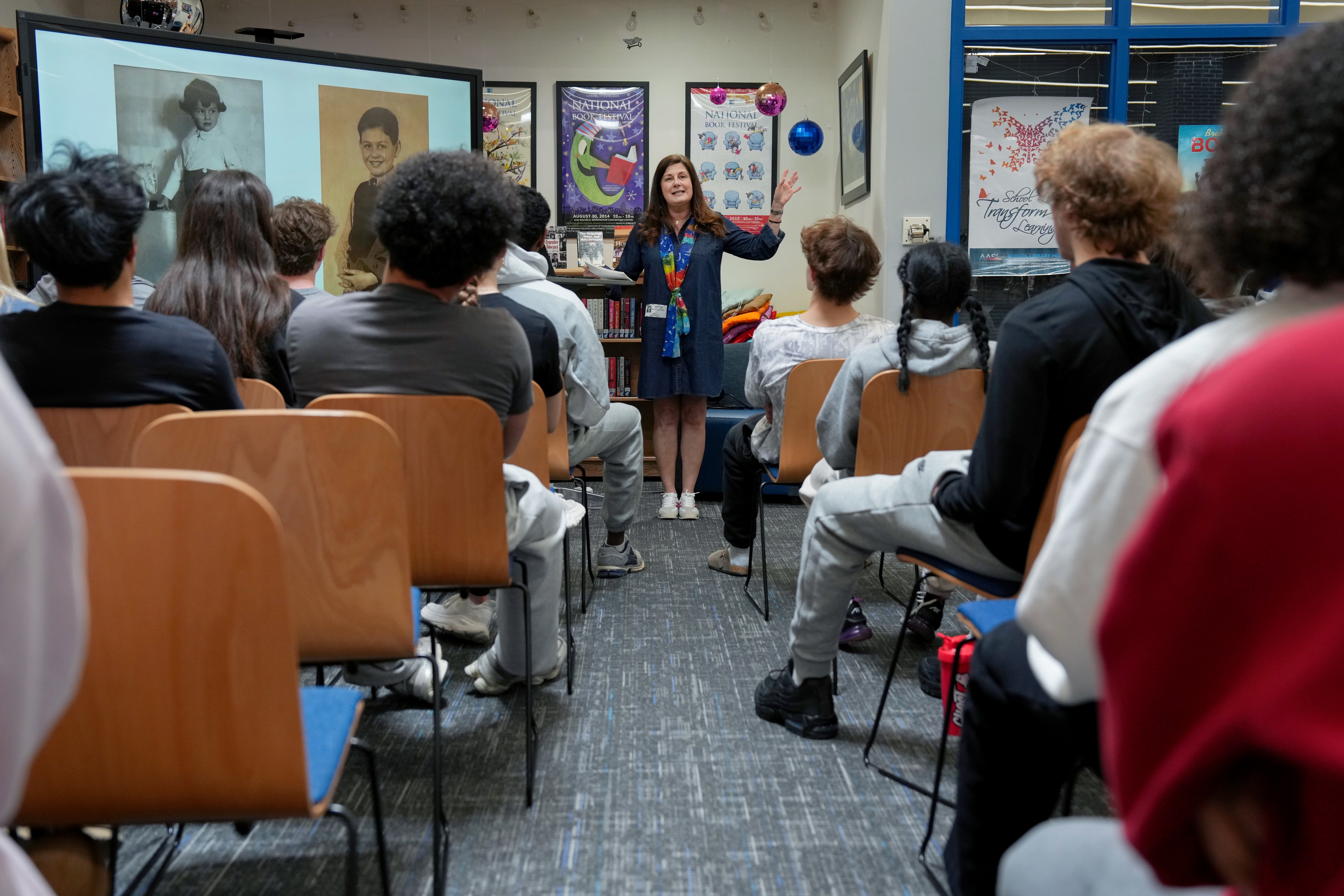
John Horvath never wanted to tell his only daughter about what he suffered during the Holocaust. But on this day, with her dad gone, Ann Horvath-Rose was about to share his story with a library full of teenagers.
She shifted her weight, lightly bouncing in her white sneakers. She’s always hated public speaking.
“This is my first time talking to students,” Horvath-Rose, 58, told her audience of high school juniors. “Bear with me.”
She had worked toward this moment for years. She’d pored through old Hungarian texts, stared at photos of emaciated bodies, memorized the path her father took to evade death in cattle cars and concentration camps.
Horvath-Rose was in the latest cohort of Maggid, a local program that helps the children of Holocaust survivors learn to tell their families’ stories to students.
Members of the group spent hours on Zoom each week chiseling their histories into cohesive narratives. They plucked out the details they hoped would make the Holocaust feel real to kids in a generation that might forget how it happened.
The Jewish Community Relations Council of Greater Washington began the Maggid workshop in response to a stark truth: The Holocaust’s primary sources are dying.
Worldwide, roughly 200,000 Jewish survivors are still alive, but 70% of them will be gone within the next decade, estimates show. By 2040, the Claims Conference expects there will be just 4,100 survivors living in the United States.
JCRC leaders can see this for themselves. The organization’s list of “second-generation” speakers has grown to about 70 people. Meanwhile, its list of local survivors who speak on campuses has dwindled to fewer than 15.
Similar speaker groups led by survivors’ children, and even grandchildren, are growing across the country. They hope to build a bridge between today’s students and the shrinking number of people who can remember the names and faces of the 6 million Jews murdered by Nazis.
Maggid, in Hebrew, means traveling preacher. And, after participants are trained in the program, they will fan out to tell their stories at public and private schools in Maryland, Virginia and D.C.

At the final workshop session, JCRC leader Guila Franklin Siegel warned participants of spiking antisemitism on local campuses.
“So much of what we see in kids is because of a lack of knowledge and a lack of exposure,” she told the group.
“A teacher could stand up there and lecture about the Holocaust for five days straight. It won’t be as impactful as you going to a classroom and sharing your personal story,” she said.
Horvath-Rose, who lives in Bethesda, knows how important it is to keep these memories alive. It’s why she decided to dredge up her family’s painful past.
But she doesn’t know how her dad would feel about what she’s doing. He never wanted to be defined by the miseries of the Holocaust.

Before he died in 2015, John Horvath wouldn’t tell his daughter the dark details of what he lived through. Now she can’t ask him questions, fill in her research gaps or gauge his reaction to her telling strangers the story he’d locked away in a box inside his mind.
In the school library, Horvath-Rose pulled up her PowerPoint, starting with a photo of her smiling beside her dad.
“I’m going to talk about my father today,” she began.
After her father was liberated from the Gunskirchen concentration camp in Austria in 1945, his love of numbers took him to a university mathematics department in Bogota, Colombia. He soon met a young woman, a fellow Holocaust survivor. They fell in love between concerts and strolls through the city’s hilly streets.
An open professor job at the University of Maryland brought the couple to the United States. And it was here they welcomed their only child, a girl they called Annie.
Horvath-Rose’s parents didn’t take her to synagogue or talk much about Judaism. Instead, she thought of classical music as their religion; every Saturday, her mom and dad sat together, listening to the Metropolitan Opera on the radio.
Still, her childhood was filled with reminders of the old world. Among them: her father’s quirky Hungarian friends.
The men called themselves the Tapirs, an inside joke about a piglike animal. They used made-up words and greeted each other with a special Tapir handshake.
It wasn’t until Horvath-Rose was in her mid-20s that she learned the full story behind this brotherhood. The Tapir friendship was built to keep the men sane as Nazis forced them to dig anti-tank trenches and marched them between concentration camps.
Although her father shared only crumbs of his story, these friends helped Horvath-Rose piece together the narrative of how he survived.

As Horvath-Rose puzzled over how to talk about her dad’s experience, she kept returning to the Tapirs.
She knew she’d have to talk about the camps, about the way her father pushed bodies off him when he woke up in the morning. She’d have to talk about the cattle cars, in which her father was one of 100 prisoners crammed into a space made to hold six horses.
The Tapirs’ friendship, she thought, was resistance in the face of those horrors.
Talking about it would be the way she honored her dad.
Each of the five Maggid sessions came with gut-wrenching homework. Program facilitator Tobi Bassin assured the group it was OK to cry.
To prepare, Horvath-Rose drafted outlines of her father’s story, mining for the deeper message she could leave with students.
She came to the first Zoom meeting full of questions. How much of the “horrible, horrible” stuff, she asked Bassin, should she include when talking to teenagers?
“It’s a common question that we get,” Bassin told her. “And the guidance that I’m going to give you is, the Holocaust was a horrible thing. We’re there to actually tell them what happened. We’re not there to whitewash it.”
That’s not to say there aren’t rules attached to these presentations. The one emphasized most: Don’t add details to your parents’ stories if you aren’t 100% sure they’re true.
“Do not insert information that you don’t know,” Bassin repeated throughout the workshop. “You can’t take creative license.”


Each story must stand up to scrutiny at a time when conspiracy theorists say the Holocaust was fiction.
Horvath-Rose knows people like that exist. When her son was in middle school, a boy walked around the lunchroom telling the Jewish kids the Holocaust never happened.
One day, it will be her son and daughter left to carry their family history.
With research skills she honed while earning her economics Ph.D., Horvath-Rose wrote it all down: a 187-page inheritance that traces their story from Hungary to the Washington suburbs.
At the final Maggid meeting, participants prepared to share their polished presentations with the group. It was some necessary in-person practice before they faced the teens.
Sitting together in Bassin’s Rockville living room, they heard the story of a young Christian woman who hid Jews from the Nazis inside an abandoned factory. They heard of a boy, separated from his mother and younger siblings, enduring nine concentration camps.

When it was Horvath-Rose’s turn, she talked about how the Tapirs’ friendship preserved their humanity as the Nazis declared them less than human.
“Evil depends on isolation,” she concluded. “It depends on people being cut off from one another. The Tapirs chose the opposite.”
When she finished, she crashed against the couch. It was exhausting to tell that story.
Bassin flipped through her notepad, reviewing what she’d scribbled as Horvath-Rose talked.

She wanted to understand exactly what became of the Tapirs. There were 47 of them. When the war ended, only 27 were still alive.
Be clear, Bassin urged, about what happened to the rest.
“They were murdered,” Horvath-Rose whispered.
Shortly after Horvath-Rose finished the Maggid workshop, the first assignment arrived in her inbox: two classes at Stone Bridge High School in Ashburn, Virginia.
As she drove there, she circled thoughts that’d been haunting her. Why didn’t the good Germans do more? How would she have acted, were she in their shoes?
“We’re building our very own camp here in Maryland,” Horvath-Rose said, referencing a potential Immigration and Customs Enforcement detention center in Washington County. “What the heck can we do? What do we do? What do we do?”
She wasn’t going to mention that to the students. She wouldn’t tell them about the stories she’d heard on NPR, detailing the ways people have died in ICE custody. But she wondered if they’d connect some dots.
Maggid leaders are explicit about keeping current events out of the presentations. During the training, for example, they advised speakers against discussing the Israel-Hamas war in Gaza, worried it would shift the focus.
A JCRC staffer offered participants a careful answer, in case a student asked about ongoing devastation in the Middle East: I know you have questions, and they’re good questions. You should talk to your classroom teacher.
But we’re here to talk about the Holocaust.
Standing in the high school library, Horvath-Rose described her dad’s childhood before the war. Back then, he was János Horváth, a young guy who was great at math, loved playing tennis and relished a good pun.

He was 19 when Nazis invaded. “About two years older than most of you,” she told the students.
In the back of the library — separate from the dozens of students assembled for the presentation — 16-year-old Jaideep Chawan was studying for a precalculus test.
Jaideep loves nature and animals, so when he heard a woman talking about tapirs, his head snapped up.
“I started listening and just couldn’t stop,” he said.
Jaideep abandoned his studying to take in the story. As he did, he said the Holocaust became something he could picture, rather than a string of devastating numbers.

He heard Horvath-Rose finish her presentation with a call to action: “Be a Tapir. Don’t let anyone face hardship alone,” she said. “Refuse to let cruelty have the last word.”
Horvath-Rose opened it for questions, unsure what the teenagers had absorbed. At least one, she noticed, seemed to have nodded off.
A boy in the front row raised his hand: What did the Tapir handshake look like?
Horvath-Rose can’t get her dad’s feedback on the presentation. She can’t ask if he approves. But more than 80 years after János Horváth was liberated, there’s a suburban teenager who knows the Tapir handshake.
She thinks her dad would like that.




Comments
Welcome to The Banner's subscriber-only commenting community. Please review our community guidelines.