
The boy’s mother raced down Interstate 70, desperate to get to Hagerstown’s Potomac Heights Elementary School before the ambulance.
She could barely understand what was happening on a call with school officials, but she could hear her 10-year-old son screaming in the background.
She would later learn her fifth grader — who is diagnosed with autism and sometimes wanders out of class when he is upset — was hitting his head against the wall in the teachers’ lounge.
“This kid’s probably gonna have to be sedated,” a Washington County sheriff’s deputy told the dispatcher after he was called to campus to respond to the student’s behavior.
The boy’s mother didn’t get the chance to intervene and calm her son. By the time she arrived, he’d been handcuffed by the deputy, sedated against her wishes and routed to Meritus Medical Center.
That April afternoon marked the start of the mother’s monthslong journey to understand how it happened. She spoke on condition of anonymity to protect her child’s privacy.
Read More
Call records, medical documents and district data reveal first responders used a little-understood legal maneuver called an emergency petition to remove the boy from school. These petitions are designed to get a person clinical help if they have a mental disorder and pose a danger to themselves or others.
Law enforcement and social workers can use them to force someone into the ER. At the hospital, a doctor must determine whether the person should be involuntarily committed to a psychiatric institution.
Maryland does not collect data about how often kids are removed from school this way. But, through public records requests to the state’s largest school districts and local law enforcement agencies, The Banner found the process has been initiated more than 1,500 times on campuses since 2021.
That tally is in addition to the huge number of petitions that come out of Wicomico County Public Schools, a tiny district on the Eastern Shore. The Hechinger Report and Associated Press revealed in 2023 that officers there were handcuffing students and taking them to the emergency room an average of three times per week.
Emergency petitions can get children, including those who have expressed specific plans to die by suicide, connected with intensive mental health resources.
But advocates for children with disabilities say petitions have been misused to remove children from school for behaviors that signal they’re not getting the help they need. They argue the process has traumatized children and left parents with hefty hospital bills.
“We’re using it as the treatment, and it’s actually causing more problems,” said Karen Duffy, who leads a nonprofit focused on mental health issues.
At Potomac Heights, school officials were aware of the boy’s behavioral needs and they were supposed to use documented strategies to calm him.
His mother was desperate to understand whether officials followed those steps and what had triggered the sedation. A single parent, she was suddenly balancing this convoluted quest with taking care of her younger daughter, showing up for her job and making sure her son got therapy.
The morning after it happened, the boy woke up groggy from medications his mother hadn’t authorized. It was his 11th birthday.

An accountability black hole
A month before the Potomac Heights incident, Del. Stephanie Smith was at a hearing in Annapolis, explaining to fellow Maryland lawmakers why little is known about how emergency petitions impact students.
“We currently lack a consistent statewide system to track when they occur, why they occur and what happens afterward,” Smith said.
She filed a bill that would have required school districts to start recording each incident, along with the student’s age and race, whether they had a disability and if handcuffs were used.
Parents and advocates who testified in support of the bill pointed out that schools keep data on suspensions and expulsions. That allows officials, and the public, to monitor their use and determine whether students of a particular race, or those with disabilities, are removed from school more often than their peers.
Leslie Margolis, an attorney with Disability Rights Maryland, said data collection on emergency petitions would allow for similar accountability. Without it, she and others are left with troubling anecdotes.
“Sometimes, young children are simply having a tantrum and, by the time the police or the parent arrive, the child is calm but is transported to the hospital anyway,” she told lawmakers.
Other times, she said, students aren’t provided proper special education services and the school then sends them to the hospital because of their behavior.
Kathy Flann told lawmakers about the first time she’d heard the phrase “emergency petition.” In January 2024, she got a phone call from an administrator at her son’s Baltimore elementary school.
Flann learned her 7-year-old son — diagnosed with autism, attention-deficit/hyperactivity disorder and narcolepsy — had been throwing Legos and water bottles around his classroom. He’d tried to leave campus to look for a toy car.
Flann said she was given a choice. She could pick her son up immediately and take him to the hospital, or the boy would be driven there in a patrol car. She rushed over.
At the hospital, a social worker noted the boy appeared calm and cooperative. The ER doctor seemed confused about why a first grader was in the hospital because of his behavior at school, Flann recalled.
The next time he had to go to the doctor for a routine visit, the boy sobbed.
“The school is sending me?” he asked his mom. “Because I’m bad?”
Shortly after the incident, the district granted approval for Flann’s son to work with a one-to-one aide — something his parents had long pushed for. With that individualized attention, Flann said, “everything changed dramatically for the better.”
“As we long suspected,” she said, “he needed more support.”
Months later, Baltimore school leaders launched a plan for tracking emergency petitions, worked with school police officers to provide guidance on when to use them and increased training on deescalation techniques.
The number of removals, data shows, fell roughly 60%.
Despite the support for Smith’s legislation, the bill never made it out of committee. Emergency petitions in schools remain an accountability black hole.
Tracking petitions
In the absence of state data, The Banner asked for emergency petition records from Maryland’s 10 largest school districts and Washington County, where the 10-year-old’s case played out.
Most agreed to share raw numbers, though only some disclosed the child’s race, age and the reason they were petitioned. A few didn’t provide anything.
In Montgomery County, school officials referred The Banner to the police department for records. The police department, in turn, advised contacting the school system. No documents have been produced.
This fragmented system makes it hard to know exactly how often emergency petitions are initiated in Maryland schools or to assess whether they’re being used as intended.
Gail Martin, a longtime school social worker, called emergency petitions a necessary last resort, deployed by people who care deeply about the children in their charge.
“They have a responsibility to that child’s learning, as well as the other 22 kids in the room whose learning they’re disrupting,” said Martin, who is retired and a member of the National Association of Social Workers’ Maryland Chapter.
In Washington County, sheriff’s deputies have issued more emergency petitions at schools in recent years.
Last year, deputies initiated petitions on campuses at least 30 times, records show. Most were in public schools, though a handful were at a nonpublic campus that serves students in special education.
About half of the incidents involved children 10 or younger. The youngest was a 6-year-old girl.
Sheriff’s office data showed that, while less than 20% of the district’s students are Black, 36% of the emergency petitions they initiated over the past five years involved Black children, including the Potomac Heights Elementary student.
This count does not include petitions filed by the Hagerstown Police Department, which maintains separate data.
“Washington County Public Schools responds to student safety and wellness concerns on a case-by-case basis and works with appropriate partners when needed. Emergency petitions are governed by Maryland law and are handled by the individuals or agencies with authority to make those decisions,” district spokesperson Erin Anderson said in a statement.
Going for a walk
The Washington County mother said she wished Potomac Heights Elementary educators had taken more time to get to know her child. She’d shared strategies with school officials in hopes they’d support her son on his hard days.
“Mother reported that when he is mad, it helps not to ask a lot of questions,” reads a 2025 behavior assessment. “Mother shared that one-word responses, going for a walk, or seeing the school counselor are helpful strategies.”

An aide was expected to work with her son during the school day, helping him learn and regulate his behavior. The boy was allowed to take breaks from class when he needed them.
Right before the April incident, the aide was not with the boy. He left the classroom to go look for help, according to his mother. A staff member asked the boy why he was wandering around.
It’s unclear what happened next. The Banner reviewed hospital records that state the boy’s behavior escalated and he became defiant.
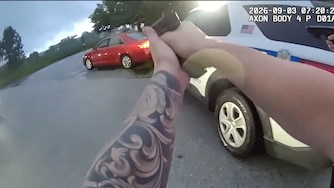
A sheriff’s deputy who was called to campus reported that he and others attempted to “de-escalate” the problem multiple times, but the boy grew agitated, “picked up a chair and attempted to strike me with it.”
The mother said her son can be triggered by police presence. A young Black boy, he’s learned about the many Black people who have been killed by law enforcement.
The deputy’s report stated the boy was handcuffed “to prevent him from hurting himself even further.” Emergency responders also administered midazolam, a fast-acting sedative.
Anderson declined to comment on the incident, citing student privacy laws.
After getting a call from the school, the mother contacted Stacy Ganz Kahn, a consultant who specializes in disability issues.
“This is crazy,” Ganz Kahn texted the mother. As she dug into the boy’s case, she thought to herself: It never should’ve come to this.
She helped the mother file a complaint to the Maryland State Department of Education, alleging the school violated provisions of federal disability law in the lead-up to the emergency petition. They recently learned the state rejected their argument. The education department’s investigation found the school system had supported the boy in the required ways.
Frustrated and exhausted, the mother’s focus has shifted. Her son will start sixth grade this month, and she wants to make sure he is never handcuffed at school again.




Comments
Welcome to The Banner's subscriber-only commenting community. Please review our community guidelines.