
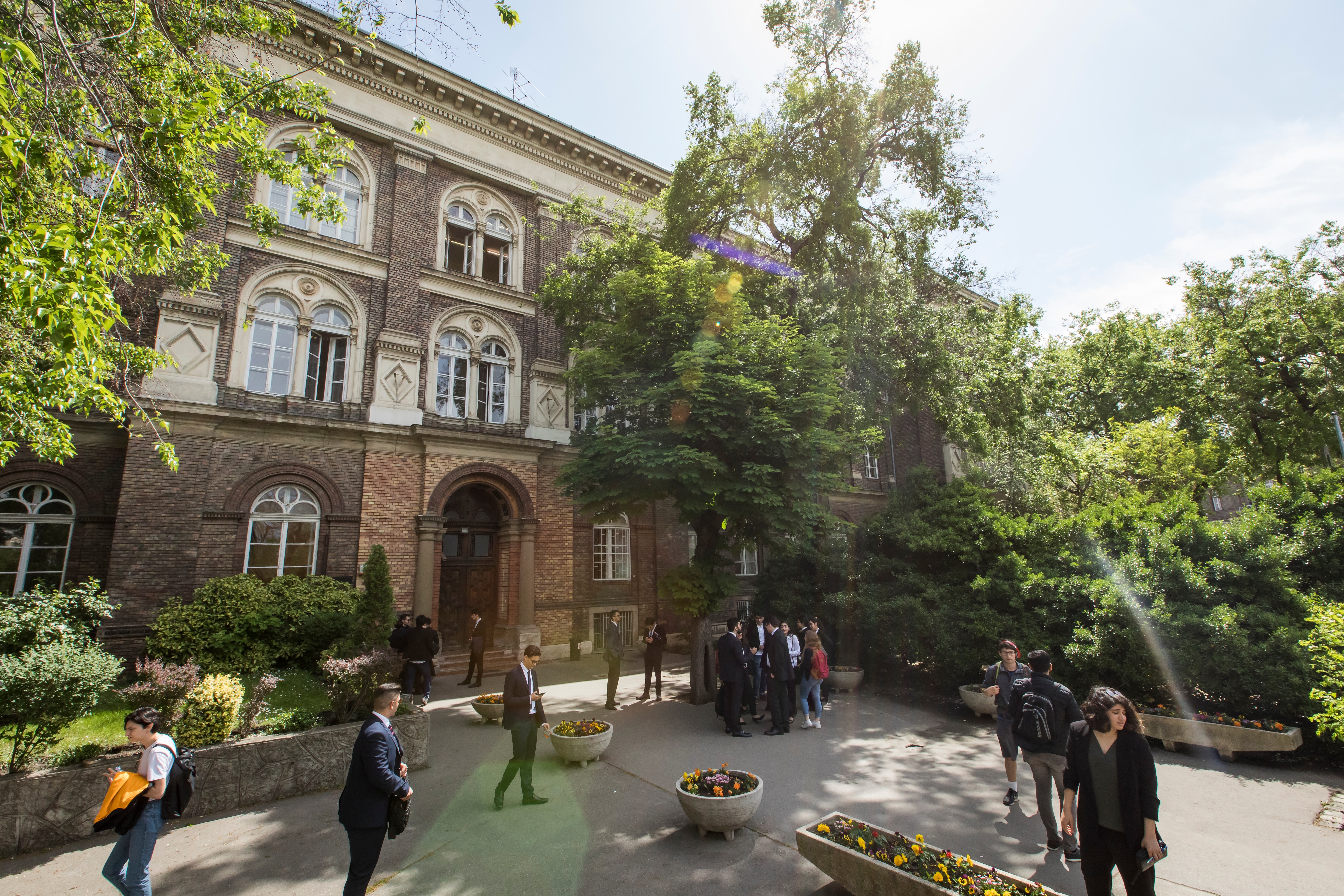
It’s not easy to operate a college in Hungary.
The Central European country’s president, Viktor Orbán, has reduced funding for universities by over 40%, passed a law to boot out colleges and packed school boards with allies.
But there’s one campus seemingly immune from the whims of the president: Maryland’s McDaniel College. The Westminster-based college has run a satellite campus in Budapest since 1994, emerging “from the vision” of an alum who wanted to introduce American liberal arts education into Central Europe, said Flavius Lilly, the college’s provost.
The outpost appears to be thriving, despite a looming election that could trigger political unrest. How does a small college in Maryland, which educates 3,000 students and has an endowment of under $200 million, have that kind of pull?
“The Orbán regime can point to McDaniel to say, ‘Look, we’re not against all universities,’” said Kim Lane Scheppele, a sociologist at Princeton University who spent decades teaching at colleges in Hungary. “McDaniel is kind of the foil in Orbán’s rhetoric for why he isn’t anti-American and anti-university.”
Orbán’s administration could not be reached for comment.
The Maryland college’s satellite campus educates 150-200 students per year and employs about 30 faculty members. Students matriculate from all over the world, and the majority spend all four years learning in Hungary to graduate with a McDaniel degree. About 20 students study abroad from Westminster each year; others study abroad from Gettysburg College in Pennsylvania and Hood College in Frederick.
It’s impressive that McDaniel has avoided Orbán’s wrath, Scheppele said. The scholar said she had to flee Hungary after learning she was being followed by government officials.
Central European University, which was founded by George Soros in 1991 and was based in Budapest, was forced out of the country in 2018. In 2021, Hungary’s parliament voted to transfer control of 11 state universities to quasi-public foundations led by close allies of the president.
The European Union froze funding to Hungary after some of the changes the country made to its higher education system. More than 30 universities lost millions for research and innovation when their boards were moved to private foundations, a policy Orbán championed.
Orbán’s moves drew the attention, and affection, of some American leaders. Vice President J.D. Vance said before taking office that some of Orbán’s higher education policies were “totally reasonable” and something that “we could learn from in the United States.”
Since taking office, Vance and the Trump administration have created a similarly hostile environment for higher education. President Donald Trump cut research money for universities and launched investigations into others in an effort to shrink the federal budget, shift spending away from “woke” academic pursuits and combat alleged antisemitism on campus.
The Budapest outpost doesn’t make the main campus any money, according to Lilly.
“It’s sort of built as a break-even operation for the college,” Lilly said. “It’s not designed to be a revenue-generating enterprise.”
Instead, the campus is meant to enrich the experience of students abroad.
Students who study all four years on the Hungary campus can major in disciplines such as business, political science and psychology. They earn a McDaniel degree with the same academic standards as the Maryland campus, accredited by the Middle States Commission on Higher Education.
Leaders at McDaniel have a positive relationship with the Hungarian government, which “appreciates our presence in Budapest,” Lilly said. The Budapest campus dean, László Frenyó, has built ”very deep relationships” with the country’s Ministry of Education and other government officials, Lilly added.
Orbán’s attitude toward higher education wasn’t on Lori Hockley’s mind when she decided to spend the semester teaching a course on international management at McDaniel’s Budapest campus. The economics professor has taught at McDaniel’s Maryland campus for five years.
“Budapest has blown me away,” said Hockley, who moved there with her 11-year-old son. “It is rich and full of history, and it feels very safe.”
She said she wasn’t worried about academic freedom in Budapest.
“I think we are an American institution that has been here for so long, and I think we’re very well respected,” Hockley said. “I know that we also have the support of the personnel and infrastructure of the Maryland campus.”
She admitted she is unsure about this month’s parliamentary election but said she has been asking her colleagues and friends about “how things will play out.”
Orbán has been accused of election fraud by rivals, who claim he uses public funds for his campaign, unfairly rewrites the constitution and uses courts, state-run television stations and school textbooks to advance his political agenda.
There have been large rallies in the lead-up to this month’s election by Orbán opponents and supporters, and many fear potential unrest when the outcome is decided.
McDaniel’s campus in Budapest will “communicate with students, as needed, to share safety reminders and provide awareness of available resources” during the parliamentary elections, according to college spokesperson Cheryl Knauer.
Leaders at McDaniel remain undeterred.
“I would love to see more McDaniel students studying there,” Lilly, the college’s provost, said. “It’s really a unique thing that the college is privileged to have.”
About the Education Hub
This reporting is part of The Banner’s Education Hub, community-funded journalism that provides parents with resources they need to make decisions about how their children learn. Read more.




Comments
Welcome to The Banner's subscriber-only commenting community. Please review our community guidelines.