
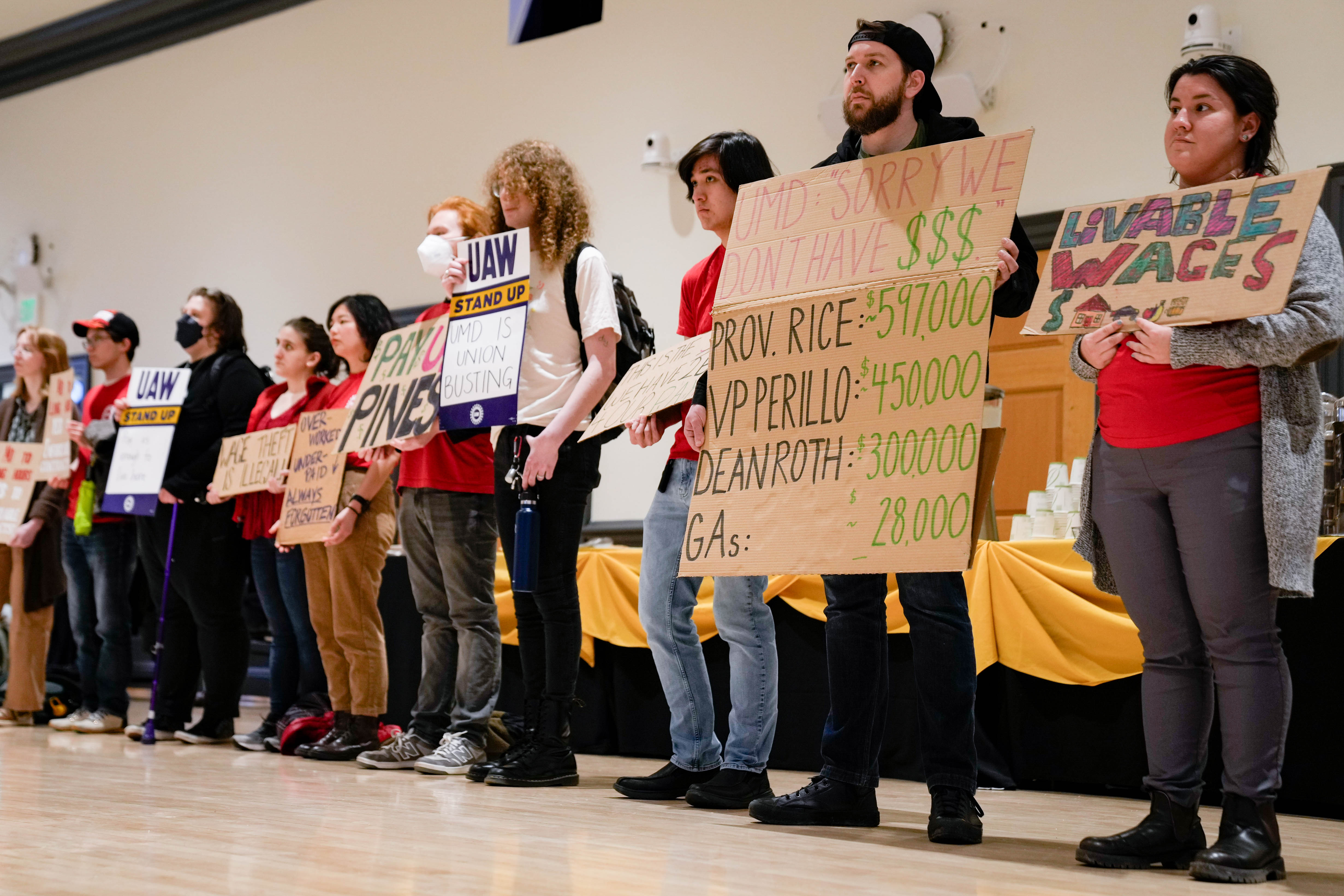
After 15 years of lobbying, graduate students at two Maryland universities are the closest they’ve ever been to getting the right to unionize.
Grad students, who often work as research or teaching assistants while earning advanced degrees, have long wanted the power to bargain for better pay and working conditions at Maryland’s public campuses. Many of their colleagues across the country have it. And now, for the first time, both chambers of the Maryland General Assembly have passed versions of a bill that would make a graduate student union legal.
But the students aren’t celebrating.
The legislation has been amended with a number of limitations: The union can’t form until 2028, it won’t cover those with grant-funded jobs, and it applies only to students attending the University of Maryland, College Park, or the University of Maryland, Baltimore County.
“It’s hard to celebrate it as a win because there are these three really harmful amendments to the bill that would exclude a lot of graduate workers and postpone it when it’s really critical right now,” said Ariel Balaban, a graduate student at the University of Maryland School of Public Health who has been lobbying for the right to unionize.
Under state law, public universities do not have to recognize graduate student unions, meaning they’re not required to negotiate with them over pay and other issues. Since 2023, graduate students have operated what’s essentially a shadow union to organize protests and advocate online.
Read More
Lawmakers have been introducing legislation to force universities to recognize unions since at least 2010, Balaban said, but they never gained much traction. In past years, University System of Maryland officials testified against those bills. Chancellor Jay Perman previously said the system couldn’t afford to negotiate with unionized graduate students amid state funding cuts.
But this year the new House speaker, Del. Joseline Peña-Melnyk, backed the legislation, according to Del. Linda Foley, who sponsored the House version of the bill.
“We’ve had support from the speaker’s office in the past, but we now really have someone who is a champion for workers rights, and particularly workers rights for collective bargaining,” said Foley, a Democrat who represents Montgomery County.
For the first time, Senate President Bill Ferguson also supports the bill, as long as it includes the amendments. Limiting the union to two campuses avoids putting financial strain on those with less revenue, such as Frostburg State University and the University of Maryland Eastern Shore, he said. And delaying until 2028 gives UMD and UMBC more time to prepare for the students’ demands.
Balaban and Siena Hurwitz, a union organizer and graduate student studying physics at the University of Maryland, wouldn’t share what they’d want to do with a union if granted the opportunity to form one. Instead, they said, they’re focused on earning a seat at the bargaining table.

“Whenever we have tried to talk to administration, we have been consistently shut down,” Hurwitz said.
The graduate students said they think the bill should be flying through the legislature without the amendments. They pointed to the fact that many other public research universities allow graduate students to unionize. Those include the University of Michigan, Ann Arbor; the University of North Carolina, Chapel Hill; and the University of California, Los Angeles.
“The University of Maryland is very much an outlier and very much behind the times in this regard,” Hurwitz said.
Hurwitz said she knows students who chose other institutions solely because Maryland did not recognize the graduate student union.
Hurwitz and Balaban spoke passionately about the need for a union to negotiate pay raises — a significant portion of graduate students, they say, can’t afford enough food on their stipends.
In other parts of the country, union pay raises have led campuses to cut back elsewhere. Boston University announced in 2024 it would not accept new Ph.D. students in a dozen humanities and social sciences programs, partially due to the graduate student union there winning big pay increases. The University of Pennsylvania made similar cuts.
That didn’t worry Hurwitz and Balaban, though.
“We aren’t some small, financially insecure institution,” Balaban said. “We’re a Big Ten university.”
Foley, the House bill sponsor, remains optimistic about getting the legislation passed and in front of the governor to be signed into law.
The House is scheduled to hear the Senate version of the bill Tuesday.
Banner reporter Brenda Wintrode contributed to this article.
About the Education Hub
This reporting is part of The Banner’s Education Hub, community-funded journalism that provides parents with resources they need to make decisions about how their children learn. Read more.





Comments
Welcome to The Banner's subscriber-only commenting community. Please review our community guidelines.