
Wind turbines are out. Submarines are in.
Five years after a historic Sparrows Point shipyard was identified as a cradle of wind energy, that land will instead be used for a massive weapons manufacturing facility. Anduril, a defense startup, will construct components of nuclear submarines for the U.S. Navy beginning in 2030, eventually creating thousands of jobs at Tradepoint Atlantic.
The move highlights a stark reversal of fortune for Maryland’s offshore wind industry, a favorite of the state’s Democratic leadership but a longtime punching bag for Republican President Donald Trump.
US Wind, a Baltimore-based offshore wind developer, began eyeing an old shipyard at Sparrows Point as the site for a steel manufacturing plant in 2016 and signed a lease there with Tradepoint five years later. Since then, political winds have turned, and the company’s plans have failed to get off the ground.
Jamie DeMarco, a lobbyist for the group Chesapeake Climate Action Network, said Trump has waged “an ideological war” on offshore wind at a time when energy bills are climbing and the country is desperate for new power sources.
Read More
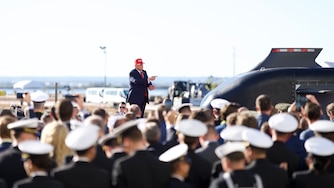
Trump, meanwhile, has embraced manufacturing and shipbuilding, which he emphasized during a visit to Baltimore County on Tuesday. In Anduril, the president tapped a company whose founder, Palmer Luckey, is a frequent donor to Republican campaigns and whom Trump calls a “friend.”
US Wind’s plant was expected to create 500 permanent jobs — but Anduril’s plans call for 3,100 permanent employees once its 2 million-square-foot facility is completed.
The shipyard, which lies on the western edge of Sparrows Point, churned out ships during the 20th century, but the industry later declined.
“The storied grounds of Sparrows Point will never fall silent again,” Trump said Tuesday in a wide-ranging speech that boasted of America’s military might.
US Wind had a 90-acre lease with Tradepoint, the sprawling logistics hub at Sparrows Point. Anduril will now assume the entirety of that lease, plus the shipyard’s other 97 acres, which were not under any prior lease arrangement. Financial terms have not been disclosed.
“Tradepoint worked with all partners on an agreeable arrangement,” Aaron Tomarchio, a Tradepoint executive vice president, said via email.
In recent years, the White House sought to block offshore development, even paying developers billions of dollars not to build offshore wind farms. The Trump administration has asked a federal court to revoke US Wind’s permit for offshore wind development off the coast of Ocean City, and last year federal officials cancelled a $47 million grant for the Sparrows Point steel plant and other “doomed” wind energy projects.

Attorneys for US Wind said in a court filing last year that Trump’s opposition to its Ocean City wind farm could bankrupt the company.
In a news release Tuesday, US Wind CEO Jeffrey Grybowski painted the submarine facility as a win that will ensure manufacturing jobs for the Baltimore County port site while the country’s offshore wind industry remains largely on ice. The Anduril development will ensure that job creation can proceed “apace” at Tradepoint, he said.
“Our offshore wind plans, like many other similar projects in the U.S., are delayed due to legal disputes and uncertainty created by federal agencies,” Grybowski said.
“We are very bullish on Maryland and its future. This is an exciting development for the state, the region and the nation.”
US Wind spokesperson Dori Henry said the steel plant is not necessary for its offshore project to move forward.
Ørsted, another offshore wind developer, was also pursuing plans for a parts manufacturing center at Tradepoint. But the Danish company put its own Maryland offshore project on pause in 2023, citing challenging economics.
For some backers of Maryland offshore wind, the withdrawal of the two companies at Sparrows Point is disappointing.
US Wind may not need a steel plant to go ahead with its offshore wind farm, but DeMarco said Trump’s opposition to the industry has driven clean energy jobs out of Maryland.
“Trump campaigned on ending wars and lowering energy bills, and this is one more example of how he’s doing exactly the opposite of that,” he said.
Still, Anduril’s facility is expected to have a massive economic impact, much larger even than initial plans for US Wind’s $400 million plant.
The Navy has entered into a $2.9 billion contract with Anduril, which will spend $3.7 billion on the facility and receive about $500 million in county and state subsidies. The site is expected to pay $312 million in wages annually, Anduril said.
The federal government is often criticized for spending too much on defense — a proposed $1.5 trillion next year — but its contracts can mean economic stability for communities. Both Republicans and Democrats attended Tuesday’s announcement promoting the new site and praised the paychecks the facility would bring; Gov. Wes Moore and Trump sparred over who got to take credit for it.
Trump touted the potential of the site for building autonomous weapons. But at least initially, Anduril expects to construct components of Virginia-class submarines. Those vessels are now made in Connecticut and Virginia, and have generated thousands of jobs in each state for more than 25 years.
They are economically essential enough that U.S. Rep. Joe Courtney of Connecticut has been dubbed “Two-Sub Joe” for his push to ensure that the military continues to manufacture two Virginia-class submarines a year, rather than just one. (Each costs $5 billion and is up to 460 feet long.)
Anduril executives said they selected Sparrows Point for its proximity to potential workers and other points in the submarine supply chain. Plus, with waterside access and a “phenomenal” dry dock, company officials described it as an optimal site.



Comments
Welcome to The Banner's subscriber-only commenting community. Please review our community guidelines.