
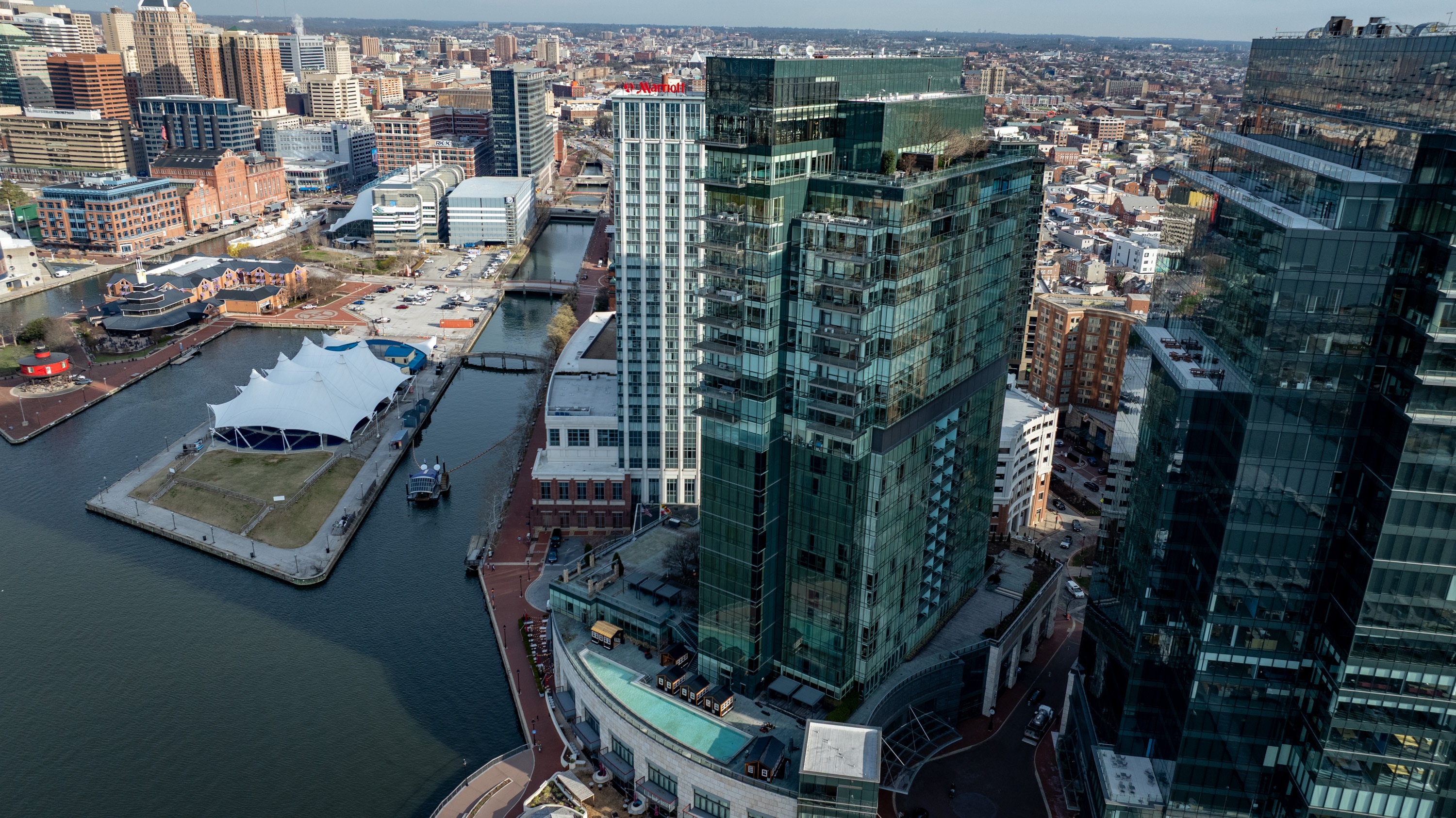
The Paterakis family has spent almost a decade waiting for the arrival of Baltimore’s high-end luxury condo market.
When the family opened the Four Seasons Private Residences in Harbor East in 2017, it was supposed to set a new ceiling for luxury homes in Baltimore. The real estate agent overseeing sales said wealthy buyers had lined up to plunk down unprecedented sums for waterfront views of the Inner Harbor. One-bedroom condos started at $1 million.
That flood of interest proved to be more of a trickle.
Today, a company founded by the Paterakis family, whose late patriarch, John Paterakis Sr., led a bread-baking empire and the development of Harbor East, still owns a third of the 62 condos.
One-bedroom condos start in the $500,000s — and three investors allege the true price is even lower.
The trio scooped up 11 units at the Four Seasons last year. Now they’re suing Harbor East Parcel D-Residential LLC in Baltimore Circuit Court, accusing the seller of artificially inflating the sale price listed in public records. Harbor East Parcel-D Residential is the limited liability company used by the Paterakis family and other investors to own and sell the condos. George Philippou, a son-in-law of Paterakis Sr., signs deeds and other property records on behalf of the company.
David J. Shuster, an attorney for the limited liability company, said in a statement the claims in the lawsuit are without merit and declined to comment further, citing the ongoing litigation. The Four Seasons, a Toronto-based company that operates resorts, hotels and condos around the world, did not respond to a request for comment.
The Paterakis family founded H&S Bakery in Baltimore in 1943. The company bills itself as the country’s largest family-owned variety baker. Starting in the 1990s, Paterakis Sr. spearheaded the redevelopment of the industrial waterfront near the Fells Point bakery, a neighborhood now known as Harbor East.
The Four Seasons building at 300 International Dr. was going to be the crown jewel of the redeveloped area. According to The Baltimore Sun, it was originally envisioned as a 44-story tower — making it the tallest building in Baltimore — with a hotel topped by 150 condo units.
Then the recession hit.
Construction halted, and the plans were scaled back to a 29-story building with 62 condo units — and even that seemed risky.
“Honestly, we’re still not certain whether or not the condo market will sustain [the new units],” Jason Huss, then the development director for Harbor East Management Group, told The Sun in 2014.

But the project moved forward. When the condos neared completion, real estate agent Charlie Hatter listed the 6,500-square-foot penthouse at $12.5 million, or more than $17 million today in inflation-adjusted dollars.
“Luxury real estate is doing exceptionally well right now,” Hatter told The Baltimore Business Journal in 2016.
It turned out the market was not as hot as it seemed. When the building opened in 2017, the penthouse sat on the market for four years, property records show, before selling at $8 million. Other units never sold.
Hatter did not respond to multiple requests for comment.
To Aeron Alberti, the unsold units seemed like a deal.
Alberti, who lives in Harford County, said he has spent years fixing up and flipping homes in the Baltimore area. He described his strategy as straightforward: Take out a short-term, high-interest loan, and buy a shoddy rowhouse; fix it up, rent it out and refinance the property using a new loan with better terms.
Last year, Alberti said, he realized he could run the same play on a much more lucrative target.
Property records show Alberti bought a 2,512-square-foot condo at the Four Seasons from the now-bankrupt developer Brandon Chasen for $2.1 million and quickly refinanced it. After that initial success, Alberti and two other investors — Joseph Avampato and Brentin Hess — set up a series of new limited liability companies, borrowed millions of dollars and bought 10 additional condos.
Then the money dried up. Alberti said they were planning to use debt-service coverage ratio loans, or DSCR loans, to refinance their portfolio. But, shortly after they bought the condos, private lenders across the country stopped doing business in Baltimore.

The lenders were spooked by a group of New Yorkers that used DSCR loans to buy more than 700 homes in Baltimore at inflated prices, then stopped paying back the loans. The FBI is investigating the matter.
Alberti, who owns eight condos at the Four Seasons, said this is when they realized a strange feature of the condo sales was quite consequential — and, they argue, fraudulent.
According to their lawsuit, Harbor East Parcel-D Residential LLC used seller credits to make it look as if condos were selling at much higher values.
Seller credits are typically a small portion of the sale price that is refunded to the buyer for repairs. But the lawsuit claims the seller credits used at the Four Seasons were unusually large.
One condo that sold for almost $590,000 had more than $100,000 of seller credits included, meaning its effective sale price was $480,000, the lawsuit said, and the other condo sales had similar provisions.

In an interview, Alberti said this didn’t matter at the time of the purchase, because they weren’t looking to sell the condos soon — they were looking to rent.
But Alberti and Avampato said the condo owners association wouldn’t let them use their condos as short-term rentals and, when they signed full-year leases with tenants, the Four Seasons tried to poach those tenants to sell them condos.
They said other key details were not disclosed at the time of the sale. The building has had plumbing issues that damaged condos with sewage water, Alberti and Avampato said.
All of this has left the investors owning condos that are worth well below what Zillow listings and public records say, they said — not to mention monthly condo fees that cost thousands of dollars per unit.
“The Realtors have manipulated the values for years, and we were victims of that,” Alberti said. “Those prices that you see these properties being sold for is not what they actually sold for.”

Alberti, Avampato and Hess used nine of their LLCs to file the February lawsuit against Harbor East Parcel D-Residential. Harbor East Parcel D-Residential has filed a motion to halt discovery and said a motion to dismiss the case is forthcoming, calling the lawsuit nonsensical.
A judge has yet to rule on the motion.
Martha Macks-Kahn has lived in the Four Seasons for about seven years. She said there were sewage and plumbing issues in the building that displaced some residents for months but added that her unit was not affected and management fixed the problem years ago.
“Architecturally, we love it. It’s a great view,” said Macks-Kahn, who founded the Goya Contemporary, an art gallery in Baltimore. “It’s expensive living there, but we knew what we were getting into.”
As for the lawsuit filed by Alberti and the other real estate investors, Macks-Kahn was skeptical.
“He’s in this business,” she said. “He should have known better.”





Comments
Welcome to The Banner's subscriber-only commenting community. Please review our community guidelines.