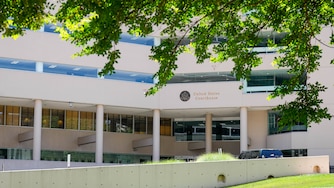
There is an impression among real estate investors today that deceiving lenders is harmless or only “technically” illegal, Judge Matthew J. Maddox said Wednesday in a federal courtroom in downtown Baltimore.
It’s time to send a message, Maddox said. He sentenced 31-year-old Alexander Schultz, formerly of Pikesville, to two months in jail.
Schultz previously pleaded guilty to taking part in real estate deals using falsely inflated property values to get bigger loans. Proceeds from the buyers and sellers were then wired from one another to cover the down payments.
Jacob Rappaport, an attorney involved in the scheme, was sentenced earlier this year to 15 months in prison.
The transactions took place around 2021 and involved an apartment complex in Southwest Baltimore and a portfolio of 42 homes in East Baltimore.
That portfolio of 42 homes was later sold to a different investor, Eluzer Gold, at an even higher valuation. Gold was part of a small group of investors from New York who rapidly bought more than 700 homes in Baltimore, borrowing more than $100 million. Almost that entire portfolio is now in foreclosure.
Read More
The FBI is investigating, though no one has been charged with a crime.
At Wednesday’s sentencing, U.S. Attorney Sean Delaney described Schultz’s actions as “financial shenanigans.”
Schultz’s ex-girlfriend and a family friend spoke at the sentencing, describing him as a compassionate, smart, hardworking young man who had made a mistake.
Delaney, the federal prosecutor, called Schultz charismatic and talented. He urged the judge to sentence him to supervised release for his felony, or, at the most, a “short, very short” time behind bars.
The defense attorney, Andrew Alperstein, said family and friends wrote glowing letters in support of Schultz, and reading them he thought, “I wanna be more like my client.”
Schultz attended Boy’s Latin School of Maryland, did not graduate from college and found his calling in real estate, his supporters said in court.
In 2021, Schultz took part in two real estate deals that eventually led his to his criminal conviction. He pleaded guilty to conspiracy to commit bank fraud in 2024, and his sentencing was delayed multiple times.
Midway through the hearing, the judge cleared the courtroom for a sealed 25-minute portion of the sentencing.
“I told myself, ‘Everyone does it,’” Schultz told the judge Wednesday. “I cut a corner that should’ve never been cut.”



Comments
Welcome to The Banner's subscriber-only commenting community. Please review our community guidelines.