
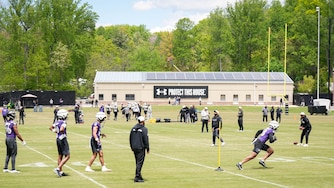
M&T Bank Stadium might seem to be the Ravens’ nest, but really, it’s in Baltimore County. That’s where the players practice, primarily live, and — crucially — pay a bulk of their taxes.
To guarantee that things remain that way, county leaders have agreed to give the football team $25 million for practice facility improvements over the next decade in exchange for the assurance that the Ravens keep their headquarters in Owings Mills. The deal was announced in July, and a formal vote by the Baltimore County Council is scheduled for Monday night.
It’s not uncommon for local governments to subsidize pro training facilities, but it’s not the standard, either, and the county hasn’t previously awarded grants for upgrades to the facility. Economists often say that giveaways to privately owned sports teams are a poor investment of taxpayer money.
In this case, Baltimore County leaders reasoned that doing so was worth it to preserve significant revenue, including millions in annual income taxes.
County leaders and Ravens officials gathered at the facility in July to celebrate the grant and accompanying lease extension. A 25-year lease of county-owned land had been scheduled to expire in 2028, and the Ravens approached the county seeking certain terms including “County contributions toward tenant improvements,” according to legislative documents.
Read More
To date, the Ravens have spent $134 million building up their headquarters, including a $20 million addition last year, and Ravens president Sashi Brown said the team never threatened to relocate their headquarters elsewhere — which would likely result in players moving themselves and their taxes there, too.
But the team, in theory, could move it. And that is often leverage enough when sports teams negotiate with government entities.
”There are other counties that would love to have this facility,“ said Baltimore County Council Chair Mike Ertel, a Towson Democrat. ”Some maybe are more geographically advantageous in being closer to the airport or some other benefit that maybe we don’t have.”
Julian Jones, the Democratic nominee for county executive, said that at one time he was generally opposed to government incentives for sports teams, but “that’s not the world we live in.”
“The reality is, every time they play, 60,000 to 70,000 people show up, they go crazy, and it gives them something to root for, to believe in, a little camaraderie for the community,” he said. “It’s a net plus for us.”
The agreement says that the Ravens will spend $70 million on upgrades to the Under Armour Performance Center, dubbed “The Castle.” The county and state’s Department of Commerce will each add $25 million, for a total of $50 million in public funds.
The commerce department did not initially commit the funds, but on Tuesday said it would be providing the money as long as certain employment goals and project costs were met.
At a meeting on Tuesday, county officials and business leaders applauded the Ravens’ philanthropy and economic impact, as well as the pride instilled in residents by being the team’s home base.
Ertel recalled then-Ravens owner Art Modell shouting out both Baltimore City and Baltimore County when the Ravens won their first Super Bowl in 2001.
“I remember that being a proud moment as a Baltimore County resident, that the owner would actually call out Baltimore County because he knew that was their home,” he said.
Some, like council candidate Josh Sines, have questioned the lack of information before the extended lease was announced as essentially a done deal. He also said he was worried about the financial contribution.
“Does that mean every 10 years, we’re gonna be asked for $25 million?” he said during an interview in August.

According to a Sage Policy Group analysis commissioned by the Ravens, the team’s players and employees paid roughly $10.6 million in income tax in 2025. That number represents the amount the Ravens withheld in taxes, and the actual figure is likely “a bit less,” said Jonathan Sachs, Baltimore County’s director of economic and workforce development.
But between that annual number, property taxes that players pay, the PILOT — payment in lieu of taxes — at the facility, and other revenues, Sachs called the return a “really, really good deal” for both the county and the Ravens. The Sage report estimated that the Ravens will generate $218 million for the county over the next decade.
“I’ve been close to this deal. I’ve looked at the numbers a variety of different ways. I’ve factored in income tax, I’ve factored in property tax, I’ve factored in economic benefit,” Sachs said. “We’ve done a thorough analysis.”
Sachs estimated that 75% of the Ravens players and personnel live in Baltimore County, meaning they pay the county’s 3.25% income tax.
Robert Raiola, director of the sports and entertainment group at tax firm PFK O’Connor Davies, noted that the county would continue to receive these tax benefits even without any contribution to the Ravens — unless the facility were to relocate.
“I think they definitely felt pressure,” he said. “And they didn’t want to lose that revenue.”
The facility lease now lines up with the Ravens’ lease at state-owned M&T Bank Stadium in Baltimore, which just wrapped up substantial renovations. If the Ravens exercise five-year options to extend that stadium lease past 2037, the Baltimore County lease will mirror it, according to the new deal.
The Ravens will also have the chance to purchase the county-owned land that the facility sits on at the end of the 10-year term. And the money that Under Armour pays for naming rights will now solely go to the football team. About one-third of that, roughly $70,000 annually, had gone to the county under the prior arrangement.
In addition to income and property tax, the Sage analysis lists other benefits the Ravens provide. For instance, each time a home is sold, the county gets about 2% of the purchase price. So, the “frequency with which NFL players switch teams” is an economic boost. It cited the sale of former Ravens coach John Harbaugh’s $6 million home as generating $120,000.
Aside from the financial details, there’s the abstract benefit of a beloved brand calling Baltimore County home, council members say.
“The Ravens have a winning culture,” council member Izzy Patoka said in an interview. “People want to attach themselves to that.”


Comments
Welcome to The Banner's subscriber-only commenting community. Please review our community guidelines.