
Proponents of Montgomery County’s controversial rent stabilization law are pointing to a new report as evidence that the policy is working.
Is Montgomery County’s rent stabilization law working?
County Executive Marc Elrich and council President Natali Fani-González, who presented the report at a press conference Thursday, said it proves that rent stabilization provides predictability and particularly helps low-income residents struggling to make ends meet.
“Either we’re not doing a very good job of conveying this, or we’re not being loud enough, or people aren’t doing a really good job of listening,” Elrich said.
The county executive pushed back on opponents of the law who say it’s overly restrictive and stymies growth, and ultimately raises rents by reducing the housing supply.
Landlords, Elrich noted, can seek county approval for rent increases and surcharges to ensure that they see returns and can afford to update facilities.
Fani-González said a segment of the building industry is cherry-picking information about rent stabilization as part of a campaign to “demonize something so important for working families. And it’s so wrong.”
Property owners and builders, though, say county officials are misinforming the public about how rent stabilization has affected housing growth.
“Multifamily permits have collapsed,” the Apartment and Office Building Association of Metropolitan Washington and the Greater Capital Area Association of Realtors said in a joint statement.
“No amount of scapegoating or shaming of developers will change the complex regulatory environment created by the passage of rent control, increases in real estate taxes and fees and other burdensome legislative mandates,” the organizations said.
The county’s report showed that most property owners have abided by the new law, which limits annual rent increases to 6% or the rate of inflation plus 3%, whichever is lower — which in 2025 meant a 5.7% limit. The law does not apply to properties less than 23 years old.
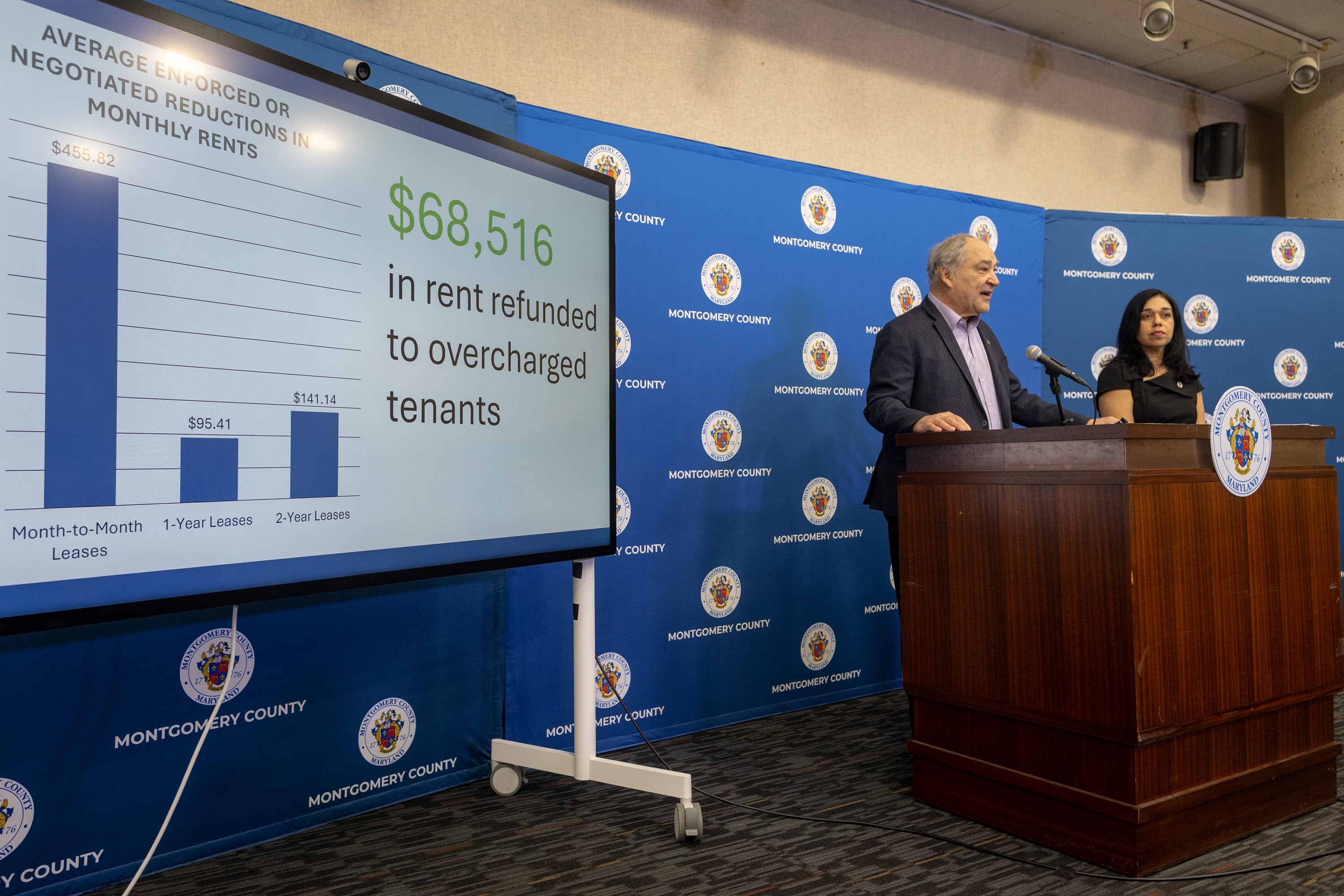
Between mid-2024 and the end of 2025, enforcement of the rent stabilization law led to rent and fee refunds for about 400 tenants whose landlords overcharged them.
Overcharged renters saved an average of $456 on month-to-month leases, $95 per month on one-year leases, and $141 per month on two-year leases, the report states.
Scott Bruton, who leads the county Department of Housing and Community Affairs, said in a statement that the law has prevented landlords from disguising rent increases as mandatory fees and helped “stop the kind of drastic price increases that displace tenants from their homes.”

Development dips?
The rent stabilization law divided the all-Democrat County Council when it passed in 2023 and has remained controversial. Candidates running for county executive disagree over the law‘s impact on renters and economic growth.
Developers have cited construction costs and increasingly low returns on investments as the most significant barriers to building in the county. But they have also said that some county policies, including rent stabilization, discourage development.
They have noted a precipitous drop in new multifamily housing permits beginning in the spring and summer of 2024 as evidence that rent stabilization deters growth.
They’ve also pointed to data showing Montgomery County as an outlier in the region.
Between October 2024 and August 2025, the county issued permits for 54 multi-family housing units, according to US Census data. Though permitting has declined regionally, several neighboring jurisdictions have issued hundreds, and in some cases more than a thousand, permits for multi-family housing units during the same time period.
“This permitting collapse represents a new status quo of the council’s creation,” AOBA and GCAAR said in their joint statement.
Following a survey of developers released in October, the county planning department also concluded that the law has had a chilling effect on housing development and recommended that the council update it.
But the law’s proponents counter that the county issued more multifamily housing permits in 2024 than it did in 2023, when the law passed. And they say that the permitting decline coincided with a regional contraction brought on by high interest rates, returns demanded by investors, construction costs and more.
“Anybody that comes to me telling me that rent stabilization is the reason why we don’t have development applications coming in — let me tell you, you don’t know how to read," Fani-González said.
This story has been updated.





Comments
Welcome to The Banner's subscriber-only commenting community. Please review our community guidelines.