
Montgomery County’s new theater season begins with a powerfully authentic production.
Bethesda’s Round House Theatre and Olney Theatre Center have teamed up for their annual coproduction, this year a staging of August Wilson’s “Ma Rainey’s Black Bottom.”
The neighboring theaters combined resources to build a larger-scale production. The result: an expertly crafted, impressive show that transports audiences to a day in the life of characters written by one of America’s most important playwrights.
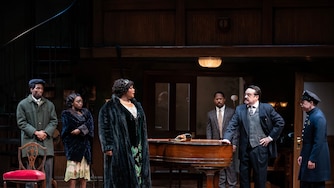
“Ma Rainey” tells the story of Levee, a young Black trumpeter (Yao Dogbe) at odds with his fellow band members — Cutler, played by Craig Wallace, Toledo (Ro Boddie) and Slow Drag (Derrick Truby) — as they spend a day in 1927 attempting to record an album with strong-minded blues singer Ma Rainey (Nicole Michelle Haskins). Levee strives to make it big in the music industry, while his peers, who each represent a different perspective on what it means to be Black in America, unsuccessfully urge him just to do the job he was hired to do.
Wilson, the late Pulitzer Prize-winning playwright, chronicled 20th century life through the lens of Black Americans in each decade of the 1900s, with the goal of showcasing humanity that hardly got recognition in mainstream American theater.
“You don’t write dialogue — you listen,” Wilson once said of his creative process.
Read More
It was that foundation of authenticity that paved the way for creatives onstage and behind the curtain to bring to life a play that feels uniquely lived in. Audiences were dropped in front of a moment in time — so they’re not just watching a story unfold but witnessing the climax of a situation that was building long before the curtain opened.
Achieving that feat took contributions from all members of the cast and crew.
In the roughly five weeks from the first table read to opening night, director Lili-Anne Brown took care to build an ensemble of performers who understood “the themes of the show and the playwright are the most important thing versus anyone’s individual anything,” she said.
Brown wanted the cast to ensure “that we’re honoring all of these people and their lived experiences,” Truby said. “We really wanted these people to feel like they could be extensions of your own family.”
Walking into the theater for the first time, Truby said, scenic designer Arnel Sancianco’s creation — an impressive three-story set covering the rounded stage — “did half of the work” to help him get into character.
Staging for “Ma Rainey” productions usually dictates a set featuring a top floor, where white music producers literally look down from their tower onto the Black musicians below on the middle floor. Here, singer Ma Rainey holds a certain degree of power as an artist but struggles against her label’s demands. The grungy basement level is where the band made up of four Black men is sent for rehearsals.

The goal was to make the basement “feel weathered and cold and really not taken care of, and really showing the audience that dichotomy,” Sancianco said. “If we don’t create those tiers on the set, we don’t really connect to the struggle that Levee is up against.”
To make the setting feel as authentic as possible, Sancianco researched Chicago architecture from 20 years prior to when the story takes place, depicting the warmth of the upper and middle floors against the neglect and weathering of the cold, cramped basement.
“I think a big mistake a lot of designers make is creating something that’s really pretty but not necessarily something that’s lived in,” said Sancianco, a professor of scenic design at the University of California, Berkeley.
“It’s finding the beauty in the dirty,” he added.
Brown also wanted to ensure there would be humor found in the midst of a serious show.

“In a lot of August Wilson [productions] that I’ve seen, they don’t allow it to be funny,” Brown said. “August Wilson is funny. He wrote a lot of very funny things. And what I like to say about a play like this is that it’s really, really funny until it’s not.”
Throughout the play, Levee’s tirades about wanting to build a name for himself in the music industry fall on deaf ears with the rest of the band. He’s giving an impassioned monologue; the rest of the men are snickering in the background.
“In these conversations about creating the world, [Brown] was really big and very encouraging on making sure that there are jokes for us, moments for us,” Truby said. Those moments, he said, help the audience believe the three veteran musicians have not only played together before but understand each other’s backstories, even as their reactions to the cards they’ve been dealt differ.
“There’s honor in representing those perspectives and not trying to cast any judgment on what they should believe or think or do,” Truby said. “How are you supposed to deal with being Black in America? How are you supposed to reckon with what people think you should be treated like? We see these characters doing it very differently, and that’s the way life is.”
Haskins recently texted Brown that the ensemble work they had done together made the cast dynamic feel like playing jazz onstage.
“We’re all playing together and sometimes people take solos and then it feels like music,” Brown said.
“Ma Rainey’s Black Bottom” is onstage at the Round House Theatre through Oct. 18.




Comments
Welcome to The Banner's subscriber-only commenting community. Please review our community guidelines.