
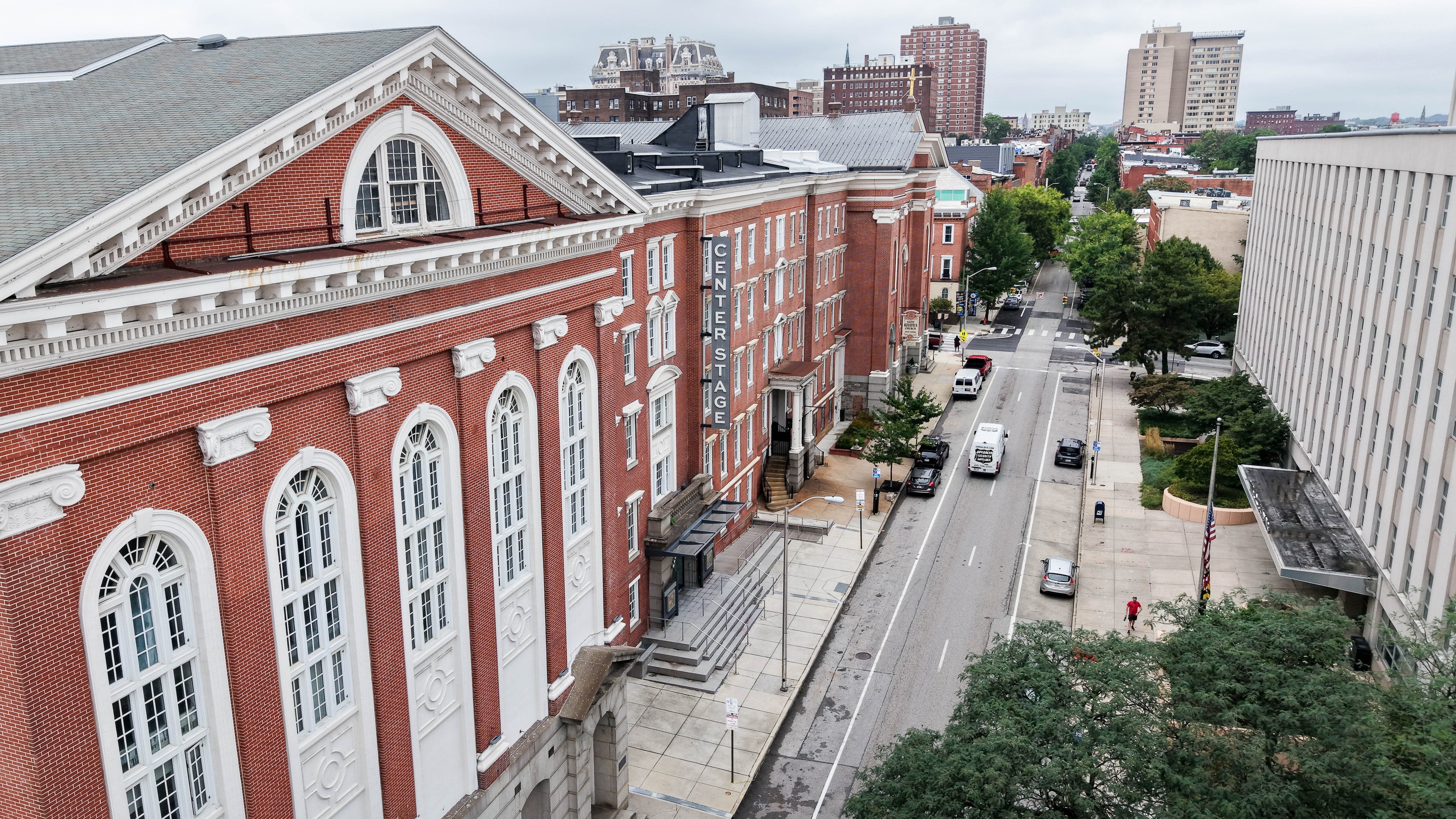
I’m always tickled when people complain about artists “going political.” The inherent nature of art, of creation and free expression, is political. This becomes obvious when entire governments try to threaten it out of existence, like in 2025, when the brand new presidential administration demanded organizations halt so-called diversity, equity and inclusion (DEI) programming or risk federal funding.
Baltimore Center Stage’s response? A resounding and hearty “Nah.” A year later, they’re still doubling down on diversity.
“Maybe it’s a triple-down,” said Ken-Matt Martin, the theater’s producing director, chuckling.
What a Baltimore thing to say! Center Stage, the official state theater of Maryland, has long been a bastion of diverse, provocative expression. This season alone included “Trinity,” a play by Lena Waithe featuring a Black lesbian love triangle, and “The Peculiar Patriot,” Liza Jessie Peterson’s work about the notoriously racist roots and realities of the American prison system.
And the recent preview of Center Stage’s 2026-27 season sees the theater continuing to keep a well-heeled boot on the neck of creative control.
“That was one of my proudest moments,” board trustee Christel Curtis said of the theater’s decision last year to continue putting out the diverse creations they’ve become known for. “To say we are not going to change even if we were going to lose money — and that’s the last thing a theater wants to do.”
Read More
Not only has the organization replaced what they would have gotten in National Endowment for the Arts (NEA) grants with other funding sources, but they’ve continued their open defiance to censorship in their programming. The new season includes productions about feminism and menopause; a Tony-winning play by perhaps the most respected Black playwright of the 20th century, August Wilson; and “Xtravaganza,” a full-scale theatrical musical spectacle about LGTBQIA+ Black and Latino dancers in New York’s underground ballroom scene.
It’s the scheduling equivalent of a cultural clapback.
Martin said that under President Donald Trump’s DEI guidelines, the rules for federal funding “are so strict that we would not qualify, because of who we are. Shows like ‘Xtravaganza’ would not exist in that world.”
Even before Trump’s executive order about DEI, the dollar amount of NEA grants had already begun declining, falling from the $50,000-$70,000 range to $25,000-$30,000. Fortunately, Center Stage has replaced that money with grants from the Andrew W. Mellon Foundation and Ford Foundation, state and city funding, and private donations.
“People have poured out a lot of love for us, and that’s more than covered it,” Martin said.
Obviously, the Trump administration’s crackdown on DEI has been to the cultural benefit of several places, including Baltimore, because artists have moved their shows and concerts out of (harrumph) The Donald Trump and John F. Kennedy Memorial Center for the Performing Arts and the Smithsonian National Portrait Gallery. The president’s reshaping of federally funded arts programs hasn’t erased those expressions, but just moved them into the outstretched arms and ears of those who appreciate them.
Grateful for the love of the community, the staff at Center Stage wants to tell stories that are relevant to those communities, whatever they are. At the presentation for next season, Martin and artistic director Stevie Walker-Webb encouraged ticket holders to try out shows that might not be about them, or naturally appeal to them, because all of these voices are valid.
“If you don’t fight for the people in groups that you’re not in, you’re next,” Walker-Webb said. “We take that seriously.”
Maryland poet laureate Lady Brion, who will star in Center Stage’s production of Wilson’s “King Hedley II,” said she knows all too well the price that organizations and the artists they contract with are paying for this administration’s DEI witch hunt.
She lost opportunities with those who had to stop producing diverse work to save their budget because of her presence as a ”Black truth-teller,” she said. ”To be able to show up as my full self is a dream. It’s an honor and a privilege. To be at a theater this courageous, this unyielding, is an honor.”
Understand that this is not mere petulance. It’s knowing how to continue your work in the face of pressure. “We’re not going to bow down to bullies,” Walker-Webb said.
And they aren’t going to stop full-throatedly protecting their ability to tell the stories they want, about all people, for as long as they can.
“We are artists who are genuinely invested in what diversity, equity and inclusion means,” Martin said. “They’ve become dirty words. Intentionally, I don’t use the full acronym. I use the full words. Let’s talk about it.”
Center Stage is going to keep talking, continuing to have conversations about complicated lives on the margins that tell the greater story of our world. No matter who says they can’t.
Hey, Baltimore! This is now almost exclusively a column about you! I want to know what you want to hear about: What issues are making you tear your hair out? What cool people and clubs are making your neighborhood better? What’s the thing about which you say, “Nobody ever writes about this?” Hit me up at leslie.streeter@thebanner.com, or leave a comment below.


Comments
Welcome to The Banner's subscriber-only commenting community. Please review our community guidelines.