
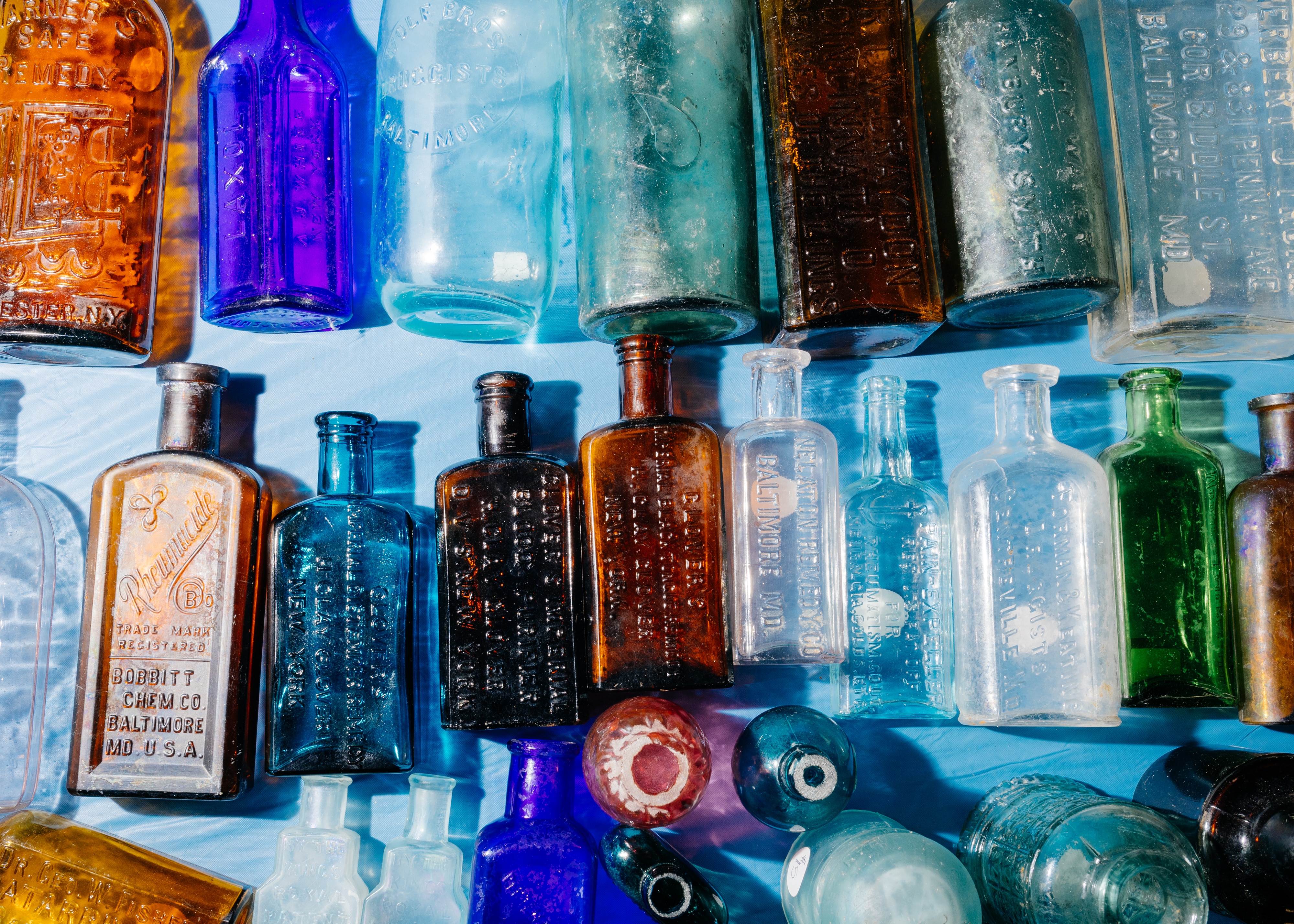
Treasure hunters arrived by the hundreds to the Howard County Fairgrounds last Sunday, gripping coffees and cash.
They shuffled into the main exhibition hall past armed security guards who had spent the night chaperoning about 340 tables that groaned beneath the weight of jewel-toned riches.
Welcome to the world’s largest one-day bottle show. It’s a surprisingly lucrative antique market that draws serious collectors and even more serious money to Maryland each spring.
In this microcosm of historic glass and pottery, a single bottle can fetch up to five or even six figures. Bottles of sodas are sold alongside vials of ancient cocaine without anyone batting an eye. Perhaps the only thing more heavily guarded than the collectibles are the locations where dealers dig them up.
“It’s an unusual hobby,” said Steve Charing, a member of the Baltimore Antique Bottle Club, which has hosted the show for 45 years. “A lot of people collect antiques. This is very specific.”
The Baltimore region was once a major bottle manufacturing hub, remnants of which remain buried in the earth if you know where to look. In 1970, a small but passionate group of collectors founded the club, originally named the Baltimore Bottle Hounds, and enshrined their values in the first three articles of their constitution.
I. Ye must be a complete hound about ye bottles.
II. Ye must be a hound willing to dig ye bottles, beg ye bottles or steal ye bottles.
III. Ye must protect ye dumps from all other lying and thieving bottle hounds.
True to their word more than 50 years later, the club’s members have authored books and compiled catalogs documenting thousands of varieties of bottles manufactured in Maryland between 1820 and 1990.
Their annual bottle show consistently draws about 1,000 attendees and several hundred vendors from around the country, as well as Canada and the United Kingdom.


Inside the 45th annual show, dealers buzzed about the highest valued item in the room, a citron green glass flask that was expected to fetch between $60,000 and $90,000 at auction in April.
One collector wore a sign around his neck declaring “Pre Prohib Beer Bottles 4 Sale,” hoping a fellow bottle hound would bite.
Another merchant, who hawked glass eyes alongside his bottles, tried to talk a customer into buying a jar.
“Some people just fill up a jar of eyeballs,” he said.
The sound of shattering glass reverberated across the exhibition hall.
Nearly everyone in the room gasped.

The smashed bottle — an 1860s pouring bottle with a decorative pewter mouth — belonged to dealer David Hughes, from Vicksburg, Mississippi.
Hughes had been leaning over his table to show another collector a cellphone photo of a bottle, for which he had just paid $7,000 and already received a $10,000 offer, when his elbow knocked it over.
“I break something every show,” he said. “This is part of the deal.”
Hughes carefully placed the purple shards back on the table and tried to make peace with the fact that he had just destroyed $225 in merchandise. He still had two more in blue and green. Maybe they’d sell better as a pair. At least it wasn’t the $550 bottle with a stopper in the shape of a cat. The sound of breaking glass was good for business anyway, he said.

Hughes confessed that, earlier in his career, he used to put a cheap bottle in a bag and break it deliberately so that people would rush to his table. He bumped another with his elbow as he told the story.
“There I almost go again.”
A few rows over, Paul and Cheryl Nemeth, from Tamaqua, Pennsylvania, examined a cathedral pickle bottle priced at $1,100 and pulled out a wad of bills.
The couple estimated that they own about 100 bottles in this style, which have appreciated in value since they began collecting them a few years ago. Whenever the couple want to go on a cruise, they sell off a few bottles, Cheryl said, as the dealer checked their $100 bills against the light.
“It’s my retirement plan,” Paul said.
To be sure, most antique bottle collectors in the room appeared to be seniors. Several said they came to the hobby as children after finding bottles in the woods or creeks.


Baltimore’s club, however, has taken steps to attract younger generations to the hobby.
Elaine Adams was wrapping up a fine arts degree in ceramics at MICA in 2023 when they found the club’s website and social media accounts. Their senior thesis involved casting glass bottles in plaster molds, and they wanted to learn more about how to find old bottles.
“I’ve always been interested in vessels,” Adams said.
They brought a friend along to the club’s meeting that December, which happened to be when members played “bottle bingo.” Adams won an oyster jar and a ceramic beer stein.

Two years later, Adams is among the club’s youngest members. The veterans are finally beginning to let them in on their best digging spots around greater Baltimore.
“Treasure hunting is a big part of it,” the 26-year-old said.
Adams encourages their friends to come along to club meetings or on searches for bottles.
“It’s one of those hobbies that’s hard to explain what the draw is,” they said. “But it’s very tactile.”
There’s something comforting about buying a bottle at the show and holding it in their hands on the car ride home.


Other collectors say they’re drawn to antique bottles for their history.
Vendor Chris Rowell, of Essex, specializes in pre-Civil War bottles made in Baltimore. He’s paid visits to Baltimore’s Green Mount Cemetery to track down the graves of certain manufacturers.
“They’re real people, not just names on a bottle,” Rowell said.
In a way, bottles are evidence of a booming business more than a century earlier. And, he said, there’s a lot to know about them — their shapes, colors and words.
About 20 years ago, Rowell dug up an 1840s bottle in Baltimore that stood out for a spelling error: “Dr. Thompson’s vegitable worm syrup.”
Rowell needed money at the time and sold it for about $600. On Saturday, before the bottle show, the dealer he sold it to offered to let him buy it back.

Rowell opened an auction house in January and, with his own business booming, agreed to pay $1,000 for it.
The next day during the show, he smiled as patrons admired glass bottles he was more willing to part with.
“That’s what happens,” Rowell said. “You see them and say, ‘I need one.’”




Comments
Welcome to The Banner's subscriber-only commenting community. Please review our community guidelines.