
Arsia Rozegar was leaping over fire.
Surrounded by friends and multiple bonfires in his backyard this month, the children’s author was metaphorically jumping from the darkness of winter into the light of spring in celebration of the Persian holiday Chaharshanbe Suri.
This year, though, amid war with Iran, normally joyous occasions for Iranian Americans are muddied with fears of escalating violence.
Still, they are trying to hold on to the optimism embodied by Chaharshanbe Suri and Nowruz, the Persian New Year celebrated at the spring equinox.
“Despite the trying times that the Iranian community is going through, I feel that it’s really important that we don’t lose our traditions,” Rozegar said.
Montgomery County ranks seventh among U.S. populations of Iranian-born residents and ninth among those who reported Iranian ancestry, according to the U.S. Census. Maryland as a whole is ranked sixth in the nation, and Virginia is fourth.

As the conflict in Iran continues, many local Iranian Americans live in fear, for loved ones in Iran and for themselves, worrying that publicly sharing their political beliefs will make them a target to those who disagree — even within their own community.
Iranian Americans are nearly evenly split when asked whether they support or oppose the U.S. initiation of war with Iran, according to a recent poll conducted by the National Iranian American Council.
Many revile the religious regime that has ruled the country since the 1979 Iranian Revolution — an event that prompted many of them to flee to the U.S. But they can’t agree on who should succeed the ayatollahs.
One divisive answer is Reza Pahlavi, the son of the shah deposed by the revolution. He was a longtime resident of Potomac, though it’s not clear if he still lives in the county.
Under increasingly trying circumstances, Rozegar is one of many Iranian Americans yearning for peace and freedom for Iranians.
Read More
“They want to live a normal life, and they can’t,” said Phaedra Askarinam, a Bethesda-based artist born and raised in Iran.
Taking a stand against the war
The anxiety that weighs on Iranian Americans spiked in January, when the Iranian regime killed thousands who peacefully demonstrated against it.
Fears heightened last month when the U.S. and Israel launched airstrikes on Iran, killing nearly 1,500 civilians, the Supreme Leader Ayatollah Ali Khamenei and other prominent officials.
President Donald Trump urged Iranians to oust the regime, which survives.
Few Iranian Americans support the rulers of Iran, whose repression has been well documented. Still, many doubt the efficacy of the war, reflecting the views of Americans in general, a majority of whom disapprove of the conflict.
Iranian Americans feel the war more personally.
Kowsar Gowhari, a Rockville-based immigration attorney who was born in Montgomery County and grew up in Iran, said she is constantly checking for new headlines and updates from her family abroad.
Internet in Iran is largely inaccessible, though Gowhari says she’s read dispatches on Instagram from journalists in the country and receives occasional calls and texts from loved ones to confirm they’re OK.
Iranian Americans fear for people they know but share a larger concern, she said. “And that’s the future of Iran.”
To cope, Gowhari advocates for the war to end. She recently met with Maryland Sen. Chris Van Hollen, who has called the war illegal and supported a War Powers Resolution that would require the Trump administration to secure congressional consent to continue it.

Pahlavi, known as the crown prince of Iran, is a staunch supporter of the war who is trying to position himself to lead his homeland.
In exile in the U.S. since the revolution, he spent more than two decades living in Potomac, where his daughters attended The Bullis School. Pahlavi put his Travilah home on the market in 2024.
His late father, Mohammad Reza Pahlavi, was a reviled figure: the country’s last Shah before the revolution that overthrew the monarchy to make way for the Islamic Republic of Iran.
In the aftermath of the U.S. attack that killed the supreme leader, Pahlavi thanked Trump in an op-ed in The Washington Post and called for regime change and democracy in Iran.
Rozegar said he appreciates that messaging.
“I listen to his words. I hear his speeches. And, to be frank with you, I don’t see any BS in it,” he said. “He’s been consistent for a long time now. He wants freedom for Iranians, a separation of religion and state.”
But some Iranian Americans don’t trust Pahlavi. Gowhari said she is troubled by his foreign policy views. And Trump has said Pahlavi doesn’t seem to have the support to lead Iran. But data suggests he is gaining it.
Half of Iranian Americans polled in a new report named him the most likely figure to help Iran move toward a democracy, according to the Public Affairs Alliance of Iranian Americans national public opinion survey, published Thursday. And 59% said they support the idea of the U.S. government publicly backing him.
“He keeps saying the right things,” said Steven A. Cook, a senior fellow for Middle East and Africa studies at the Council on Foreign Relations who interviewed Pahlavi last fall.
Iran’s path to a new government is strewn with obstacles, Cook said. But, for some local Iranian Americans, there’s enough momentum for cautious optimism.
“I think we’re going to see some results — I really do think so this time around," Askarinam said. “Whatever is going to happen is going to be better than what it was. It can’t be any worse.”
Healing together
Regardless of their views of the war, Iranian Americans in the area are looking for ways to cope together.
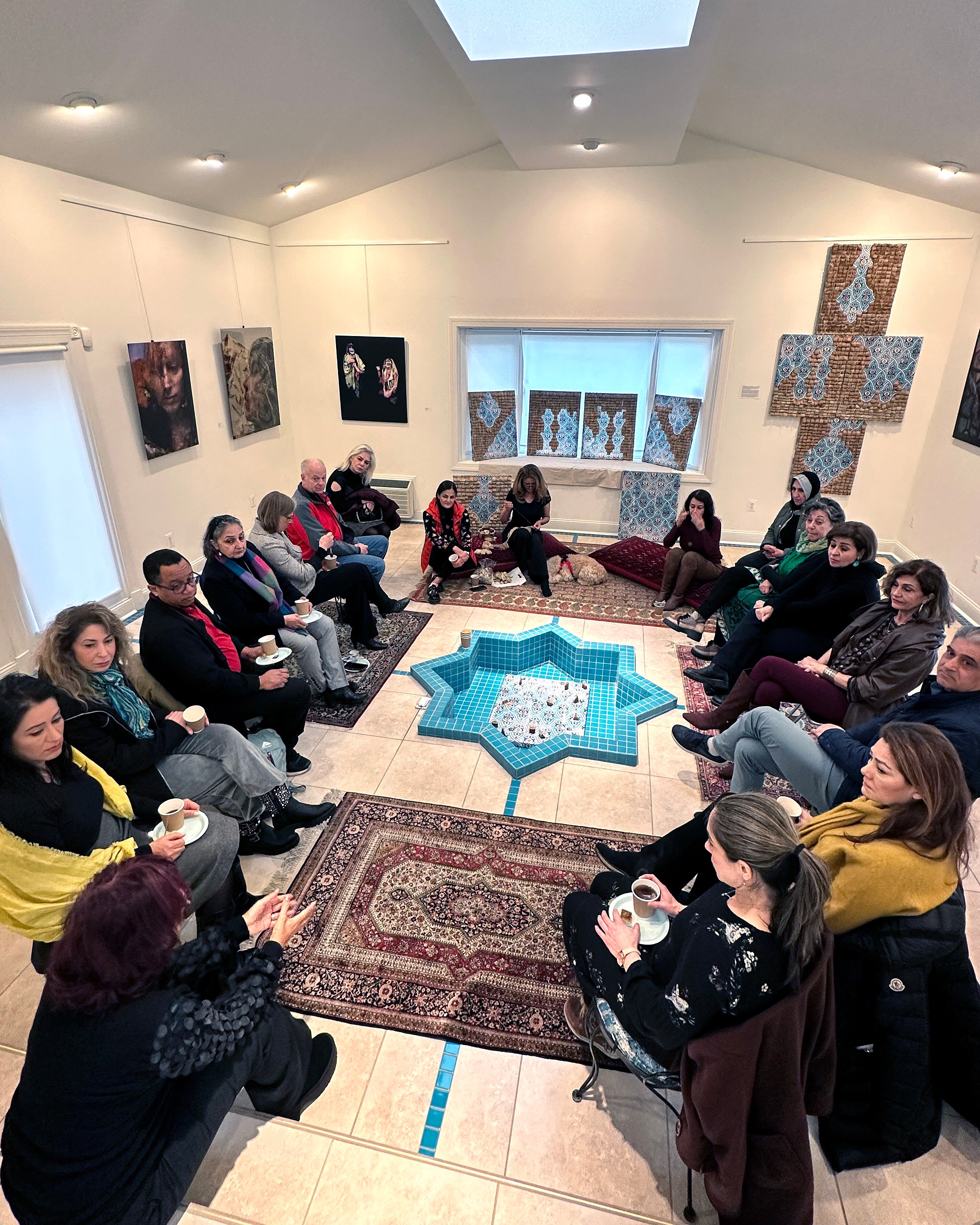
Askarinam’s latest art project, “Healing With a Cup of Tea,” explores what it means to carry each other’s emotional pain.
She has spent two years collecting used tea bags from anyone willing to share, including neighbors, attendees of her local art shows and strangers who drop them in the mail. She works them into a series of collages.

She hopes the physical act of handing over a used tea bag makes people feel as though they’re handing over their burdens for someone else to shoulder for a while.
“I use my art for healing,” Askarinam said. “In my culture, if anyone comes to your house, as hospitality, as healing, you offer tea.”
Rozegar, a former Marvel Comics creator who frequently hosts author events for his books about Iranian myths and history in Montgomery County and around the region, was born in Iran and moved with his family to the greater D.C. area when he was a baby.
One of his favorite parts about living in an area with significant Iranian American populations is celebrating Persian holidays.
This year, Rozegar took part in the Nowruz Festival in Herndon, Virginia, the largest throughout the DMV. He hosted a reading of one of his illustrated books: “Shahnameh For Kids,” a series sharing Iranian myths and legends about ancient Iran.
The best antidote to feelings of helplessness over Iran, he and Askarinam said, is to join others in celebrating Persian culture and mourning their people’s losses.
“Hopefully this ends sooner than later,” Askarinam said. “And we can all go back to Iran for Nowruz next year.”




Comments
Welcome to The Banner's subscriber-only commenting community. Please review our community guidelines.