
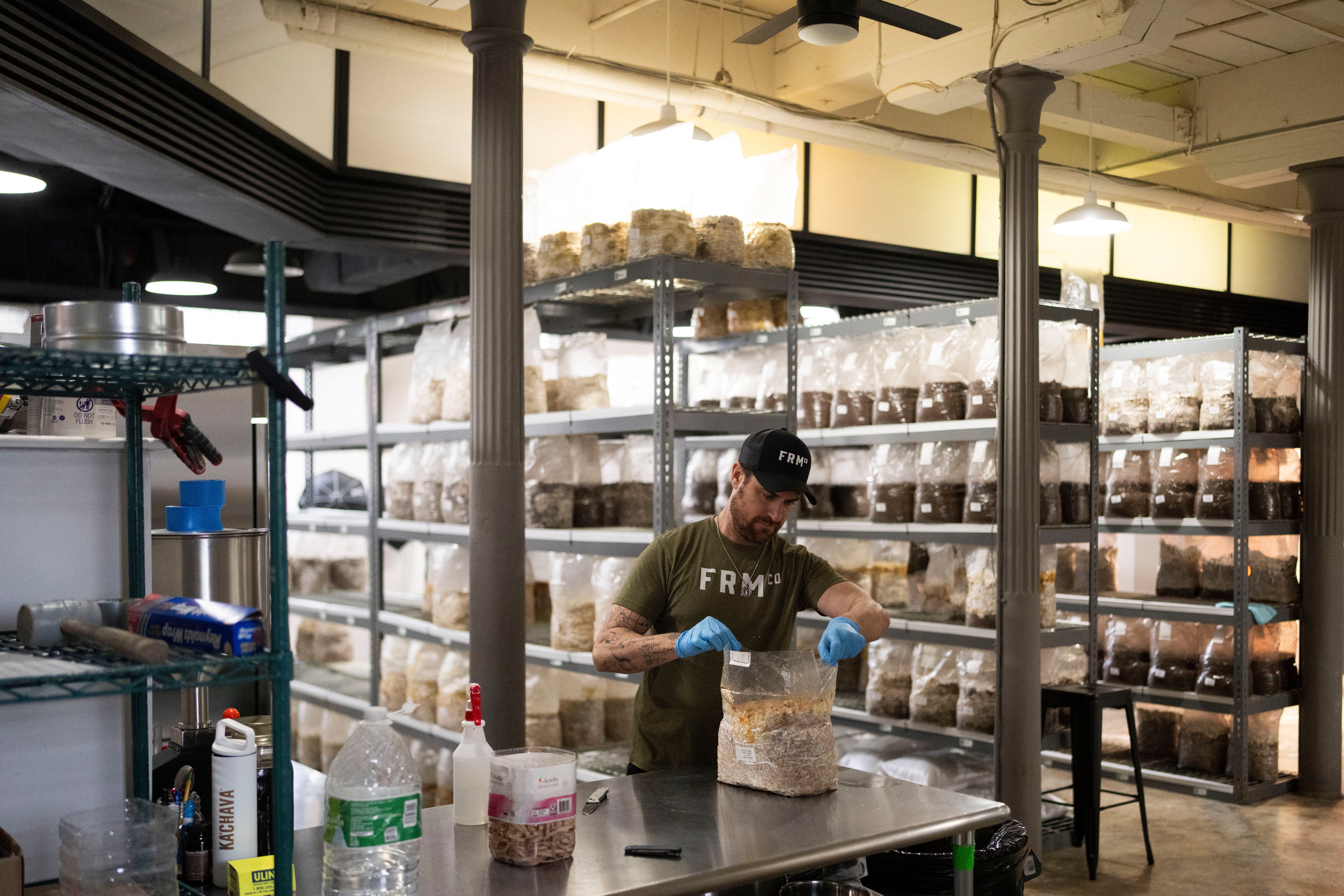
There’s something decomposing in a dark, formerly vacant office in Hampden — and it’s not what you might think.
At 3000 Chestnut Ave., bags of wet sawdust, sorghum and soybean hulls sit in rows, fermenting under low light. Inside the grain-filled substrate, sprawling, spine-like mycelium fades from brown to white. It stretches, strangling every kernel of nutrients until white caps and thick stems begin to sprout above the surface, resembling tiny bowling pins.
“It’s kind of like a sourdough starter,” said Falls Road Mushroom Company owner Jonathan Manekin, who has set up tents, fans and spinning machines to control every stage of the operation.
Manekin, who left behind a 20-year career at his family’s real estate firm to start up his farm, now leads a team of impassioned fungi enthusiasts and foragers who churn out pounds of the mushrooms in species ranging from lion’s mane to grapefruit-sized king oysters.
You might recognize some of the wares. Like the tendrils beneath his mushrooms, Manekin’s network of buyers is spreading, connecting the menus of social clubs from Green Spring Valley Hunt Club in Owings Mills to Baltimore’s Mount Vernon and Maryland clubs, and restaurants like The Corner Pantry and the Tavern at Woodberry Kitchen.
Read More
The enterprise is now one of several rapidly growing vertical farms in Baltimore. Everything in the 2,800-square-foot space, from the humidity to the sterilizing fluid used to clean your shoes upon entry, is carefully designed to cultivate sustainably grown, cost-efficient mushrooms that are enticing enough to attract some of the most particular chefs in the region.
Despite being in business for just over a year, this unassuming operation is angling to make a bold imprint on the city and state.
“In a way, this is an example of how very cool things can happen in unexpected places,” said Spike Gjerde, chef and owner of the Tavern at Woodberry Kitchen.
Gjerde tries to use hyperlocal ingredients in his food — an extension of the chef’s desire to see less of the country’s food system controlled by large, private companies. He admires Baltimore’s small-scale microgreen farming operations and other innovators experimenting with urban aquaculture or locally harvesting fish, even as obstacles to starting up these farms mount.
Manekin’s farm feels “like a win” for local food, Gjerde said. He called the mushrooms in “absolute pristine shape,” fresh and free of the usual damage seen in packaged and shipped fungi since Manekin’s warehouse is only blocks away.
“A lot of the chefs we talk to just don’t get regular access to these [types of] mushrooms,” Manekin said, adding that he did market research to tailor the produce to chefs’ desires.

Neill Howell, owner of The Corner Pantry, said he created a popular mushroom banh mi with fermented chili oil for his menu to incorporate the meaty stems found on Manekin’s mushrooms. They’re “extremely clean” and “beautiful,” he said.
Falls Road Mushroom Company’s controlled environment allows for predictable, year-round harvests in a process that Manekin has tried to make more energy- and cost-efficient than that of a normal urban farm.
In recent years, urban farming has experienced a growth spurt. Consumers are increasingly looking for fewer pesticides and hyperlocal supply chains when choosing their food. Chef Malachi Child, who works for Manekin in mushroom research and development, believes the interest comes from “people waking up” to the impact certain chemicals and processed foods have on the body. Production lead Walker Santos said he turned to studying and foraging for mushrooms himself as a means of taking greater control over his health.
But developing an indoor farming operation is complicated. Urban farms are often criticized for using wasteful levels of energy to grow high-quality produce. Billion-dollar farm start-ups like Plenty and Bowery — whose Baltimore County operation was once touted as a potential salve to food insecurity — recently declared bankruptcy and shuttered their warehouses nationwide. Industry experts attributed the closures to the high costs of technology and energy consumption, since the leafy greens grown on the farms required large amounts of artificial lighting.
Mushrooms, on the other hand, don’t need light for energy. Manekin discovered while growing fungi in his home during the pandemic that they require less space and are less costly to produce than most vegetables. They just need humidity, moderate temperatures, good ventilation and a food source like sawdust — which Manekin sources for cheap from agricultural waste or the wood left over from cleared trees, often found at regional mills.


Manekin says the next step is to use urban waste, including cardboard and coffee grounds. He’s already started giving some of his mycelium, from which the mushrooms grow, to other farms to use with their compost, which he said can help regenerate the soil and have positive health impacts on bees.
It doesn’t stop there.
Manekin believes the mushrooms can be used to remove contaminants from the soil and to revitalize blighted areas downtown, from offices that won’t sell to the partly demolished jail sitting vacant on Eager Street.
“For Brandon Scott or Wes Moore to say we turned a prison into a farm to feed our community” would be exciting, he said. “Turn downtown Baltimore into the nation’s example of food agriculture.”
It’s ambitious, but that’s exactly how Manekin operates. That’s why, at the end of 2024, he quit his job at Manekin, his family’s company and one of the largest commercial investment firms in the mid-Atlantic.
“I wasn’t happy with what I was doing. There was a disconnect in my heart and my soul,” he said.

By the time he signed his lease for the Hampden office in January 2025, Manekin had already visited a scientist studying fungi in Phoenix and a 50,000-square-foot production facility in Chicago. He had built relationships with suppliers of liquid substrate, which dictates the species of mushroom grown, and sold a home he owned in Little Italy to invest his capital.
Manekin said his location can grow up to 50,000 pounds of mushrooms and is within 80% of their customer base. The business is on its way to being profitable, he said, and one day he hopes to see the fungi on restaurant tables at Charleston in Harbor East, where he takes his wife for anniversaries, and other local fine dining eateries.
“I think people are probably pleasantly surprised the business is doing well,” he said.
Manekin’s largest expense is labor, he said, and the painstaking amount of time it takes to keep the office free of contamination. But behind the fans, tents and protective gear, there’s not much else needed to keep the operation humming.
“That’s what I love about this business,” he said. “When the world’s gone crazy and I’m asking myself ... ‘What are we going to do?’ ... We just need sawdust.”





Comments
Welcome to The Banner's subscriber-only commenting community. Please review our community guidelines.