
A trail of stepping stones leads to a little cottage that’s out of place among the grand houses of Northwest Baltimore. Someone has patiently trained grapevines to grow over the trellised path.
There’s a warning sign on the door — authorized personnel only.
Here, one of the great Italian glass artists has worked for decades in relative obscurity.
Gianni Toso traces the Venetian art of glassmaking back 700 years on his father’s side. His mother’s family, the Ballarins, has worked in the glass factories since the Middle Ages. The crests of both families are painted on the ceiling in the Museo del Vetro, the museum of glass, on the main island of Murano.
Even among masters, Toso is royalty. They call him “maestro.”
The craft of making glass in the U.S. had been mostly limited to manufacturing before art students invited Toso over in the 1970s. Glassblowing was a dance that he taught the Americans. Joyfully, too. Because glass is elemental and fluid like life. He sang “Bella Ciao” and invited everyone back for wine. This was long ago.
It’s getting dark one evening in January when he leaves his studio and follows the stepping stones back through the yard to his house. In his 80s, tall and thickly bearded, he’s unbowed, even vigorous at times. Not tonight.
Toso shuffles inside cold and tired, and falls into a beautifully carved chair that had belonged to his friend the contessa. Around him are Venetian splendors: dishes and goblets of brightly colored glass. Overhead hangs a Ca’ Rezzonico-style chandelier with gold leaf, the sort that hangs in the palaces of Italy. He shrugs off compliments.
“Decorative art is not fine art,” he says.
Toso has devoted his life’s work to this distinction. He traded the glassworks of Venice for the studios of America, moving on from luxe housewares to fine art.
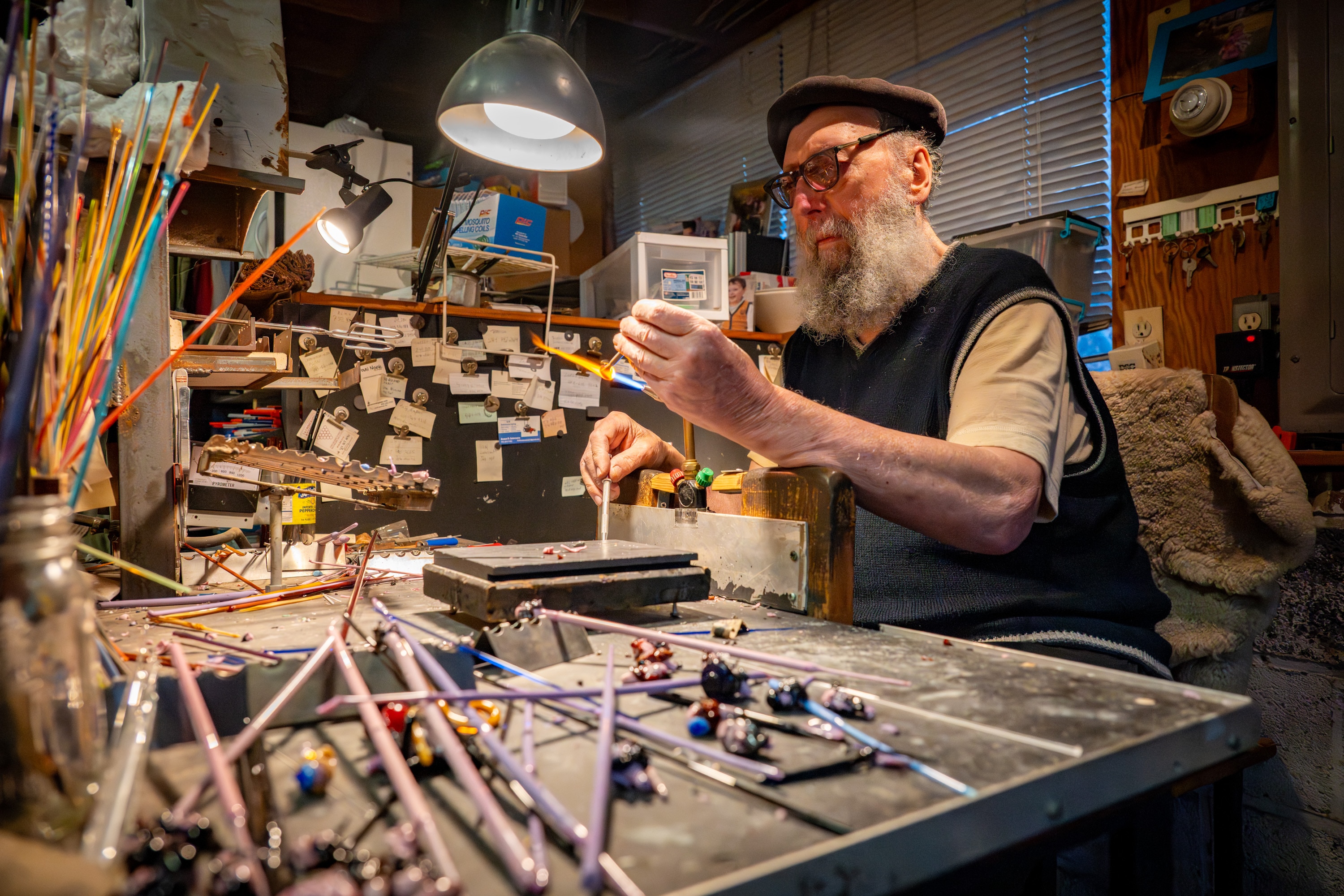
As an Orthodox Jew, his work and his faith are one. With hand torches, he would melt sticks of colorful glass into rabbis, priests and carnival performers, placing them in tiny, fanciful scenes of Jewish faith and Italian street life. His method was so intricate that he shaped the hot glass with dental picks and homemade tools, producing some of the most exquisite flamework ever made.

His hands are magic. At least, they were.
He holds them up to show the tremors.
“I’m in a state of crisis,” he says.
Closely guarded secrets
The Venetian Lagoon is a marshy bay where land and sea blur together. The little islands hold iridescent cities; everything shimmers and flows. Fittingly so, artisans have been making glass here — celebrating it, rather — for more than 1,300 years.
They don’t cut glass in the Italian tradition; rather they melt and blow it into graceful shapes capturing light and motion. With furnaces exceeding 2,000 degrees, burning day and night, fire was a constant hazard. Venice itself sat atop wooden piers.
In the late 13th century, the Republic of Venice ordered the glassblowers next door to Murano, a cluster of tiny islands stitched together by bridges. Concentrated here, for centuries, their craft flourished.

Glassblowing is chemistry: basically sand, ashes and lime melted into paste and stuck to the end of a blowpipe called a punty rod. Glassblowing is art, too: A maestro puffs, spins, stretches and twirls the lava bubble into shape.
On Murano, the masters went further. They mixed in soluble gold to create distinctive wine-colored glass known as rosichiero. They bleached their ingredients to produce the first colorless glass, Venetian crystal called cristallo. Their experiments led to filigreed glass, feathered effects and a technique to resemble crushed ice.
The secrets were closely guarded. Glassmakers who left Murano were banished from the trade. The factories mass-produced tableware, but also made ornate mirrors and the crystal lenses known as “stones for reading.” Galileo put them in his telescopes.
During the 15th and 16th centuries of the Italian Renaissance, the islands supplied Europe’s hottest decorating trend. Kings and queens dined with Murano glass in the royal courts. Murano-made chandeliers sparkled overhead.

“They were kind of like the Louis Vuitton bag of their day,” said Laura Morelli, an American art historian and author who teaches a class online about Murano glass.
From this heyday came a decline. Napoleon’s conquest of Venice in 1797 brought steep taxes, and the glassmaker guilds disbanded. Competition from Bohemian crystal flooded the markets. Some furnaces shut down. Many of the old secrets were forgotten.
The mid-19th century brought a revival of Murano’s legacy, with plans for an archive and museum. One factory led by six brothers set out to recreate the lost art of ornamental glasswork. They unveiled a stunning chandelier, the glasswork like a bouquet of flowers.
Over the next century, the finest Venetian glass became synonymous with the family’s name: Toso.
The maestro
Gianni Toso didn’t touch the glass. Not in his first job in the factory.
The 10-year-old fed blocks of wood — “bigger than me,” he remembers — into the furnaces. At home, his older sisters would pluck the splinters from his hands.
He was born in Murano in March 1942. Under the Fascist regime of Benito Mussolini, there was hunger and poverty. His grandfather (a well-known glass chemist), father and uncles all worked in a glass factory. And yet his mother broke from tradition to enroll him in the fine arts academy, where he studied proportion and copied masterpieces by Michelangelo.
He was supposed to be a painter. Of course, he opened a glass studio.
Glassblowing requires a workshop with furnaces and assistants. Alone in a tiny studio, however, he could flamework; that’s using hand torches to melt and shape pencils of colored glass.
Postwar Venice attracted a jet-setting crowd. The heiress and art collector Peggy Guggenheim lived in a palazzo on the Grand Canal. Toso went to dinner with a contessa and drinks with the actor Peter O’Toole. And he was offered a commission to turn Salvador Dali’s surrealist flowers into glass.

It’s fairly simple to sculpt hot glass, but it’s difficult to join two pieces. Both must be about the same temperature at the same time — or else they burst. His Dali commission was an experiment in time and temperature. Toso assembled the flowers slowly, painstakingly, petal by petal.
The master glassblowers came by to witness the feat, he said. Peggy Guggenheim gushed over his work, even teasing Dali for being an inferior artist, at least in Toso’s telling. The Dali flowers whisked Toso into Venetian society. The maestro’s reputation was born.
In the U.S., meanwhile, the studio-glass movement of the 1960s was introducing hot glass to the fine arts. The art student Marvin Lipofsky went to Venice to learn from the Italian masters. He blew glass with Toso at the Venini Factory, then introduced the maestro to West Coast art schools in 1976.
“Having a bona fide Venetian maestro demonstrating all these mysterious techniques that were cloaked in secrecy to American artists was really kind of amazing,” said Tina Oldknow, the retired curator of the Corning Museum of Glass in upstate New York, the world’s largest museum dedicated to glass art and history. “He was the first of several people who came from Italy and changed the face of American studio glass.”
Toso’s fine-arts reputation was cemented by his series of evocative glass chess sets. Rabbis on one side, priests on the other. Are they opening up a conversation or squaring off? The Corning Museum bought one set around 1981 in “the ultimate accolade for craftsmen in glass,” The New York Times noted.

The American graduate student Karyn Cohen had read about the master glassmaker of the Jewish ghetto. Europe’s first “ghetto,” — a label believed to come from the Italian word for bronze casting done there — the center of Venice has been a home to Jewish faith and culture at least since the 16th century.
Toso believes he has Jewish ancestry on his mother’s side, and he embraced the faith as an adult. When Cohen arrived in Venice around 1981, she sought out his shop.
The windows displayed his signature, finely detailed rabbis. Hungry, she went in and asked directions to the kosher restaurant.
“He told me it was closed, and if I wanted kosher food, I would have to have dinner with him,” she said.
He made pasta. They talked and talked. In what felt like mere minutes, he sculpted for her in purple glass, delicate as ice, an outstretched hand. On the thumb, a tiny dove. Almost one year later, they married.

The couple split time between her home in New Jersey and his in Venice before children.
“We would walk down the street and people would go, ‘Maestro! Ciao, maestro! Ciao! Welcome back, maestro!” she said.
When the time came to raise a family, they looked to the Jewish neighborhoods near Pikesville. Baltimore seemed full of writers, artists and creatives compared to humdrum New Jersey, and was still within a day’s drive of the New York art galleries.
They found a house in Bancroft Park, and Toso converted a greenhouse out back into his cottage studio. He planted grapevines and made wine in the old tradition by the phases of the moon. He and Karyn raised three daughters and one son. All the while, Toso made glass art.
Museums of modern art in London, Japan and Denmark featured his work. So did American institutions including Corning, the Chrysler Museum, the Henry Ford Museum and the Toledo Museum of Art. When Charles Shepard of the Fort Wayne Museum of Art set out to assemble a collection of modern glass, “Gianni was at the top of the list,” he said.

Toso chess sets fetch more than $30,000 on the secondary market, said art dealer Aaron Schey of Habatat, the leading U.S. glass gallery. And yet, the fame and wealth of contemporary American glass artists, luminaries such as Dale Chihuly, passed Toso by. There’s a limited market here for religious art compared to Europe, and the Jewish Shabbat was reserved for rest, not gallery shows and receptions.
“Everything is on a Friday or Saturday night, and he couldn’t do it,” Karyn Toso said. “He pretty much dropped out of the art world because of his faith.”
Toso received commissions from in-the-know Jewish collectors, such as the Seagram’s heirs. And he went on making glass, even as he began to notice, in the late 2010s, a tremor in his hands. He made Ner Tamid eternal lights for Baltimore synagogues. Years passed by. The tremors worsened.
“If you ask me, can I make the Salvador Dali flowers?” he says.
He shakes his head.
Dancing again
Parkinson’s disease comes from damage to nerve cells in the brain that produce the feel-good chemical dopamine. These nerves control muscles, too. When dopamine signals are interrupted, movements may slow and stiffen. One common symptom is tremors.

Doctors don’t know what causes the progressive disorder, but it’s the fastest-growing neurological disease, affecting more than 1.1 million people in the U.S., according to the Parkinson’s Foundation. Most famous among them: the actor-turned-advocate Michael J. Fox. There’s no cure.
In January 2024, the Ohio artist Alexandra Fresch drove to Baltimore to help Toso blow glass. She had assisted the maestro at a workshop in Columbus, Ohio, years earlier and stayed in touch, captivated by the Italian masters of the art form.
Karyn Toso told her of her husband’s diagnosis.
“I thought, OK, we’re going to start easy and just try to make a cup,” Fresch said. “He’s like, ‘Nope. I have all these plans. We’re going to be pulling cane.
“We’re doing what? Super-intense Venetian glassmaking techniques?”


Pulling cane involves layering rods of colored glass, then stretching and twisting them into intricate patterns such as a helix. The trick is that the glass must be stretched evenly before it cools. This requires steady hands and sure movements. Fresch was stunned to see him in action.
“He jumps up to the reheating chambers, sits back down. He’ll pick up a tool, flip it and catch it,” she said. “I’m like, you were just slowly walking in and shuffling through the snow.”
Karyn Toso came to watch along with his two therapists. His hands were steady when twirling the steel punty.
“He’s so fluid with it; he almost danced with it,” said therapist Patty Wessels. “In that moment, his brain had enough of the chemicals of joy and pleasure that he did not look like he had Parkinson’s.”
That morning was a revelation. Making glass was his medicine.
Still, the disease had robbed him of the ability to make his signature flamework. And he couldn’t return to his origins as a glassblower without an assistant. When The Banner visited him in January, he was stuck.
“The greatest trial of his life,” Karyn Toso said.
No sooner had The Banner called Towson University art professor Jennifer Figg than she recommended her husband, Matthew McCormack, an experienced glassblower himself, help out.
Venetian maestros — steeped in 1,000 years of tradition and exacting in their technique — are famously difficult in the studio. And yet, Toso and McCormack hit it off.

He’s been assisting the maestro four days a week and has applied for a state arts-apprenticeship grant to continue.
“I was like, oh, wow, 20 years of glassblowing, and I learn a new technique in a day,” McCormack said.
Toso is experimenting again: veiled canes, colors jacketed in translucent glass, suspended gold leaf. He’s toying with an idea for masked characters from the Carnival of Venice, in billowing gowns of blown glass — a secular turn for his art.
Henri Matisse, after all, bedridden and unable to paint, made wildly innovative paper cutouts at the end of his life.
Toso just turned 84, and he’s telling McCormack they must work faster, hotter.
In the studio, with the furnace ripping at 2,200 degrees, awash in the heat of creation, Toso’s movements fall into rhythm. The punty rod spins. He’s dancing, again.
Afterward, he sits to rest and cool off. Only then does the disease appear: McCormack helps him into his coat before they go.






Comments
Welcome to The Banner's subscriber-only commenting community. Please review our community guidelines.