
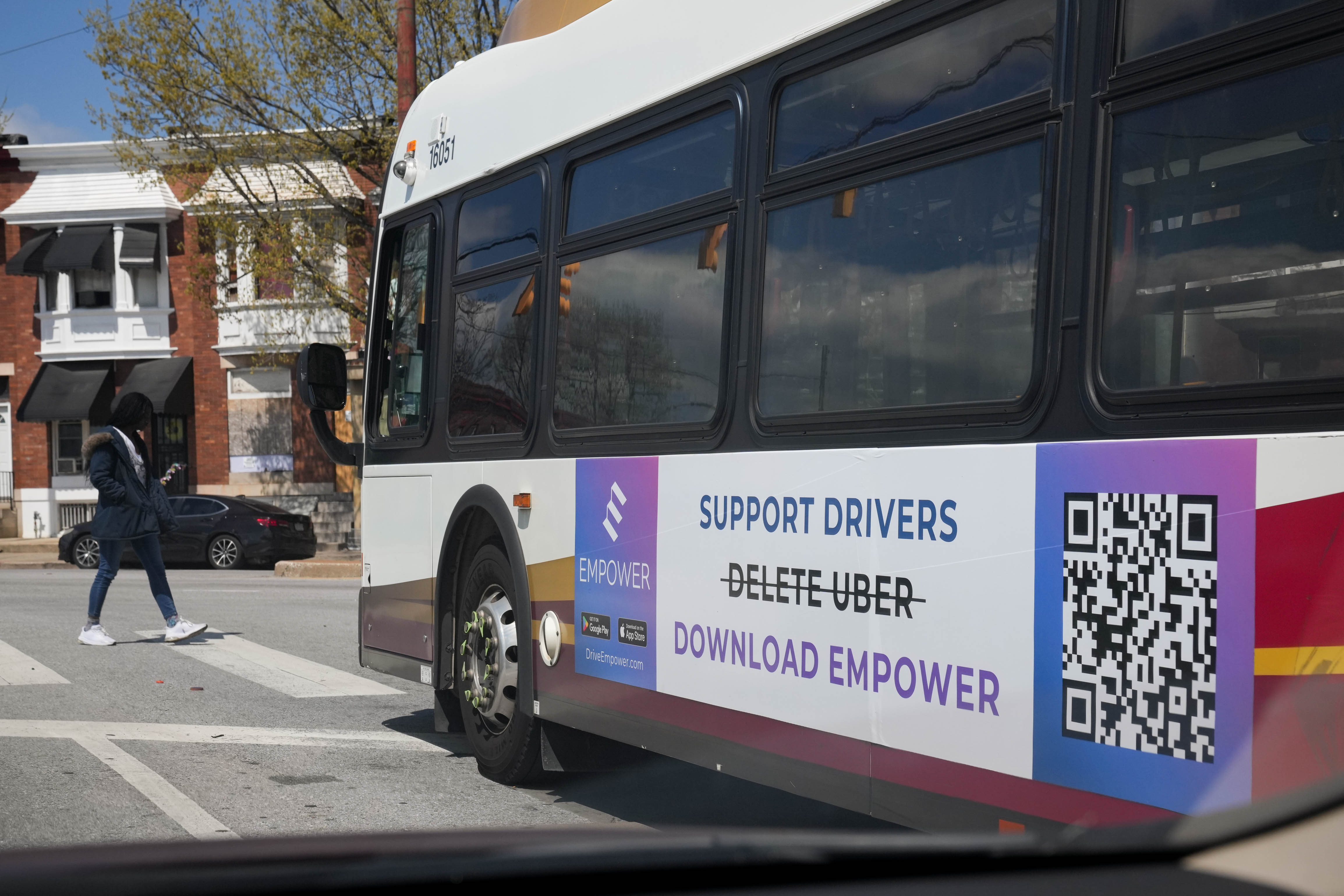
The ads on some Baltimore buses offer a simple directive — “Support drivers, delete Uber, download Empower.”
Empower is an app people can use to hail a car similar to Uber or Lyft. But it promises to do it for cheaper without taking money off the top — the cost of rides goes entirely to drivers, who the company contends benefit more using Empower software to run their own business.
So why are Maryland regulators going after the company?
Empower has been locked in a tit-for-tat with the state for years over its refusal to register as a company that provides transportation services. Maryland’s Public Service Commission, which regulates public utilities including rideshares and taxis, alleged in a 2024 complaint that Empower has been operating as a transportation company illegally in the state.
“As a result of its unauthorized operations in Maryland, Empower is evading the comprehensive web of safety, insurance, and fare protections for the public that are established” in the regulations of public utilities, the complaint reads.
But Empower has always contended its business model is distinct from companies like Uber and Lyft, and so subjecting it to the same regulatory framework doesn’t make sense.
In an emailed statement, Empower Chief of Staff Roshn Marwah wrote that drivers using their app provide “sedan services,” which Maryland code distinguishes from companies like Uber or Lyft. The company has repeatedly offered to talk with state regulators to address their concerns, Marwah added.
“Empower has made clear to PSC for years that the company welcomes the opportunity to work with PSC to answer any questions it has about safety and to share data with the agency about every single trip that is booked using our software.”
Defining terms
Empower’s app functions much like the others: set a pick-up and drop-off location, pick a ride option, then hop in and go. For drivers: get alerted to a potential ride and decide whether to take it.
What sets it apart, the company pitch goes, is that drivers set their rates and end up taking home more money because no one takes a cut.
“Using our software, drivers set their own rates and get 100% of their hard-earned fares,” Marwah wrote.
Empower considers the drivers its customers, not employees or contractors. Drivers pay a weekly or monthly fee to use the platform. Marwah said the drivers earn thousands of dollars more using its software than drivers for other ride-hailing apps.
That makes Empower a software company, it argues, not a transportation company, and the drivers who use it are running their own businesses.
“I made really good money,” said Bemi Byrd, who earned an average of $50 to $60 more per day using Empower than driving for other apps.
Muhammad Khan also said he makes more per ride through Empower than other apps. He switches between Uber and Empower depending on the time of day — Empower during the day, Uber at night — because Uber’s rating and verification process gives him a better sense of who’s getting into his vehicle, he said.
There’s a catch, though. Driver access to the software is available through different plans and price points — daily unlimited plans go for $19.99, a monthly one for $249.99, and a plan with cost tiers based on how much money drivers make through it.
That seems to be partly why Maryland doesn’t buy the company’s logic.
In January, the PSC ruled that Empower fits the definition of a Transportation Network Company under Maryland law, highlighting the pricing tiers and writing that passengers “indirectly pay a fee to Empower.” Now the commission has renewed demands that the company turn over a slew of data, including passenger reports about safety concerns, and is considering financial penalties if it doesn’t comply.
But Empower remains defiant, appealing the commission’s ruling.
If that appeal isn’t successful, it would mean Empower would need to change what amounts to a big difference between its business and Uber or Lyft — how it handles insurance.
Maryland requires “transportation network companies” like Uber or Lyft to carry commercial auto insurance policies that cover drivers and passengers in the event of a crash. Drivers are still legally required to have their own insurance for personal use of their vehicle, but the rideshare policy covers while the app is on and they’re transporting a for-hire passenger.
Empower doesn’t carry such a policy but requires drivers to get their own commercial coverage and provide proof of insurance during their sign-up process.
If a driver doesn’t maintain the right coverage and gets involved in an accident, the only way passengers could recoup damages is to sue the driver for a judgment against their assets, said Juan Carlos Puga, a personal injury attorney with Saiontz & Kirk.
Over the years, a few people who were passengers of drivers that they connected with via Empower have tried but failed to hold the company liable in court after a crash.
Empower is adamant about the safety of its platform and wrote the commission in March, saying it would “relish a fair comparison of its subscribers’ safety records against Uber’s.”
“There is no evidence that a single person who has booked a ride using Empower’s software has been unable to legally recover for any injuries sustained in an accident in which a driver using Empower’s software to run their own business was found to be at fault,” Marwah wrote.
The road ahead
Just as Empower said it was expanding into Baltimore, a judge in Washington, D.C., ordered it to cease operations in the nation’s capital.
As in Maryland, Empower hadn’t registered with Washington’s office that taxes and regulates for-hire vehicles. After racking up fines, the company sought the registration that officials said it needed, but was denied.
Instead of shutting down, Empower made its software free for drivers there.
Last month, D.C. Superior Court Judge Shana Frost Matini reimposed about $7 million in accrued penalties for the time Empower refused to properly register with D.C., according to The Washington Post. Matini previously even threatened the company’s CEO, Josh Sear, with jail time.
If Empower’s playbook in D.C. offers any hint, then its fight with Maryland regulators is far from over. The company appealed the PSC’s January ruling and continues to resist its data requests.
All the while, Empower has grown.
“Hard-working drivers running their own sedan service businesses using Empower’s software are providing over 1/3 of all private vehicle-for-hire rides in the State of Maryland,” Marwah said.




Comments
Welcome to The Banner's subscriber-only commenting community. Please review our community guidelines.