
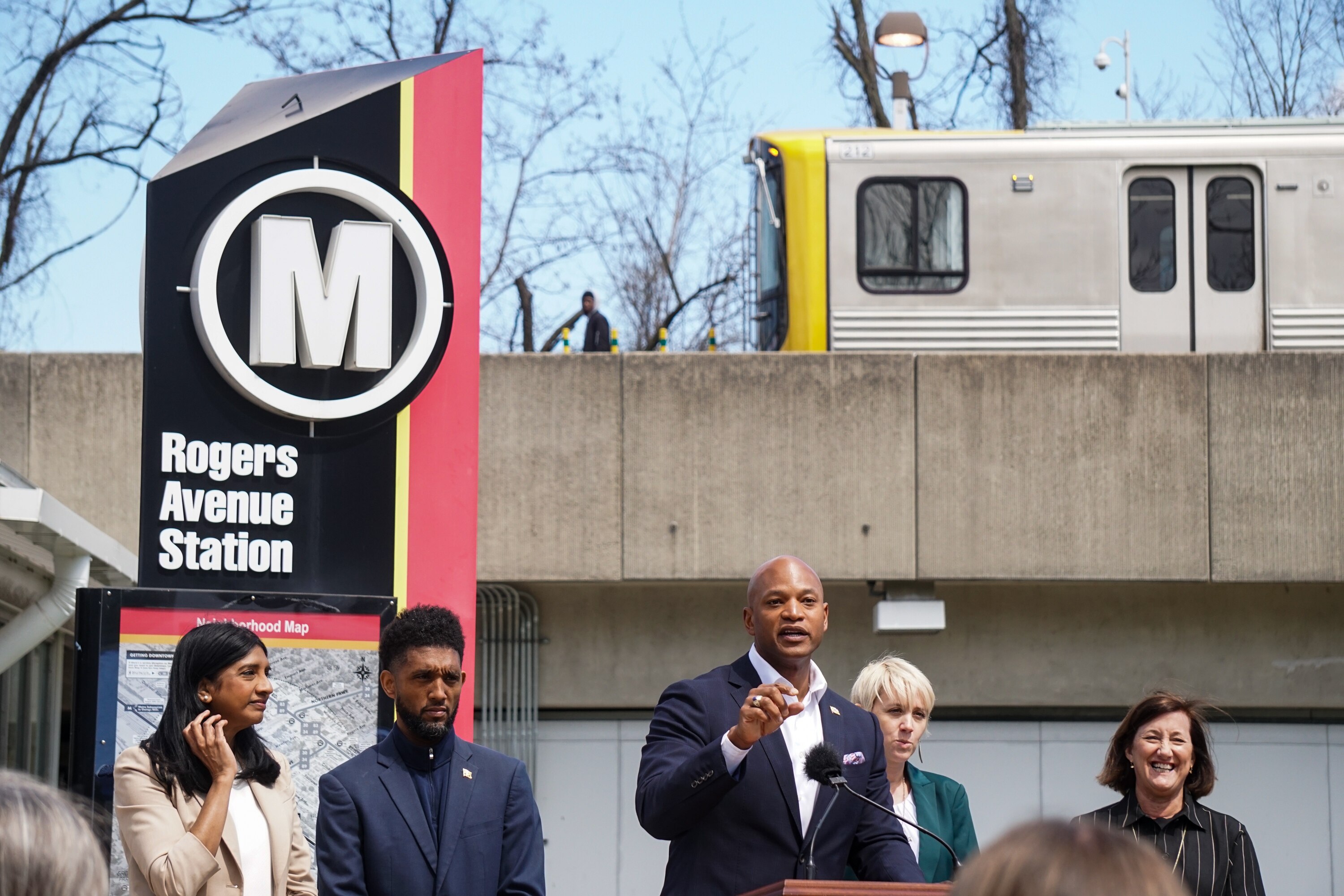
The state is revamping plans to redevelop land at Light Rail and Metro Subway stations by working with the private sector to create new housing and retail hubs within walking distance to major public transit lines.
The new regional strategy was announced Monday at the Rogers Avenue Metro station in Northwest Baltimore by Gov. Wes Moore.
The state owns 134 acres of land across 17 different transit stations in Baltimore City and Anne Arundel and Baltimore counties, largely surface parking lots. Moore said the land is “just sitting there” and could accommodate up to 5,000 new homes while generating roughly $1.4 billion in added tax revenue.
The new strategy comes as the state faces a shortage of housing units and Marylanders list housing affordability as a major concern. Most respondents to a January statewide survey indicated that they supported building more housing near public transit stops.
It also comes after a big investment in Baltimore’s lone subway line, which stretches from Owings Mills to the Johns Hopkins Hospital campus in East Baltimore, with new trains rolling into service throughout the year and a new control system that officials say will significantly improve its reliability. There’s also a $1.4 billion rebuild of the Light Rail on the horizon.
Moore lamented the rising price of gas that Marylanders are seeing amid the U.S. and Israel’s war in Iran. As Metro trains came and went on elevated tracks behind the podium, Moore said the development strategy is about creating more opportunities for families and connecting where they live with where they work, study and worship.
“And that means thinking about what we build around transit,” he said.
“Transit-oriented development,” or TOD, aims to create a symbiotic relationship with public transit: making more places — from grocery stores to apartments to cultural sites — accessible by a bus or train ride, which encourages more people to ride them.
Washington, D.C.’s aggressive approach to TOD has helped make the nation’s capital a city where it’s possible — and some say enjoyable — to live without a car. Meanwhile, Baltimore’s Light Rail and Metro lines remain stuck in the ’90s with stations designed largely as park-and-rides.
“When housing, jobs and services are within walking distance of transit, access is built in, not out of reach,” said Lt. Gov. Aruna Miller, a former transportation engineer.
She highlighted that most Marylanders spend more than half of their monthly budgets on housing and transportation costs, and called transportation a civil rights issue.

The new strategy — available online here — will serve as a guiding document for joint development between the state, local governments and private companies.
It includes overviews of each station’s market readiness, zoning and land availability, as well as available financing strategies like tax increment financing, incentives tied to enterprise or opportunity zones, and a strategic loan fund administered by the state’s economic development corporation.
Moore also announced a request for qualifications from developers for the Rogers Avenue site, which has nine acres that officials believe could host as many as 400 new housing units.
“Welcome to my subway station,” said Baltimore Mayor Brandon Scott, earning laughs from the crowd.
Scott, who grew up down the road from Rogers Avenue and took the Metro to high school everyday, applauded the effort to transform empty space into “something that actually serves our residents.” He pledged to join the state’s plan to drive growth in areas historically impacted by restrictive housing policies.
Both Moore and Scott highlighted Baltimore’s efforts to reduce the number of vacant properties across the city. Baltimore has 11,800 vacant structures — the lowest number the city has had in decades, they said.
Kickstarting redevelopment at Rogers Avenue comes nearly two years after the Maryland Department of Transportation released a concept plan for the nearby Reisterstown Plaza Metro Station that shows townhomes, apartment buildings, and a redesigned, pedestrian-friendly Wabash Avenue. MDOT officials hope to have a master development agreement signed for Reisterstown Plaza before the end of the year.
Beyond the Light Rail and Metro, MDOT also is planning redevelopment at multiple commuter rail stations along the MARC Penn Line that connects Baltimore and Washington, D.C.
In Annapolis, lawmakers also are considering a bill that would streamline zoning for mixed-use developments around train stations across the state. Moore said he’s confident lawmakers can pass the bill, and that it will help drive down housing costs over time.




Comments
Welcome to The Banner's subscriber-only commenting community. Please review our community guidelines.