
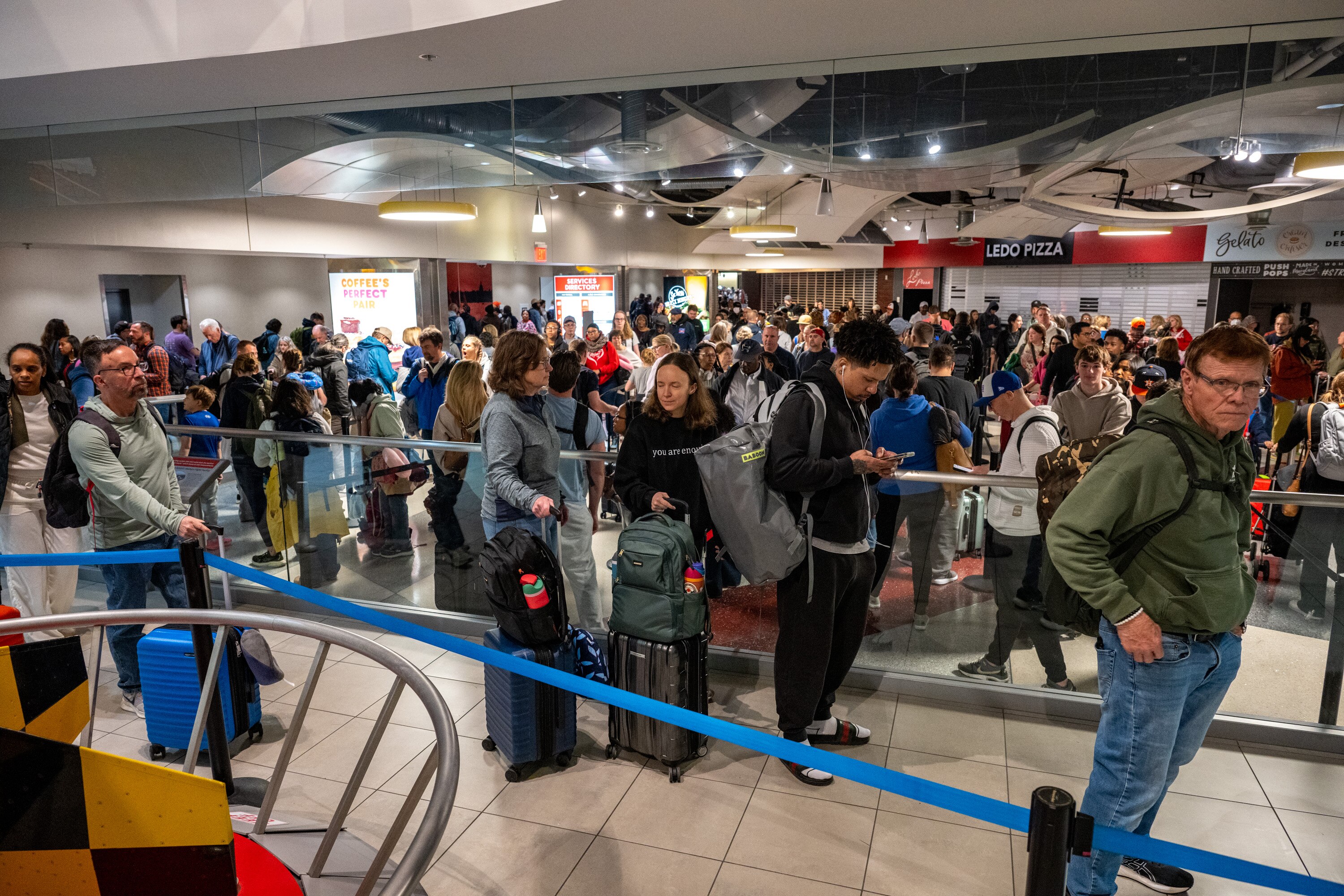
Over the weekend, roughly a third of the Transportation Security Administration agents scheduled to screen passengers at Baltimore-Washington International Thurgood Marshall Airport called out of work as the airport experienced its highest passenger counts of the year.
It was a moment that tested the airport’s ability to provide real-time information about wait times. Some travelers complained that the airport left them in the dark. Others recognized it as a symptom of a larger problem.
“This is an unprecedented time,” said Shannetta Griffin, executive director and CEO of the Maryland Aviation Administration, which oversees BWI, in an interview Monday.
Security line wait times at BWI have fluctuated dramatically amid a partial government shutdown that has forced TSA agents to work without pay. As thousands call out of work across the country to make ends meet with another job, travelers have been funneled into fewer checkpoints, the lines growing especially long during morning and evening windows with denser flight schedules.
On Sunday, BWI experienced the highest call-out rate of any airport in the country at 38.5%, according to figures provided by the Department of Homeland Security, which oversees the TSA. It fared worse than two airports in Houston, which previously saw single day call-outs approaching 50%.
Griffin heaped praise on the TSA agents working Maryland’s premier airport while recognizing how the spring break travel season created more pressure during a fraught couple of weeks.
Read More
“I think this was just kind of a perfect storm,” she said.
Last week, BWI had suspended real-time tracking of the estimated time to get through security lines on the airport’s website, and began telling flyers to arrive four hours early on Saturday and three hours early on Sunday, much earlier than the normal two-hour recommendation.
Travelers turned to The New York Times, social media and even online forum Reddit to scrounge together what on-the-ground information they could. Ultimately, all apprehensive travelers could do was arrive early — and hope they made their flights. Some didn’t.
BWI uses LiDAR, a technology that measures changes in light to detect objects and motion, for its real-time line-tracking feed. The LiDAR sensors stationed around the security checkpoints see how quickly people are moving through the lines and runs that data through an algorithm to predict wait times.
But on March 22, the first day BWI saw major backups, lines stretched well beyond the queuing areas covered by the LiDAR sensors, and the technology could no longer provide a precise reading.
“We didn’t think that level of non-reliability should be up on the board,” Griffin said of the decision to pull the wait time estimates from the website.

Such data is critical information that a lot of travelers rely on, said Bob Westgate, an instructor in airline planning and operations at the University of Colorado Denver. While it’s on passengers to arrive early and do basic preparation for the security line (no water in the bottle, identification ready, etc.), airports can help the traveling public by sharing those wait times publicly, as well as informing them about options like TSA PreCheck and CLEAR that could move faster.
“People like options, so give them options,” Westgate said.
Over the past week, public communications from BWI have contained little specific information about security lines, besides saying that wait times are long and recommending that airport patrons arrive extra early.
Wait times stretched to four hours and longer at points Friday, with some unlucky passengers missing flights. But lines at BWI have been short to nonexistent throughout much of the ongoing shutdown, and people traveling outside of peak hours have been surprised at what they found.
“I saw on the news yesterday that it was really bad, that the lines were long, so I said, ‘Let me get here early,” said Lekisha Hodges, of Fort Washington, who arrived more than three hours before her 1 p.m. flight on March 23. When she spoke with the Banner around 10 a.m. that morning, BWI’s display boards showed a less than five-minute wait for security.

“I felt relieved,” she said, “but why did I get here so early, because I also don’t like sitting around waiting.”
Griffin said Monday that things appear to be approaching normal again and that her team will restore real-time security wait data once they believe TSA checkpoints have returned to routine operations.
Two passengers looked confused as they walked to Checkpoint C on Monday, asking where to find the line for security screening. One of them smiled when an airport official told them there was none.
Congress, still gridlocked over reforms to immigration enforcement, left Washington, D.C., on Friday without reaching an agreement to fund the Department of Homeland Security, which oversees the TSA. Democrats and Republicans have traded barbs blaming the impasse on each other and are now on a two-week recess. All the while, TSA workers have missed multiple paychecks during their second government shutdown in less than a year.

On Friday, President Donald Trump signed an executive order directing DHS to pay TSA workers. Agents should be seeing payments as early as Monday, according to acting Assistant DHS Secretary Lauren Bis.
But it remains unclear whether that will stabilize the ranks at the TSA, where hundreds of agents across the country have already quit.
Despite the challenges of the past couple of weeks, Griffin is “really proud of how staff and partners came together, including TSA.”
BWI staff, including medical personnel, have been dispatched around the airport to help with the long lines, hand out water and snacks, and assist passengers with mobility needs.
Griffin knows some travelers are frustrated but appreciates the courtesy and compassion she’s seen both from her staff and airport patrons.
“Be patient with us and know that the airport is here to support you,” she said.
When things return to normal, Griffin said her team will learn from the past couple of weeks about ways to improve. But she’ll also be knocking on wood, she said, in hopes that this doesn’t happen again.
The Banner’s Clara Longo de Freitas contributed to this article.





Comments
Welcome to The Banner's subscriber-only commenting community. Please review our community guidelines.