
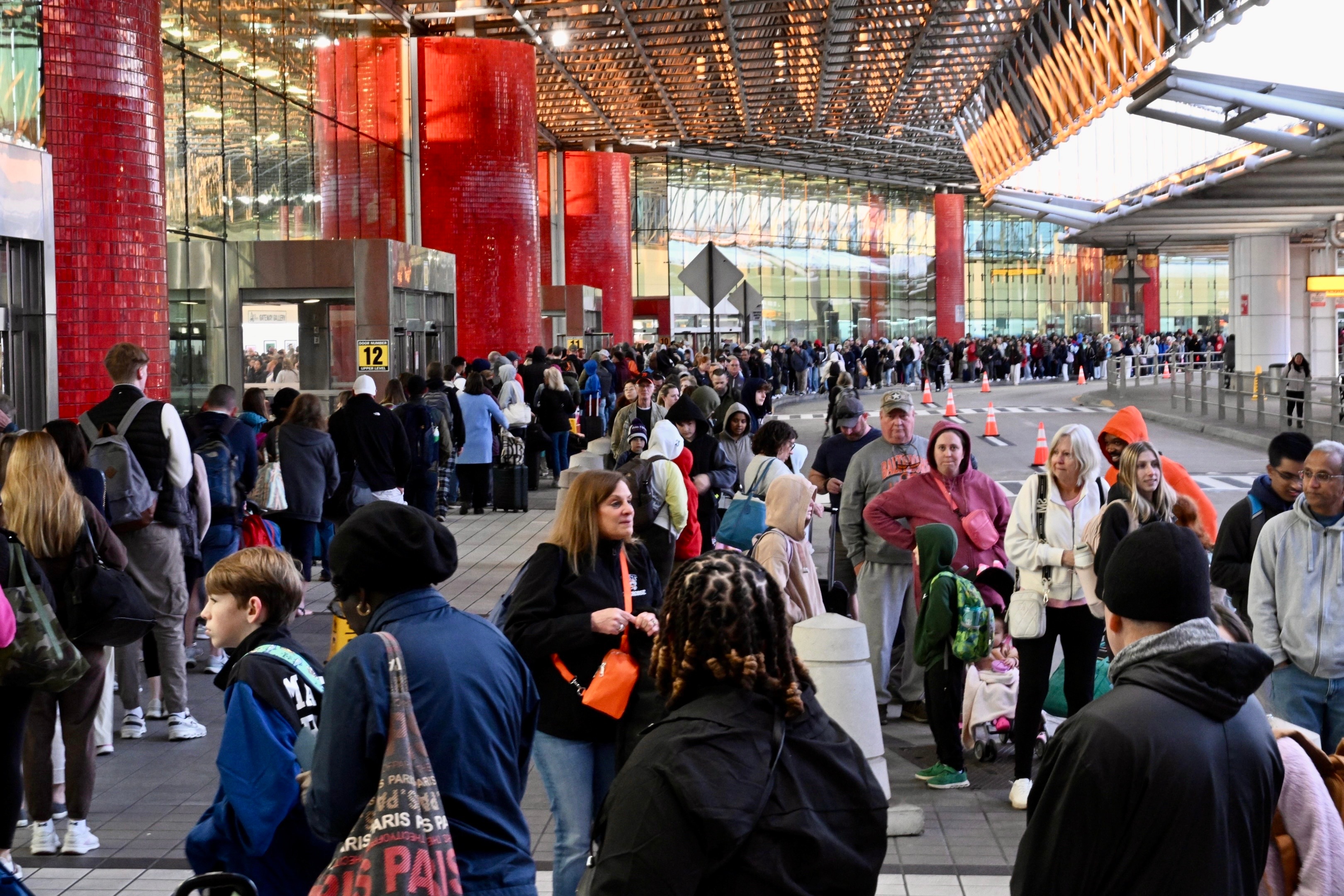
Baltimore’s “easy come, easy go” airport was not so easy as spring break travel crowds swamped the place Friday and Saturday, with security lines stretching more than four hours long and drawing national and international attention.
Baltimore-Washington International Thurgood Marshall Airport was hit hard by staff callouts among the Transportation Security Administration agents who screen passenger at security checkpoints.
The absences came as nearly 29,500 passengers departed from BWI on Friday, the highest number since just before Christmas, airport spokesperson Jonathan Dean said. Flight volumes remained steady over the weekend, he said.
BWI was hardly the only airport experiencing problems.
Amid the ongoing partial government shutdown over immigration enforcement, more than 500 TSA security agents have quit and hundreds have called out of work every day, hitting some of the nation’s biggest and busiest airports. Smaller airports that use private security have fared better.
Though it’s not entirely clear why BWI has been disproportionately impacted, agents across the country have missed multiple paychecks and are looking for ways to make ends meet.
Southwest Airlines accounted for roughly 7 in 10 of BWI’s flyers last year, meaning far more people are funneled into the security checkpoints going to that carrier’s gates.
At peak travel times, when more people are going through fewer security checkpoints due to TSA staffing issues, the result is epic lines.
It’s not easy working without pay
Although BWI is a smaller, regional hub, its callout rate Saturday was the third highest in the nation, behind only Houston’s two airports, where four-hour waits also were reported.
On Saturday, the Department of Homeland Security reported, 33.5% of BWI’s TSA agents did not report to work, more than at the major hubs of Atlanta and New York’s JFK.
Time-lapse: Massive lines at BWI
BWI’s callout rate was a slightly higher 35.6% on Friday, when security lines also snaked outside along passenger drop-off, and it reached as high as 38% earlier in the week. The national average, which has hovered around 12% for most airports, was 10% on Saturday.
This is the second time in less than a year TSA agents have had to work without getting paid. Some may be able to rely on savings to pay bills, but many have felt forced to get a second job or pick up gig work like driving a ride-share to cover rent and put food on the table.
When asked about the high callout rate Sunday, two workers with the Department of Homeland Security, which oversees the TSA, said Maryland’s high cost of living might be contributing to their colleagues’ absence. The workers declined to provide their names because they were not authorized to speak to the news media.
Baltimore is more affordable than Washington, where Reagan National Airport hasn’t seen as many TSA staff members call out. But everyday costs for housing, transportation and groceries have gone up across the state, and Marylanders are feeling it.
“People have told me they’re down to their last $80, they’re down to their last $50,” Robert Williams, a 16-year TSA agent at BWI, said on WYPR’s “Midday” last week.
Charities such as the Maryland Food Bank have stepped in with donated meals and gift cards to help with the basics. But, for major expenses such as a mortgage, school payments or auto repairs, workers may be left looking for another job.
Congress failed to fund DHS before leaving Washington last week, and President Donald Trump signed an executive order to pay TSA agents as early as Monday.
“During this time, over 500 officers have quit, and thousands more have been forced to call out because they can’t afford basic necessities like gas, childcare, food, or rent,” acting Assistant DHS Secretary Lauren Bis wrote in an email Sunday.
Is it all just politics?
In 2026, even airport security lines have become politicized.
“This is now the longest government shutdown in history — the Democrats must stop playing political games and reopen DHS now,” Bis said.
Congressional Democrats largely offered a similar message.
“For weeks, we have been urging Republicans to stop blocking funding” for TSA and other arms of DHS that are not involved in immigration enforcement, Sen. Chris Van Hollen wrote in a statement Friday. “Their inaction led to worsening chaos at airports across the country and considerable hardship for unpaid federal workers.”

From DOGE to delayed pay, some government workers have felt increasingly like political pawns during the second Trump administration. They wonder how much more they can take.
Now, Immigration and Customs Enforcement, perhaps the most polarizing federal agency, is stepping in to assist, including at BWI.
Some airports haven’t seen the same chaos because they use privately contracted security companies instead of TSA workers. Workers at those airports are getting paid, while the companies that employ them are feeling the funding crunch, according to CNN.
Critics of Trump and other Republicans have said the shutdown is playing into a broader strategy of privatizing public services, a goal of the controversial Project 2025.
In an emailed statement, Dean, who’s also the spokesperson for the Maryland Aviation Administration that oversees BWI, said the airport has not considered switching to private security. He noted that BWI was the first U.S. airport with a full federal team of airport security personnel in April 2002.
“For a great many years, we have worked closely with the professional, dedicated personnel of the TSA to help ensure the safety and security of the traveling public,” Dean wrote.
He deferred questions about staffing numbers and callouts to TSA.
Did it get so bad because BWI is busier?
The shutdown began after the busy holiday season but has stuck around long enough to impact spring break.
The classic recommendation of arriving two hours before a scheduled flight stretched to three and even four hours at BWI, and some travelers elected to get to the airport even earlier as social media was abuzz with videos of long lines.
On Saturday, 634 flights came and went through BWI’s tarmac, according to FlightAware, roughly on track with the same date the previous two years. On Friday, there were 633 flights.
For the 60-70% of BWI’s TSA workers who show up, that means more work and tougher days for everyone. And it’s impacting morale, said Williams, the TSA agent.
“As the shutdowns get more frequent ... uncertainty has increased quite a bit,” Williams said. “I don’t know many who will work a job and go for 30 days or more without receiving a paycheck.”
It’s expected that it will be days or even weeks before air travel in the U.S. returns to normal, depending on whether TSA agents stop calling out.
Banner reporter Bria Overs contributed to this article.





Comments
Welcome to The Banner's subscriber-only commenting community. Please review our community guidelines.