
Brittney Cheshier’s son had questions. The 6-year-old overheard her talking about a man who had been found dead just outside their front door.
“How did it happen?” her son asked.
“Honestly,” Cheshier said, “they found him hanging from a tree.’”
“Wow,” the boy replied. “Why?”
This public suicide of a Black man in Upper Marlboro this week has forced difficult conversations about mental health in the historically Black community while thrusting it into a national conversation about how such tragedies evoke a painful history of lynchings.
Prince George’s County Police said an initial investigation found no foul play. The state medical examiner has determined the man died by suicide. But, with the roadside scene triggering comparisons to the public killings of Black Americans that have stained the nation’s history, officials sprang into action to dispel rumors and parents like Cheshier scrambled for child-friendly explanations.
Public health experts who specialize in suicide prevention say parents should be proactive about discussing traumatic events and emotions with their kids.
When Cheshier was talking to her son, the medical examiner had not released an official cause of death. So Cheshier told him she didn’t have all the answers — someone could have harmed the man, or he could have been struggling with his mental health.
“We sort of brought it back to communicating, making sure your mental [health] is good and also being OK with opening up and talking about stuff,” said Cheshier, 38. “I try to be as honest and direct as I can, even though he’s still young. Like, hey, you’re going to find out one way or another, so I’d rather tell you.”
Discovery of the man’s body Sunday morning sparked alarm in the historic Black community, known as Little Washington, and throughout the county.
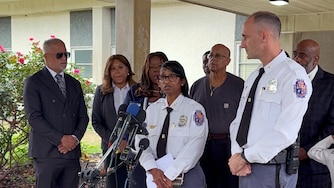
To address growing speculation, County Executive Aisha Braveboy and other officials held a news conference at Arrowhead Elementary School.
In the middle of her remarks, flanked by council members, police officials and members of the Little Washington Civic Association, Braveboy learned of the medical examiner’s ruling.
Still, some members of the community who attended the Monday afternoon session remained skeptical. The death remained under investigation, according to Prince George’s County Police. Police said they were in touch with the man’s family, who shared that he had “prior issues and difficulties,” while the medical examiner said there was no trauma to the man’s body.
Part of the reason for the skepticism is the violent and racist legacy of lynchings in the United States, and more recent deaths by hanging, including a man who was found near a D.C. police station this year. These deaths are often ruled as suicide or undetermined.
“I am not going to allow this incident to be part of theory, innuendo and folks who want to spew untruths,” Braveboy said before leading the group on a walk from the school to the site where the man was found. “We will tell the truth, we will be transparent, which we have been, and we will take care of our community.”
Council member Danielle Hunter, who represents Upper Marlboro, spoke with The Banner about the conversation she had with her 17-year-old son.
“I explained to him, being fully transparent, because he’s 17, that this was a hanging in the community,” Hunter said. “We don’t have all the facts, but we have enough to say, or to believe, that it was a possible suicide.”
Hunter said her son saw photos of the man circulating on social media and had started reading comments online about the incident.
She said she asked him if he understood what suicide is (he said they talk about it in school) and emphasized that the comments on social media can’t always be trusted.
She told him: “When you see something that disturbing, to refer to Mom and Dad and detach from social media,” Hunter said. “And that’s what he did.”
But, she added, she didn’t bring up the racist legacy that this sort of death evokes. It was late, and he was about to go to bed.
“I didn’t want him to go to bed with that,” Hunter said. “Even though he does know the history, but that wasn’t the time for me to have that conversation.”
Michael Lindsey, a youth mental health researcher who is dean of the New York University Silver School of Social Work, grew up in the area. His mother’s house was about five minutes from the scene, he said. One aspect of his research has been how to speak to kids who know someone or witnessed a person who took their own life.
“Sometimes parents are reticent to talk about it because they feel they’ll be planting ideas in the child’s head. At the same time, silence can signal that it’s not OK to talk about your feelings or reveal that they’re struggling,” he said. “So that’s why it’s important to have that conversation.”
Lindsey said it’s better for parents and caregivers to ask kids how they’re feeling, rather than how they’re doing. That will allow kids the chance to articulate their emotions, as opposed to giving more closed-ended responses.
He also said it’s important to be persistent and, if a parent or caregiver notices changes in a kid’s behavior or hears them expressing self-harm, it’s time to seek professional help.
“I often tell Black parents who are waiting to find a Black therapist, you could be waiting for Superman,” he said. “It’s important to get the child connected to treatment without delay.”
Paul Nestadt, medical director of the Johns Hopkins Center for Suicide Prevention, echoed much of Lindsey’s guidance.
For kids who’ve seen traumatic images, such as photos of the man in Upper Marlboro, parents should acknowledge the images are disturbing and be truthful about the fact that the death was a suicide, but they shouldn’t provide details about the method.
“Research shows that, when you report on the method in detail, that tends to increase chances of that method being used,” he said.
It’s also helpful to tell them sadness and anxiety can be normal after seeing something disturbing, Nestadt said.
Lindsey and Nestadt noted that studies have shown the rate of suicide and suicide attempts among Black youth has increased, while it has decreased or remained static among other racial and ethnic groups.
Research led by Lindsey, for example, drew from data from 1991 to 2017 showing the rate of self-reported suicide attempts increased by 73% for Black teens; the rate increased to 144% when he expanded the time frame to 2019.
Cheshier said her son did not appear to dwell on the tragic death down the road. Her neighbor, Ashley Ritter, said some of her kids, ages 15 and 12, reacted much the same way.
“That’s actually sad that they’re so desensitized,” Ritter said. “They see so much nowadays. It’s like, ‘Oh, it happens.’”
For Lindsey, that could present another opportunity for parents, whom he encourages to be persistent in speaking to their kids about traumatic experiences and mental health.
“In some of my research, kids have told me that they want their parents or loved ones to pull it out of them,” he said.
If you or someone you know is experiencing suicidal thoughts or behavior, call or text 988 to contact the 988 Suicide & Crisis Lifeline.



Comments
Welcome to The Banner's subscriber-only commenting community. Please review our community guidelines.