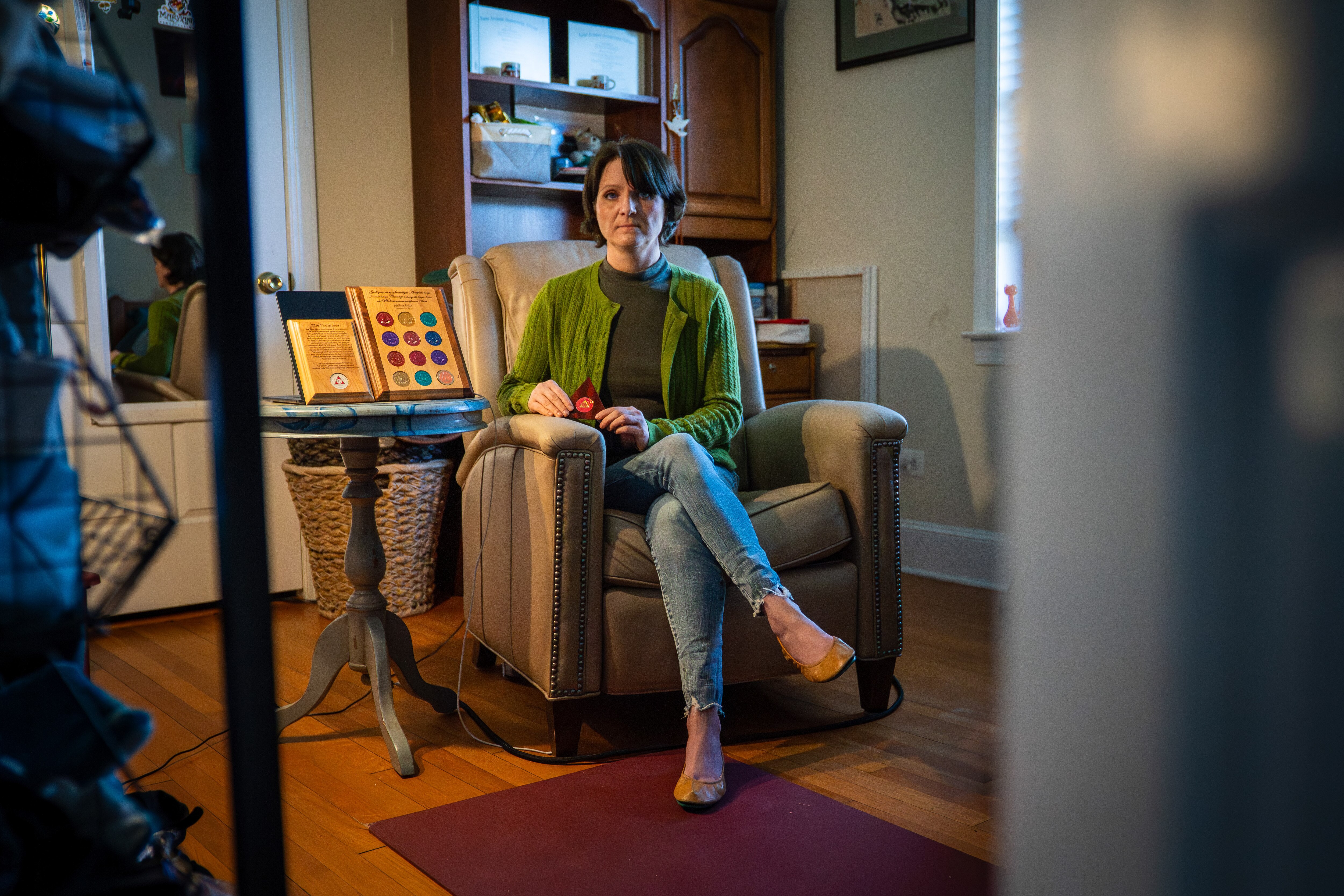
Melissa Grim’s phone lights up with texts from a job recruiter every few weeks: Baltimore-area addiction treatment programs are hiring.
Though the 42-year-old Annapolis resident graduated with a degree in addiction counseling last fall, she has to pass up these job opportunities.
That’s because she’s been waiting for six months — with no end in sight — for the Maryland Board of Professional Counselors and Therapists to process her application to become a licensed counselor.
Grim has had to put on hold her dream of helping people whose lives have been upended by drugs or alcohol — like hers once was. And she’s not alone.
Across Maryland, people have reported waiting half a year or more for their applications to move forward. The board, an arm of the Maryland Department of Health, plays a critical role in overseeing some 13,000 practitioners in the state but has been plagued by dysfunction for years.
Long-standing problems with retaining staff and tracking paper records have caused the board to fall short on its most essential responsibilities, government reports show. That includes not only vetting applicants, but also investigating complaints against practitioners, which can include serious allegations of sexual misconduct, unlicensed practice and fraud.
Read More
The board has taken steps to reduce application and complaint backlogs, Department of Health spokesperson Amanda Hils said in an email.
It is working to streamline the review of applications and prioritize time-sensitive cases, she said, adding that the launch of a digital application process in June is expected to improve efficiency.
The board oversees several types of counselors, including those who treat alcohol and drug addiction. Ted McCadden, director of the Community College of Baltimore County’s Human Services Counseling program, sees them as an important defense against an ongoing overdose crisis that killed more than 1,300 people in Maryland last year.
“We are a profession that is trying to combat the opioid epidemic with one hand tied behind our back because we can’t process enough qualified clinicians into the field,” McCadden said.
Grim, the aspiring counselor, said she was inspired to pursue a career in the field by her own experience.
Throughout her life, she turned to alcohol to cope with multiple hardships: sexual harassment in graduate school, an abusive relationship and undiagnosed mental health disorders. By 2017, Grim said, she was drinking a box of wine every day and a half and regularly woke up in a panic after blacking out.
Around that time, her family helped her get into a recovery program.
“It was the launching pad of seeing people worse off than you,” Grim said of finding her community through treatment. “And inspiring a little bit of, maybe I can help you or we can help each other.”
She was giddy when she mailed her application to the counseling board. But “I’m pretty discouraged at this point,” she said.
The process should only take about 45 days, according to an email she received from the board. But Grim has been waiting more than 180.

Sara Meinsler, professor of human services at Anne Arundel Community College and Grim’s former teacher, said she has seen countless graduates get caught in a bottleneck created by the board’s backlogs.
Despite a hot job market, “students have waited to get promotions, waited to get jobs,” Meinsler said, adding, “I don’t really understand why it has to be this way.”
She encourages applicants to email and call the board repeatedly, even though staff return messages infrequently. She has even told people to complain to state officials.
The board recently announced a new online licensing system will launch on June 20 to replace paper applications. The state has been urging the board to modernize for at least a decade. The board noted however that the transition to a new system may temporarily increase response and processing times.
“That’s a miracle,” Meinsler said. “I’m so happy because they’re finally entering into this century.”
Major problems with the board have been detailed in state reports dating back almost two decades. The most recent was published last September.
Between 2020 and 2024, the number of people issued credentials by the board increased by more than a third, according to the report. But during that time, the board cycled through eight executive directors, each staying in the position on average for only six months. And the number of staff positions fell by nearly 20%.
As a result, the board struggled to keep up.
On average, it took about three months for the board to approve applications, according to the September report. But nearly 20% of applications expired before the board moved to either approve or deny them.
An audit last year found that out of 290 open complaints, almost 70% had been open longer than the state-designated investigation time frame of six months; nearly 30% had been open for more than two years. This is significant, according to auditors, because licensed individuals can practice until investigations are completed.
Additionally, the board doesn’t have the staff or resources to go after illegal, unlicensed practitioners, an ongoing problem in the state, a report found.
Some patients told The Banner they were enrolled in programs that hired virtual counselors who lived in other countries, such as Nigeria, and did not appear to be licensed or certified in Maryland. It is unclear how widespread this practice is. When it was described to board Executive Director Tomiloba Olaniyi-Quadri last year, he said it could be a violation of state law.
Olaniyi-Quadri declined a recent interview request and referred questions about the board’s shortcomings to the state health department.
Hils, the department spokesperson, wrote in an emailed response that the board takes the issue of unlicensed practice “very seriously” and that related complaints or reports are investigated or referred to other entities.
She added that the board has closed over 320 investigative cases since February 2025 and is expediting complaints that involve potential harm. It is also working to fill vacancies and converting contract positions to permanent ones to improve staff retention.
The Board of Professional Counselors and Therapists is not the only health occupation board that has come under scrutiny in recent years.
In 2024, The Banner reported on major backlogs in applications and complaints at the state Board of Nursing. Last year, Gov. Wes Moore ordered an independent review of the Board of Morticians and Funeral Directors after inspectors repeatedly found decomposing bodies awaiting cremation at a Charles County crematory.





Comments
Welcome to The Banner's subscriber-only commenting community. Please review our community guidelines.