
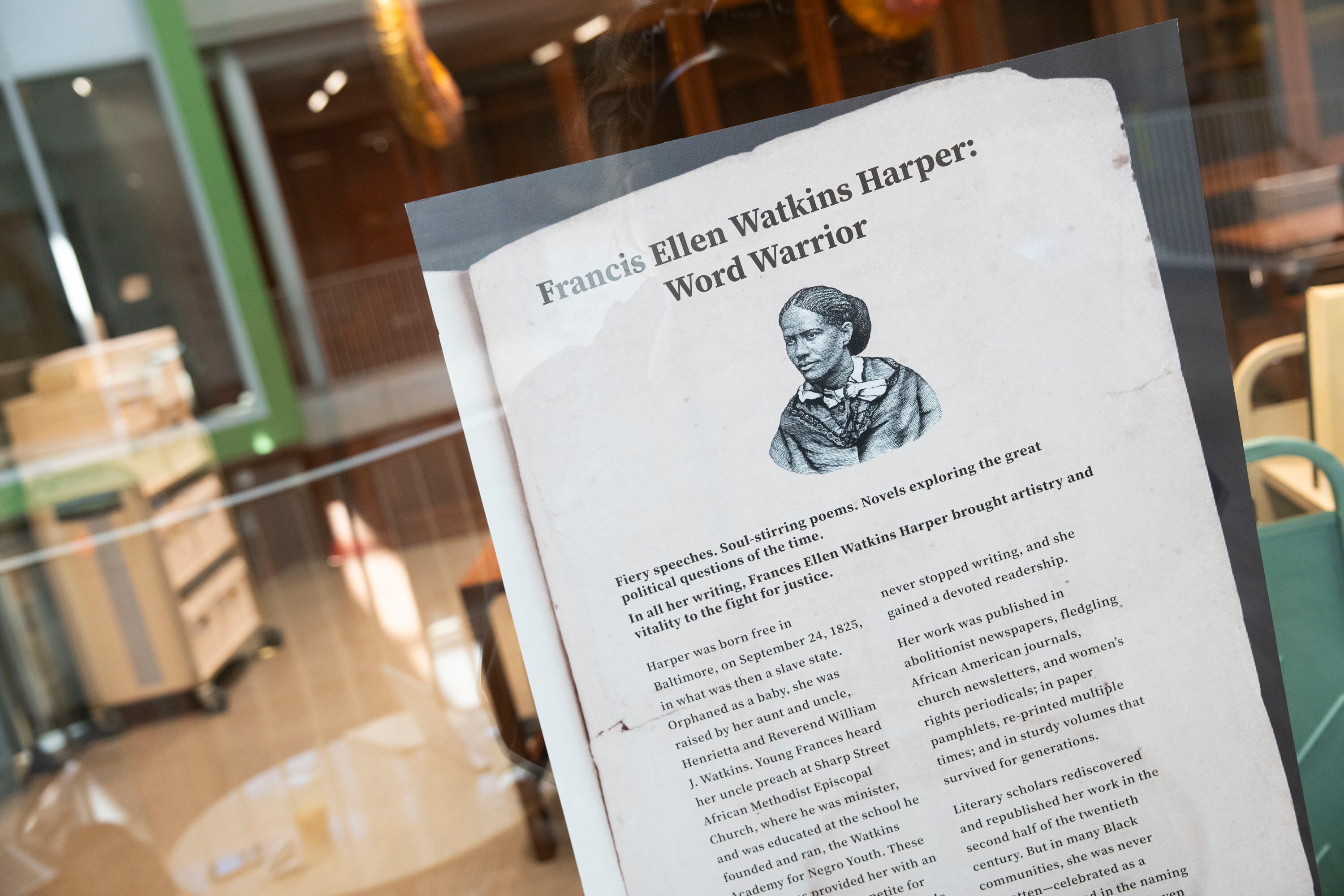
Centuries before Camden Yards defined South Baltimore — back when the shackles of the enslaved, marching to steamboats bound for the Deep South, echoed nearby — Frances Ellen Watkins Harper lived on Camden Street.
Harper, a Black woman born free in a slave state in 1825, rose to prominence in the 19th century as an abolitionist, suffragist and prolific writer. She was the first African American woman to publish a short story and among the first Black published poets and authors.
But Harper’s legacy remains largely forgotten.
“Here in Baltimore, where she’s originally from, she’s not recognized,” said Betty Bland-Thomas, president of the Sharp Leadenhall Community Association, which represents South Baltimore’s oldest continuous Black neighborhood, where Harper is from.
The Billie Holiday Center for Liberation Arts at the Johns Hopkins University is trying to change that.
Read More
The center is hosting an event Thursday evening honoring the 200th anniversary of Harper’s birth at the Baltimore Museum of Art, featuring a lecture by history professor Martha Jones, musical performances by the Jonathan Pettus Chorale and a one-night, pop-up exhibit called “We Rise: The Life of Frances Ellen Watkins Harper,” curated by Raynetta Wiggins-Jackson.
“She was unbending in public to divide the issues of gender and racial equality,” the center’s director, Lawrence Jackson, said of Harper.
The antebellum period, during which Harper came of age in Baltimore, threaded the needle between revolution and submission in a slave state, Jackson added.
“It’s not surprising that, you know, Thurgood Marshall, Pauli Murray and Clarence Mitchell, that they’re all from the same community in Baltimore,” he said. “They’re inheritors of this political legacy that Harper is connected to.”
‘We are all bound up together’
Orphaned at the age of 3, Harper was raised by her aunt and uncle, Henrietta and Rev. William J. Watkins Sr., who shaped their niece’s political and social activism.
![Frances E.W. Harper, three-quarter length portrait, standing, facing front].](https://www.thebanner.com/resizer/v2/TLNYHJYFXRAHNPT7QVRMYJ37CU.JPG?auth=74c17c2e630348e685210bdfd022923d35ef8d60d3577dbe1171397cdd6c6fcb&quality=85&height=1366&smart=true)
Her uncle ministered at the Sharp Street Methodist Church and formed the Watkins’ Academy for Negro Youth, which educated 50 Black students annually, including Harper, in the neighborhood now known as Sharp Leadenhall.
“She’s growing up in this household with, at least for a time, you know, where her uncle is the most prominent Black abolitionist thinker and writer in the mid-Atlantic,” Jackson said.
Watkins’ tutelage and fierce anti-slavery and anti-colonial rhetoric left a deep impact on Harper, who at 20 years old published her first book of poetry, “Forest Leaves,” which highlighted her abolitionism. She published nine more volumes of poetry, a novel and several short stories and essays.
She taught in Ohio, assisted freedom seekers along the Underground Railroad in Pennsylvania, delivered sharp rebukes of efforts to divide African Americans’ and women’s rights, and founded the National Association of Colored Women in 1896.
Following the end of the Civil War, Harper delivered a speech at the National Women’s Rights Convention in New York City and called out white women for not acknowledging that the fight for equality between the sexes must include women of color.
“We are all bound up together in one great bundle of humanity, and society cannot trample on the weakest and feeblest of its members without receiving the curse in its own soul,” she said. “You tried that in the case of the Negro. … You white women speak here of rights. I speak of wrongs.”

Wiggins-Jackson, who designed the pop-up exhibit on Harper, said it’s maddening how many Black revolutionary voices are lost to time. That’s why the work of the Billie Holiday Center is so important, she said.
“It’s kind of mind-blowing who gets carried onto our current times and whose names don’t live as broadly,” she said. “We have Frederick Douglass, we have Harriet Tubman, but there’s so many like Harper we don’t know.”
Historic Sharp Leadenhall
Outside her rowhome, Bland-Thomas proudly points to one of 55 banners the Sharp Leadenhall Community Association commissioned celebrating the 200th anniversary of Harper’s birth.
The banners pay respect to three other Black heroes with South Baltimore roots: Douglass, Tubman and Elijah Cummings.
Harper’s “accomplishments didn’t get the kind of recognition that it should have, but I believe, when seeds are planted, they sprout and they grow,” Bland-Thomas said. “And that’s the effort this community is trying to do because we’re facing gentrification.”

Across from Bland-Thomas’ house there is a 250-unit luxury apartment building with an Orangetheory Fitness gym on the first floor.
Bland-Thomas said the home Harper lived in with her aunt and uncle was demolished to make way for Camden Yards in the 1990s.
The 76-year-old explained that Jackson and the work the Billie Holiday Center is doing inspired her to delve deeper into Harper’s history and champion her efforts.
“We feel like women’s advocacy is not being respected as it should,” Bland-Thomas said. “You know, we’re still having our children, raising our families, fighting the good fight,” and also fighting injustice.
It’s Jackson’s hope that Thursday’s event not only draws more attention to Harper’s legacy and connection to a storied South Baltimore neighborhood but also reminds the community that the Billie Holiday Center and its resources are available to preserve and promote Baltimore’s Black history.


He paused while reflecting on how much Harper achieved in spite of the era she grew up in.
“To be a thinking Black person in Baltimore in the 1820s and 1830s … you’re always at these cross purposes, you know. You’re having to make alliances with people that you know are actively working to see you gone, but at the same time they’re crucial to your ability to stay here,” Jackson said. “And, you know, that’s the circumstance that produces her.”
The following is Harper’s poem, “Ethiopia,” which opens the “Forest Leaves” collection she published in 1846.
ETHIOPIA
Yes, Ethiopia, yet shall stretch
Her bleeding hands abroad.
Her cry of agony shall reach
The burning throne of God.
The tyrant’s yoke from off her neck,
His fetters from her soul,
The mighty hand of God shall break,
And spurn their vile control.
Redeem’d from dust and freed from chains
Her sons shall lift their eyes,
From cloud capt hills and verdant plains
Shall shouts of triumph rise.
Upon her dark despairing brow
Shall play a smile of peace,
For God hath bent unto her woe
And bade her sorrows cease.
’Neath sheltering vines and stately palms,
Shall laughing children play,
And aged sires with joyous psalms,
Shall gladden every day.
Secure by night, and blest by day
Shall pass her happy hours,
Nor human tigers hunt for prey
Within her peaceful bowers.
Then Ethiopia, stretch, Oh stretch
Thy bleedings hands abroad,
Thy cry of agony shall reach
And find redress from God.


Comments
Welcome to The Banner's subscriber-only commenting community. Please review our community guidelines.