
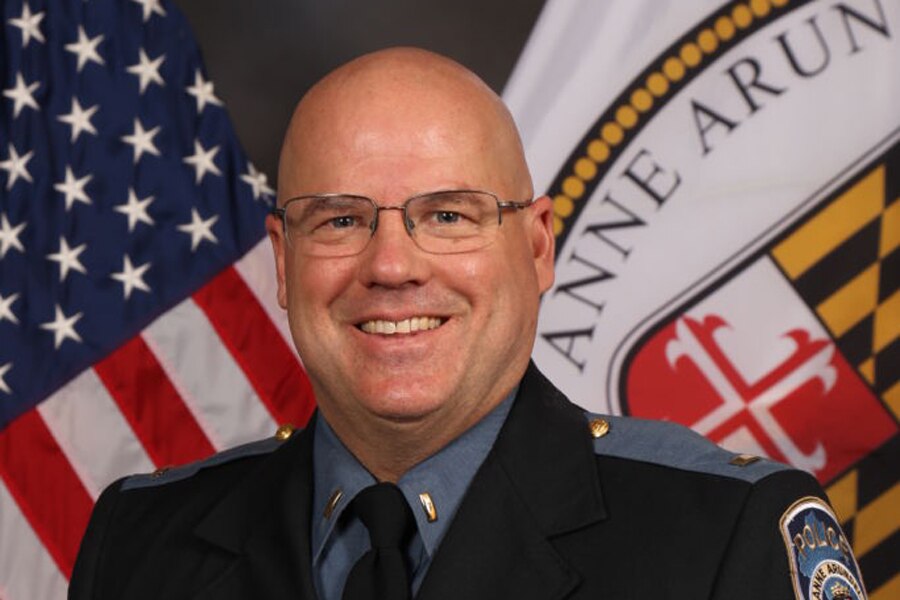
Lt. Steven Thomas, who led the Anne Arundel County Police Department’s Crisis Intervention Team to international renown, has been reassigned to mall security after being disciplined for giving his officers the discretion not to handcuff people with mental illness or addiction.
His apparent ouster from the unit he’s helmed for a decade sent shock waves through the county’s criminal justice and substance abuse and mental health treatment circles.
Melissa Owens, a longtime Anne Arundel County Public Schools high school teacher who has bipolar disorder, credits Thomas’ unit with saving her life on several occasions when she was in crisis. She said Thomas’ reassignment, and the apparent reasoning, “raises questions.”
“Why have an entire program where you train first responders in how to use this discretion, all the tools they have in action, and then tell them you can’t use them?” said Owens, who now helps train officers on responding to people in mental crisis. “That’s pointless to me.”
Thomas is now assigned to the Bureau of Community Services, Police Department spokesperson Justin Mulcahy said. He declined to answer other questions, including about what prompted the change. Mulcahy said an acting lieutenant was in charge of the crisis unit.
A 30-year police veteran, Thomas now works out of the department’s post at Arundel Mills Mall, said O’Brien Atkinson, president of the union that represents Anne Arundel police officers. Atkinson said he couldn’t discuss the reassignment but lauded Thomas’ leadership of the Crisis Intervention Team.
“Our CIT program has been recognized as one of the best in the nation and world, really,” Atkinson said. “I think he certainly was a big part of that.”
Under Thomas’ leadership, the police crisis team was declared the best in the world in 2020 by CIT International. His unit also received that organization’s first regional platinum certification in 2024. These accolades drew praise from elected officials and contributed to Anne Arundel County’s status as the gold standard for crisis response in Maryland.
Officers in Thomas’ unit wear light-blue collared shirts and complete specialized training on how to help people in crisis. They connect people with mental illness or addiction to treatment. They sometimes transport people deemed to be dangerous because of mental illness to hospitals for emergency evaluations. When there’s a terrible tragedy, like a homicide, CIT officers respond to the emotional needs of people affected by it.
The unit is a part of the county’s broader Crisis Response System, which includes mental health clinicians. That whole team plays a central role in Anne Arundel County District Court’s relatively new Mental Health Court program, which seeks to provide treatment instead of punishment for people charged with minor crimes.
Some credit Thomas with helping change the Police Department’s culture.
“Over the 10 years that we’ve been together, I’ve seen more and more buy-in to using our crisis system in patrol,” said Jen Corbin, Anne Arundel County’s director of crisis response.
Elizabeth Palan, the county’s public defender, said in a statement that Thomas exemplified the standard that “people in mental health crises deserve treatment, not handcuffs.”
When Palan’s office represented a teenager who was to be transferred from a psychiatric bed to adult jail, Thomas personally brought her before a judge and advocated for her to get treatment, Palan recalled. The judge agreed.
“We commend Lt. Thomas, but what he did should not be the exception,” Palan said. “Treating mental illness as a medical condition, responding with training and humanity rather than force — that must be the standard for every officer in every department."
Thomas regularly lectures on mental illness, teaching peers nationwide and judges in Maryland. He is a Mental Health First Aid instructor and serves on Maryland’s in-custody death review task force, the Maryland Suicide Fatality Review Committee and the Johns Hopkins University National Extreme Risk Protection Order Resource Center. He was also co-chair of Gov. Wes Moore’s public safety transition team.
Approaching retirement, Thomas recently filed as a Democrat to run to represent Anne Arundel County’s District 32 in the Maryland House of Delegates. His campaign platform centers on decriminalizing mental illness and expanding mental health care.
His campaign attorney, Daryl Jones, said Thomas could not comment on his reassignment because of Police Department policy, but Jones provided a copy of a “minor disciplinary action report” dated March 3.
According to the report, internal affairs investigators found Thomas violated policies when he admitted he gave his officers discretion on handcuffing people with mental illness and addiction, saying that by doing so he knowingly advised his officers to violate department regulations. A provision of the department’s written directive simply says “prisoners are to be restrained during transport.”
His punishment was two days’ lost pay. The document makes no mention of his transfer.
“It’s a program that he worked heavily on to bring such great acclaim to it, awards and everything else. It’s a shame they’re not embracing him with both arms,” Jones said. “They have an opportunity to get it right, and we’ll see if they get it right.”
CIT International and several other mental health organizations advise against restraining people with mental illness when possible. If it becomes law, a bill pending in the Maryland General Assembly would require officers to use such “best practices” when transporting patients for emergency evaluations.
“If I’m asking for help and I’m not combative and the mental health piece is not rearing its ugly head, why [use handcuffs]? I’m not saying they should ride in the front seat. They can ride in the back. But why take their dignity away?” said Angel Traynor, who founded the substance abuse recovery organization Serenity Sistas in Anne Arundel County.
Traynor recalled working with Thomas as opioid overdoses raged in Anne Arundel around 2015 and ironing out the kinks in the county’s Safe Stations program, in which anyone experiencing addiction can go to a county fire station and ask to be connected with treatment.
Traynor, who said she was “mad” about Thomas’ reassignment, has watched Thomas interact with countless people experiencing the “worst day of their life.” He treats them, she said, “as the human beings they are.”
“When I watch Steve in action, there is no stigma,” Traynor said. “There is no judgment. There is only: ‘How can I help you? What can I do to help you to make sure you’re safe?’”
Owens, the county teacher, said she was involuntarily hospitalized twice in 2017.
The first time officers transported her, she was not handcuffed, she said, and officers talked to her calmly on the ride.
The second time, officers handcuffed her and restrained her legs. She said she was made to lie down in the back of a police car and couldn’t see where she was going.
“Because of that, my symptoms went through the roof,” Owens said.
Once she got to the hospital, “I ended up knocking pictures off the wall. It was night and day,” she said.
Owens decried Thomas’ reassignment.
“It’s a really horrible way to send somebody out at the end of their career,” she said. “I think it’s tragic. It’s disheartening.”





Comments
Welcome to The Banner's subscriber-only commenting community. Please review our community guidelines.