
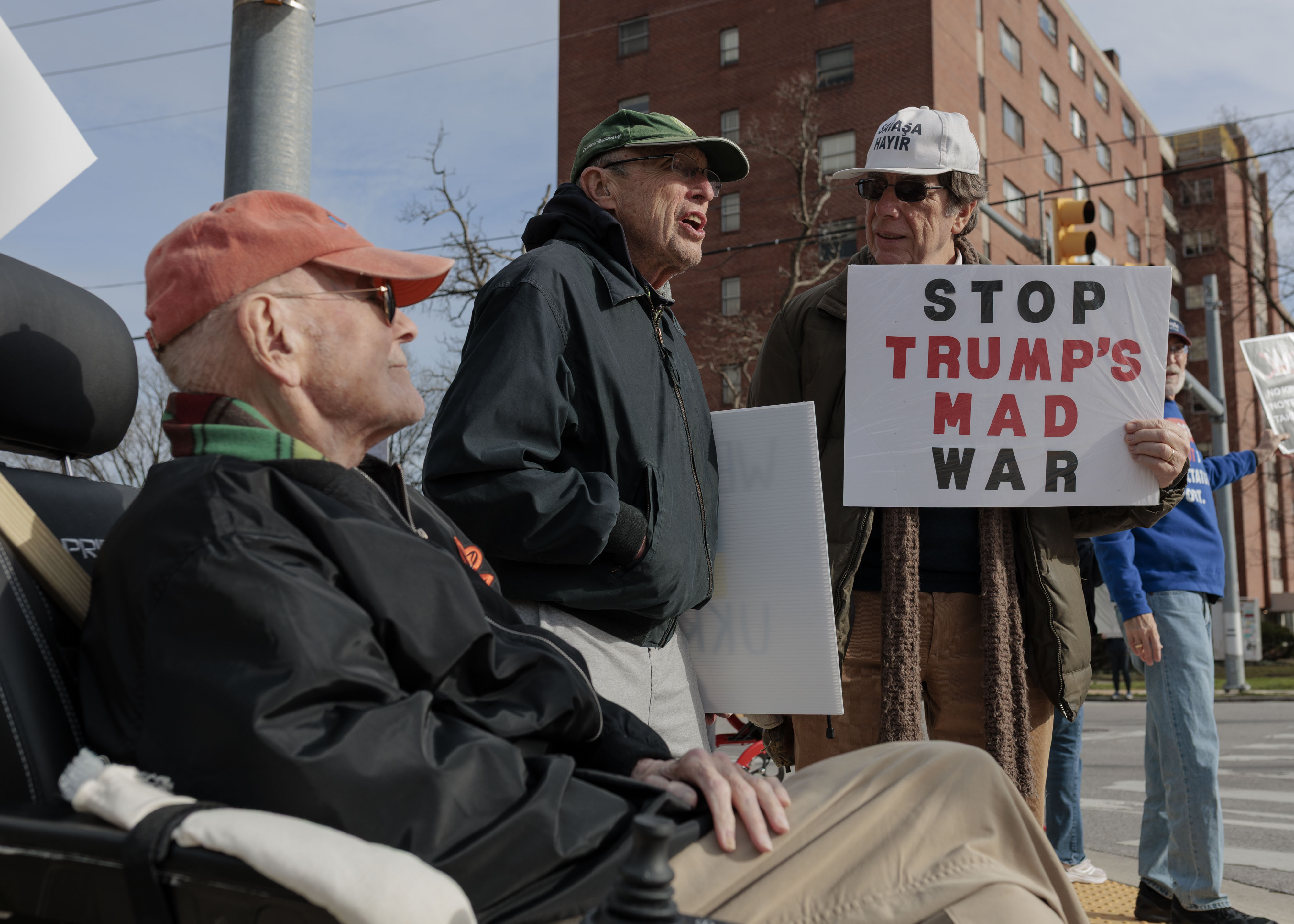
Dr. Barbara Rocah gripped her walker with one hand and raised a “No Kings” sign with the other as drivers honked support at a busy North Baltimore intersection Wednesday afternoon.
Rocah, 95, is one of dozens of residents of the Roland Park Place senior living complex who show up each week to protest President Donald Trump’s administration. While these seniors did not plan to spend their retirement at rallies and marches, they feel a duty to call out what they perceive as a dangerous erosion of democracy.
“I’m doing this,” said Rocah, a retired psychiatrist, “because it should be done.”
Some of the most ardent and dedicated critics of Trump’s second term, across the country and here in Maryland, are people in the president’s age bracket — those 65 and older. They are organizing rallies for Saturday’s No Kings Day, waving signs on street corners and urging their peers — and their grandchildren — to vote.
Data from polling site Yougov.org, recorded after October’s No Kings Day, showed that 25% of self-reported protest attendees were over 65, compared to 16.8% of the overall population in that age group.
Since its 2019 inception, We the Seniors, a progressive activist group, has grown to 63 chapters. Members of Third Act, a climate and pro-democracy senior organization, roll up at protests with rocking chairs, reclaiming a stereotype of old age. There’s a national group of Raging Grannies, a local circle of Grandmothers Defending Democracy, and a 130,000-member Facebook group called Grandparents Against MAGA/Fascists. (We are Gran-tifa).

“The current older population is healthier than previous generations. They’re more educated than past generations,” said Takashi Yamashita, a gerontology and sociology professor at the University of Maryland, Baltimore County. “And the baby boomers,” those between 60 and 82 years old, “are more likely to be liberal than previous generations of older people.”
That means many left-leaning seniors say they are using their free time to raise alarms about the war in Iran, the aggressive tactics of Immigration and Customs Enforcement agents and breaches of civil rights, among other issues.
“It’s up to us,” said Uta Allers, a local Third Act leader. “We’ve been through wars and we’ve been through hard times. We know when we need to do something.”
For Karl Alexander, 79, and his wife Kathy, 70, doing something meant rallying residents to write postcards to swing state voters when they moved into Roland Park Place in 2024.
About 50 people volunteered, divvying up duties based on their abilities, said Alexander, a retired Johns Hopkins University sociology professor. Those with steady hands wrote the cards; those with tremors proofread; a woman with limited vision affixed the stamps on the envelopes.


The group sent out 2,500 postcards the first year and 3,500 the next, he said.
But they wanted to do more. In March 2025, the Alexanders and others decided to gather along the sidewalks at 40th Street and Roland Avenue, near their senior living building, each Wednesday to protest.
“We have not missed a week,” said Alexander.
Members of The Wednesday Movement, as they call themselves, have withstood the summer’s heat, winter’s frigid temperatures, rain and snow. As many as 90 people show up on pleasant days, including many who do not live at Roland Park Place, said Alexander.
A similar group at Catonsville’s Charlestown Senior Living Community has been organizing protests on the Interstate 695 overpass at Frederick Road since 2024, said Donna Martin, one of the group’s leaders.
The group Never Too Old to Speak Out counts 200 residents on its mailing list and about 50 who regularly participate in their Baltimore County events, said Martin, explaining that the group is a private club and not sponsored by the senior home.
“When I am walking down the hall and people see my protest signs, I get big smiles,” said Martin, 82.
There are also a few frowns from those who don’t share her opinions, just as there are the occasional drivers who flip the bird when the Charlestown group waves signs along the overpass.
But Martin, a retired Methodist pastor, is unfazed.
Like many older activists, Martin has been politically active for decades, taking part in protests for civil rights and women’s rights, and against the Vietnam War in the 1960s and ’70s.
Martin stopped marching when her children were little but felt called to publicly support the Black Lives Matter movement during the first Trump administration.
Her commitment to activism has only grown since moving to Charlestown in 2018. She’s chartered a bus to bring residents to the Frederick Road overpass this Saturday as part of the No Kings Day rally.
Among those who plan to join is retired accountant Theresia Hane. She was so troubled by Trump’s words and actions that she attended her first protest two years ago — at age 87.
“We are rallying the community for some decency,” said Hane. “I’m disturbed by the behavior of our president. I’m ashamed of him.”
Beyond these senior-led groups, many of the most committed activists at larger rallies, marches and sign-waving events are also in their golden years.


Don Saleh, 75, and his wife Florence Saleh, 73, of Sparks, are among the organizers of a No Kings Day rally planned for Hunt Valley on Saturday.
Don Saleh, a retired university administrator, said he was particularly troubled by his taxes supporting Trump’s war against Iran.
“Every time we drop a bomb, I feel like my name is on that bomb,” he said.
The couple estimated that at least 40% of participants at the two previous No Kings Day rallies were over 65. Each rally has brought greater participation from younger people, they said.
“I hope we can motivate others to shake off complacency and vote in November,” said Florence Saleh, a retired speech pathologist.


But not all seniors who oppose Trump’s policies feel comfortable protesting.
Deborah Mason, 74, an art curator from Edmondson Village in Southwest Baltimore, said she has refrained from taking part in protests because she has a bad hip.
But Mason, who is Black, said she is also worried that she would be a target for law enforcement or hostile passersby.
“When I protested back in the ’70s, I was afraid, but I did it anyway,” said Mason. But this time around, she’s letting others take the mantle.
Nationally, Black activists and pundits have discussed a reluctance among Black people to join protests against the Trump administration. While few Black people voted for Trump, some say they have been disproportionately harmed by his policies.
Ian G. Anson, a UMBC political science professor, said many older white people say they feel their sense of privilege deepens their obligation to protest.
“We appear nonthreatening. We’re not being discriminated against,” said Anson, describing the sentiments of older white progressive activists. “And this gives us an opportunity to serve as a surrogate for people who can’t.”
Anson pointed out that police officers were friendly to white women who took part in the 2017 Women’s March on Washington, handing out water bottles and posing for selfies. Meanwhile, police brandished shields at Black protesters at Black Lives Matter rallies, he said.
There’s little scholarly research on protest participants, Anson said, so it’s hard to draw clear conclusions about who attends and why.
He noted that while the Black Lives Matter protests were often promoted by social media, cable news shows, which are more likely to be watched by older people, have maintained a steady drumbeat of coverage of the No Kings Day movement.


Of course, a significant portion of older adults are conservative. About 39% of Boomers identify as liberal while 32% identify as conservative, according to a 2017 Pew Research report. For the older Silent Generation, about 39% are conservative and 28% are liberal, according to the report.
But for seniors who lean liberal, Trump’s words and deeds have been a call to action.
Mary Mulvihill, 83, a retired nonprofit leader, began meeting with a circle of 15 like-minded friends in 2018. Since then, Seniors Taking Action, the group she founded, has grown to include 1,900 members in 31 groups across the country.
“I don’t want to just sit around and watch a movie,” Mulvihill said. “Seniors really value democracy and we’re terrified it will be taken away from us.”

The Roland Park Place residents who organize the Wednesday afternoon rallies in Hampden have been excited to see their protests gain momentum.
Attendees say they feel a duty to protect the country for future generations.
Margaret Boeckmann, 83, who is legally blind, used her white cane to find a spot on the sidewalk to wave her sign.
“I’m so angry at what’s going on, and I don’t want my children and grandchildren to have to deal with this,” said Boeckmann, a retired policy analyst.
“We can’t do a lot,” she said. “But we can vote and we can protest.”

Comments
Welcome to The Banner's subscriber-only commenting community. Please review our community guidelines.