
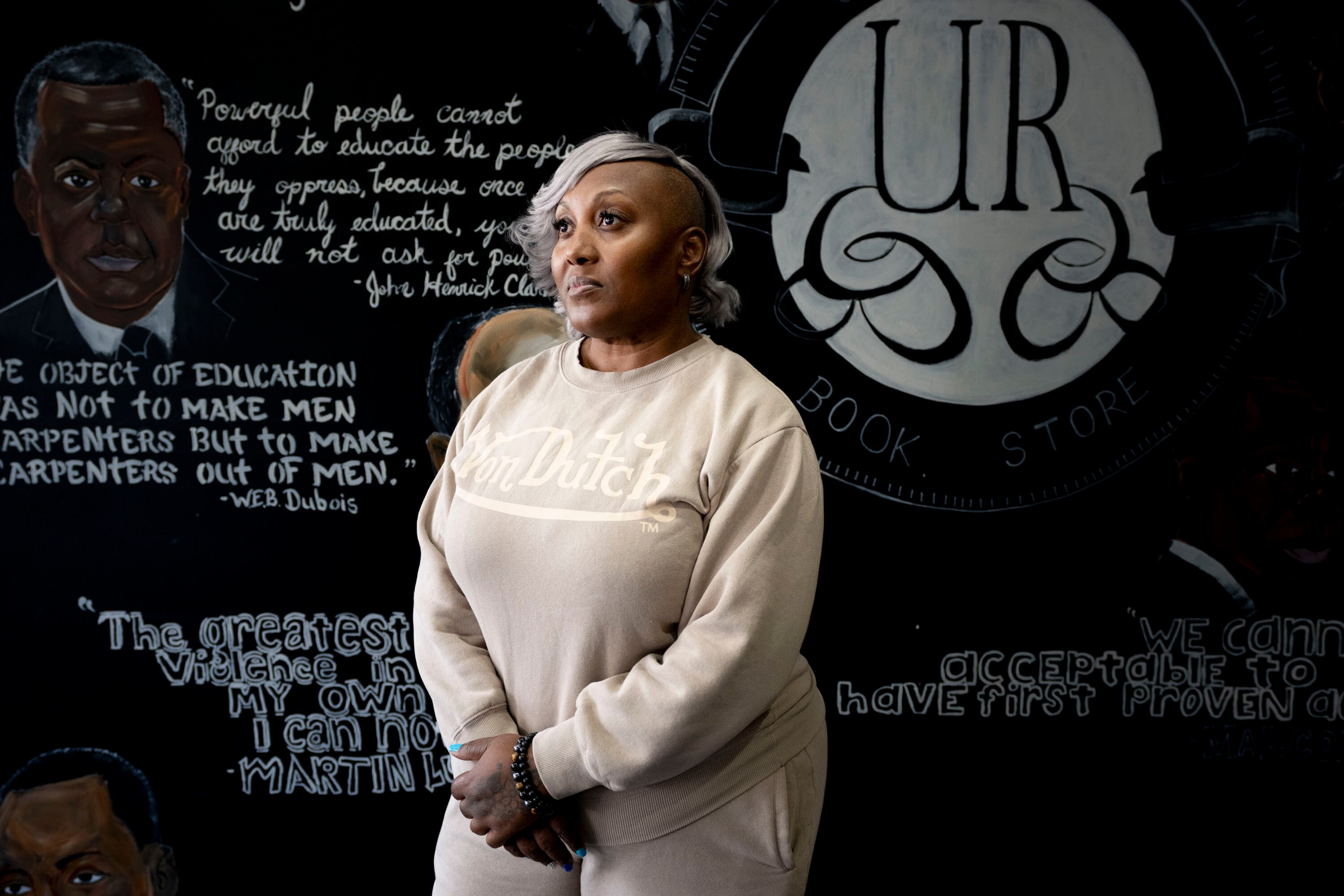
Tia Hamilton asked the judge whether she could address the young man who burglarized her business, broke a window and stole a camera worth $2,000.
She then walked up to the 20-year-old inside Courtroom 1 in the Edward F. Borgerding Court Building in Northwest Baltimore and gave him a hug.
“This is what you need,” Hamilton said to the man. “You need hugs, and you need to be told, ‘I love you.’”
Many times, victims of crime ask judges to hand down the maximum sentence. Instead, Hamilton showed up to court to advocate for a plea agreement that not only called for the man to perform community service with her instead of jail time but would allow him to avoid a criminal conviction.
Hamilton, 48, who’s the owner of Urban Reads Bookstore on Greenmount Avenue in Waverly, said she was formerly incarcerated and wanted to help. Locking him up, she said, would not teach the man how to stop committing crimes.
“Prison is supposed to be rehabilitation. And it doesn’t provide rehabilitation,” she said. “It creates a stronger monster.”
The break-in happened on Nov. 6, 2025, at DiGi Business Center on Greenmount Avenue in Waverly, which provides printing, shipping and mailing services. Hamilton no longer owns the venture.
Baltimore Police came out and reviewed surveillance video of the burglary.
A crime lab technician processed the area for latent fingerprints — and got a match.
The Banner is not naming the man. He could not be reached for comment, and his plea agreement allowed him to avoid a conviction.
Assistant State’s Attorney J. Isaac De La Cruz reviewed the statement of probable cause, gathered evidence and contacted Hamilton to find out what justice would look like to her.
Hamilton expressed that she wanted the man to do community service instead of jail time. De La Cruz explained that they needed to come up with a contingency plan if the judge expressed skepticism about the arrangement or the man did not want to accept the plea agreement.
The two spoke on the phone several times and ironed out the details. De La Cruz also worked with Will Lawler, the assistant public defender.
Hamilton runs Urban Reads Foundation, a group that aims to disrupt barriers to literacy inside prisons, juvenile detention centers and the community. She created a detailed plan that also involves two other organizations: We Are Us and The Movement Team.
“Our job is to make sure he’s connected, that he’s part of the community, and that he has everything that he needs to be successful,” said Antoine Burton, president of We Are Us, which focuses on helping boys and young men obtain resources and guides them to productive paths.
De La Cruz described the moment in court as touching.

“It looked like something out of a movie,” De La Cruz said. “It was a wonderful reminder as to why I became a prosecutor, and why seeking justice in this way can impact a person’s life and the community around where an incident happened.”
Baltimore District Judge Tameika M. Lunn on March 9 accepted the plea agreement.
The man pleaded guilty to burglary and received probation before judgment, which is not a conviction.
If he completes 360 hours of community service at Urban Reads Foundation within eight months, he will not have to pay back $2,500 in restitution.
“Do you understand the opportunity you’re getting today?” Lunn asked him. “Take it and run with it.”
Though she’s relieved the man avoided incarceration, Baltimore District Public Defender Marguerite Lanaux said her office remains deeply frustrated with the “continued prioritization of carceral outcomes in low-level misdemeanor prosecutions.”
“Without the victim’s advocacy, our client would not have been connected to restorative support that helped him secure stable housing and employment,” Lanaux said in a statement. “That should not depend on a victim stepping in.”
The Baltimore State’s Attorney’s Office, she said, “should be proactive in offering restorative justice options that help people keep their jobs and homes.”
Instead, Lanaux said, public defenders have seen “slow and insufficient engagement in our ongoing efforts to facilitate discussions to expand diversion programs.”
Hamilton said she believes that some are too quick to throw young people away. Instead of showing empathy, she said, they would rather lock them up “as if they’re not little humans.”
“If we want a legacy, we’ve got to change them,” she said. “If we don’t, what are we doing?”
She said she was upset that the man broke into her business and believed that he needed to experience consequences. But Hamilton said he also took accountability for his actions.
Hamilton said she immediately knew the man was lacking something.
“Children don’t just go and do these things,” Hamilton said. “They’re lacking money. They’re lacking resources. They’re lacking family.”
Hamilton said she’s now going to help prepare him for life.





Comments
Welcome to The Banner's subscriber-only commenting community. Please review our community guidelines.