
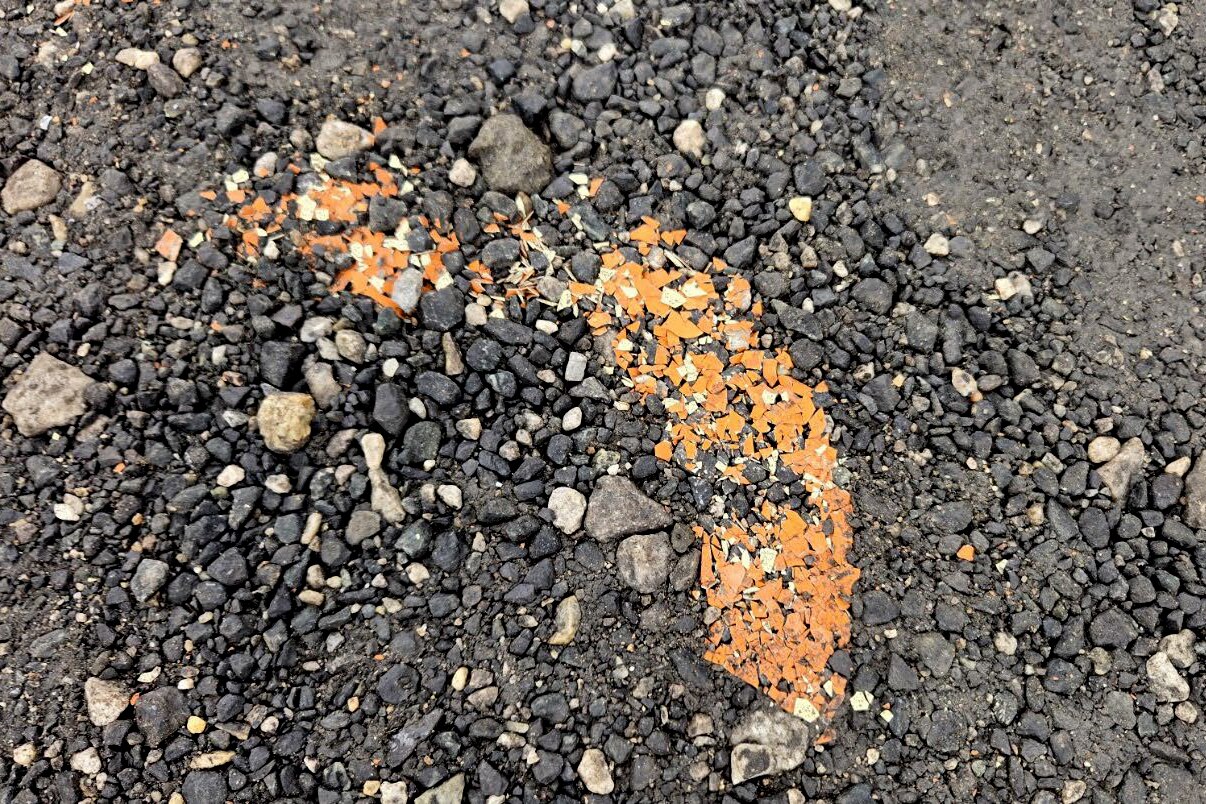
State investigators determined that chunks of orange paint scattered in the waters of the Jones Falls and along the trail are contaminated with lead and issued a violation against Baltimore City, officials said.
Investigators spent nearly an hour under the West 28th Street overpass observing the orange paint chips on Feb. 6, according to a report from the Maryland Department of the Environment. Lab results show the paint chips contained levels of lead far above the safety standard, according to MDE.
The paint chips are believed to be from the West 28th Street bridge, which opened in 1961 after years of construction, per local newspaper archives. In the report, officials urged Baltimore City to remove the paint chips from the ground and stream and manage it as hazardous waste.
The state found Baltimore City in violation of the Maryland Environment Article Title 9 and warned of thousands of dollars in potential penalties — potentially for each day the violation continues.
“We will follow up to ensure that the environment and public health are protected,” Jay Apperson, an MDE spokesperson, said in an email.
MDE was pushed to investigate the matter after The Baltimore Brew alerted them and Blue Water Baltimore, a water quality and safety nonprofit, while reporting a story on it.


Blue Water Baltimore commissioned independent testing that showed the orange chunks of paint exceeded the standard for safety and contained polychlorinated biphenyls (PCBs). The group is also testing chips falling from the Orleans Street bridge over Guilford Avenue.
“Lead paint is literally raining down on our residents and landscape, and it needs to be treated as the serious emergency it is,” Alice Volpitta, the Baltimore Harbor waterkeeper with Blue Water Baltimore, said in a news release. “The fact that the City didn’t know that this is lead-based paint is outrageous.”
Kathy Dominick, a spokesperson for the city’s Department of Transportation, said in an email they are working with state agencies to establish an action plan to address the situation responsibly after receiving MDE’s report.
The Environmental Protection Agency notes that exposure to lead can negatively impact every organ and system in the body, posing several health risks for people, such as increased blood pressure and hypertension, decreased kidney function and reproductive issues. PCBs also pose endocrine, immune, neurological and reproductive health risks, according to the EPA. Blue Water Baltimore notes it PCBs could enter the food chain and end up in seafood.




Comments
Welcome to The Banner's subscriber-only commenting community. Please review our community guidelines.