
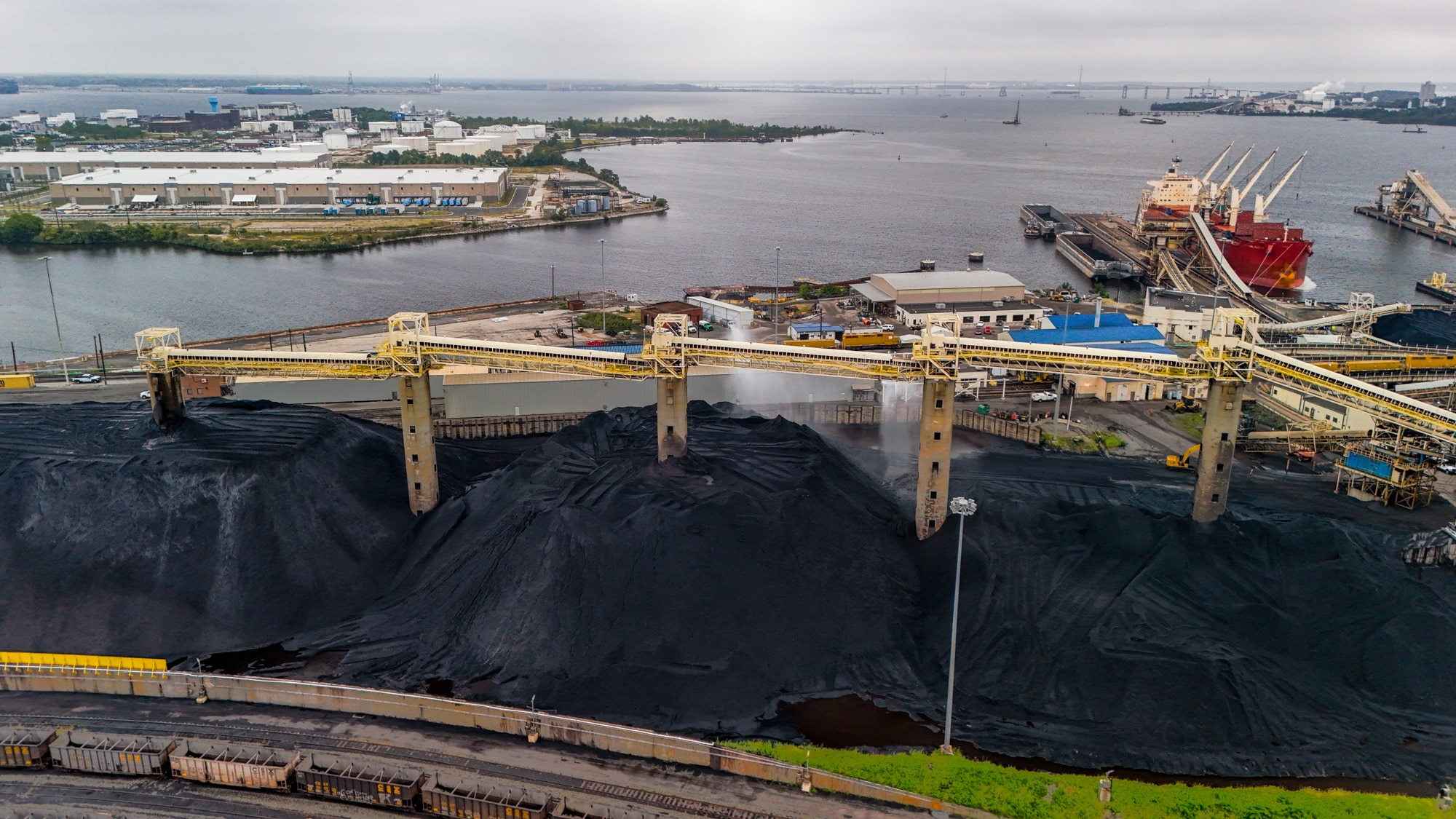
South Baltimore residents have long called for the closure of an export terminal that loads tens of millions of tons of coal each year near their homes. A 2021 explosion at the site blanketed the Curtis Bay neighborhood in dark dust, and advocates have documented how winds routinely blow coal off the terminal’s piles and into the community.
State regulators in recent years have begun to acknowledge the prevalence of coal dust in Curtis Bay’s air, but a new report suggests the fossil fuel has contaminated nearby waters, too.
The report, conducted by a team of researchers from Johns Hopkins University and the University of Maryland, Baltimore County, found coal and toxic metals in sediment drawn from the harbor surrounding the site, which is owned and operated by the railroad giant CSX.
The study, which has not been peer reviewed, didn’t examine whether this coal came from the CSX piers or when it entered the water. Researchers said more work is needed to determine the origins of the coal and hazardous metals.
A CSX spokesperson declined to comment. The Jacksonville, Florida-based company has pushed back on claims that it’s to blame for the dark dust coating Curtis Bay, a working-class neighborhood surrounded by other industrial sites, and pointed to mitigations it has installed — like sprayers to dampen coal dust and fence-line monitors to measure escaped particles.
CSX also fought a new regulation, imposed by the Maryland Department of the Environment last year, that would force the company to build a huge windscreen around its premises to stop coal from blowing into the community.
The new study, which examines sediment samples taken from six sites near the CSX terminal in March of last year, found almost no life in the sediment, just tiny worms and a single small clam — a sign that the waters don’t support underwater life, said Maya Gomes, an associate professor in the Johns Hopkins Department of Planetary Systems.
One of the researcher’s samples, however, contained visible coal particles, while all of their samples contained metals often associated with coal at levels higher than federal environmental standards.
To Upal Ghosh, a UMBC environmental engineering professor and author on the new report, that’s no surprise.
“If we have piles of coal next to the water, some of it will get into the water,” he said. “The question is: How much, and what’s the impact?”
For now, those questions remain unanswered.

John Scheinman, co-founder of the group Coal Kills Baltimore, which secured funding for the new report, hopes to see the Maryland Department of the Environment investigate the contamination source. He doesn’t expect the windscreen will be enough to shield the community and nearby waters.
“When there is virtually no life, except a few little worms, it’s not exactly representative of a healthy coastal community,” said Scheinman, who also sits on the attorney general’s environmental advisory council. “So, who is responsible, and what’s going to be done about it?”
MDE spokesman Jay Apperson said the agency appreciates research into Baltimore’s environmental challenges and will review the findings.
The concentrations of many metals measured by the research team weren’t unusual for the Baltimore harbor, which has suffered from generations of industrial and stormwater pollution, but Ali Meek, an environmental researcher in Baltimore, found the findings concerning.
Sampled arsenic concentrations exceeded those found elsewhere in the harbor, reaching nearly four times the highest levels Meek has observed in studies of the nearby Middle Branch.
Arsenic, a toxin linked to certain cancers, measured 11 times higher than what researchers would expect to find in nature, said Meek, while lead levels in the Curtis Bay samples were 18 times higher than the natural state. Both chemicals are found in coal.
Even so, Curtis Bay is home to dozens of industrial sites, and Ghosh said it’s possible that metals and even coal contamination could have come from somewhere other than the sprawling CSX terminal.
The team’s samples are made up of decades of sediment accumulation, and Baltimore has a long legacy of reliance on coal. The Curtis Bay piers date back to the 1880s, and a century ago coal provided heat for many Baltimore homes.
While Maryland has almost entirely phased out reliance on coal power, exports through the Port of Baltimore have boomed in recent years. Between CSX’s site and another terminal across the harbor in the Canton Industrial Area, Baltimore is the country’s second-largest coal exporter, sending most of the black Appalachian rock to India.
Recent research has focused largely on coal in the air around Curtis Bay, leaving environmental advocates with little grasp of CSX’s potential impacts on the harbor, said Alice Volpitta, a water quality watchdog with the group Blue Water Baltimore.
One reason may be the challenge of investigating waters near the terminal. Volpitta said Blue Water Baltimore has tried to assess impacts there before, but because of CSX’s security protocols, they’ve been unable to get close to the site.
The new findings help complete the picture, she said. “This is a really good first step.”





Comments
Welcome to The Banner's subscriber-only commenting community. Please review our community guidelines.